
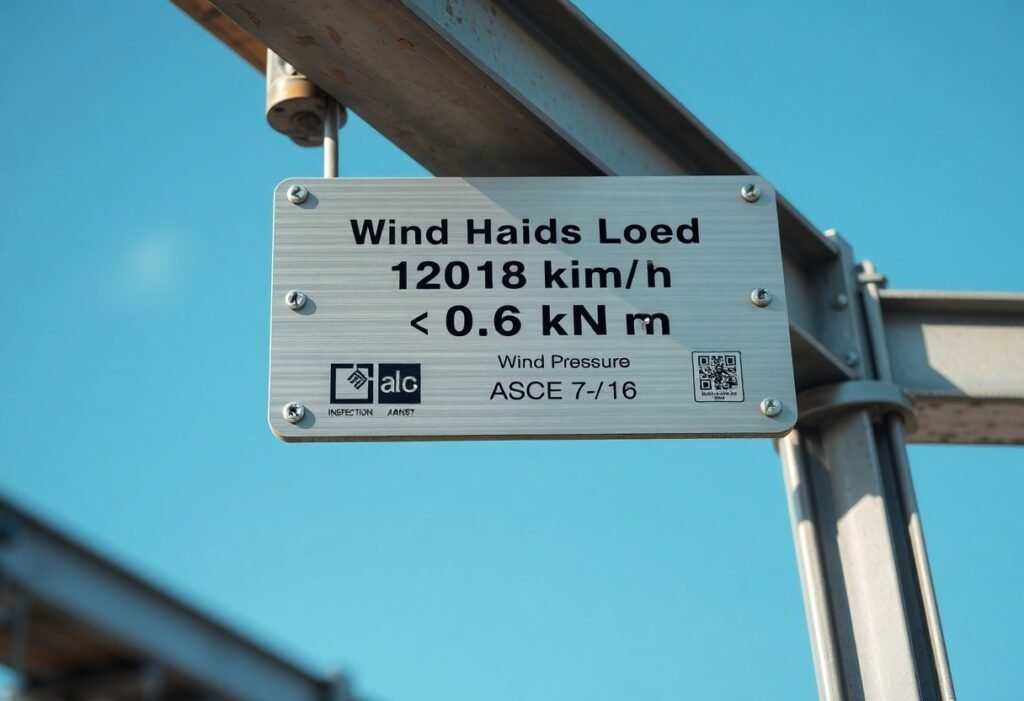
Safety signage for wind loads protects you and others by clearly indicating design load limits, anchor points, exposure categories, and required actions; it helps you comply with building codes and standards by specifying placement, size, symbols, inspection intervals, and maintenance procedures so responders and contractors can make safe decisions and avoid overloads or installation errors.
Key Takeaways:
- Post the design wind speed and governing standard (e.g., ASCE 7 or local building code) as the design basis for the structure or equipment.
- Show allowable wind loads/pressures, maximum wind-speed limits, and orientation or configuration limits for safe operation or installation.
- Place durable, weather-resistant signs at points of access and on the affected equipment, sized and contrasted for clear visibility; include pictograms or translations as needed.
- Include inspection/test date, next inspection due, and the responsible party/contact on the sign to support ongoing safety and maintenance.
- Require engineer-signed calculations and on-site documentation for temporary installations (scaffolds, banners, cranes); comply with local permit/OSHA requirements to avoid removal or fines.
Understanding Wind Load
You apply the design wind speed, exposure, and importance factors from the governing standard (for example ASCE 7) to determine pressures and uplift; wind load scales with V^2 so a 100 mph gust produces about 25% higher pressure than an 90 mph gust (q = 0.00256V² psf). You also factor in gust-effect and dynamic response for tall, flexible structures and provide signage or attachment details based on calculated pressures.
Definition of Wind Load
Wind load is the distributed pressure and resulting forces that wind exerts on a structure or sign, typically expressed as surface pressure (psf) and resultant shear/lift forces; you use the 3-second gust speed and code coefficients to convert that speed into design pressures and load combinations for structural and attachment checks.
Factors Influencing Wind Load
You evaluate exposure category (B/C/D), topography, building height, shape, and orientation, since each alters pressure distribution-for example, exposure D can increase coefficients by 20-50% versus B. You also include turbulence intensity and shielding from nearby terrain or buildings when sizing anchors and sign frames.
- Exposure: open coastlines or flat plains raise Kz and qz values.
- Topography: ridges and escarpments can locally amplify speeds.
- Geometry: large flat signs and sharp edges increase suctions and uplift.
- Thou must include gust-effect and dynamic amplification per ASCE 7 when structure period and wind spectrum interact.
You can quantify effects: use q = 0.00256 V² (V in mph) to get velocity pressure, then apply GCp and area to compute resultant force; for a 60 ft tall sign in exposure C with a 100 mph gust, nominal q ≈ 25.6 psf and peak uplift can exceed 1,000 lb on a 40 ft² panel, so you size anchors and backstays accordingly. Perform wind-tunnel or CFD for unconventional shapes and note code-required load combinations and attachment safety factors.
- Calculation: convert 3‑second gust to qz and apply G and Cp values from tables.
- Testing: wind-tunnel data refines coefficients for bluff or perforated signs.
- Installation: anchor pattern, embedment, and corrosion allowance affect capacity.
- Thou must document assumptions, code references, and calculations for compliance and inspection.
Signage Requirements
You must post permanent, weatherproof signs that state the design wind speed (e.g., 130 mph / 58 m/s), the governing standard (ASCE 7-16 or applicable local code), and the structure or equipment’s exposure category. Include installation and last inspection dates, a maximum allowable orientation or configuration if applicable, and a conspicuous emergency contact. Use high-contrast text and UV-stable materials so information remains legible through expected service life.
General Requirements for Safety
Place signs at all access points and control stations where personnel make decisions during high-wind events, mounted between 4-6 ft for eye-level readability. Use at least 1 in (2.5 cm) capital lettering for primary data, pictograms for quick recognition, and bilingual text if your workforce requires it. Fasten signs with tamper-resistant anchors rated to resist expected wind uplift and inspect signage every 6 months or after any severe storm.
Compliance Standards
Follow ASCE 7 for the wind design basis, ANSI Z535 series and ISO 3864 for sign colors/format, and OSHA 1910.145 for accident-prevention sign specifications. Your signage should directly reference the controlling standard (e.g., “Design wind: 130 mph – ASCE 7-16”) so inspectors and responders can verify compliance quickly. Keep an audit trail of sign installations and inspections for regulatory review.
For practical compliance, maintain a checklist: sign content (wind speed, code citation), material spec (aluminum, laminated polyester), legibility at 10 ft, mounting height, and fastener type. Photodocument every sign at installation and after scheduled inspections; store records for the retention period required by your jurisdiction (commonly 3-5 years). During audits, being able to present dated photos, inspection logs, and replacement receipts demonstrates conformance to standards and effective asset management.
Proper Signage Placement
Place wind-load labels where technicians and inspectors will see them during routine checks: on the sign cabinet or pole within 0.5-1 m of the foundation, on the main access panel, and on both faces for double-sided signs; if you have freestanding installations, follow emerging guidance such as ISA Proposes New Wind Design Criteria for Freestanding … to align placement with inspection paths and aerodynamic exposure.
Ideal Locations for Signage
Mount plaques at eye level for the intended audience: 1.2-1.8 m (4-6 ft) for pedestrian access and 2.0-2.5 m (6.5-8 ft) where vehicle-level inspection is expected. Position within 0.5-1 m of the base or access door, on the windward side when possible, and on each structural leg for multi-post signs so you and inspectors can read data during site walks and routine maintenance.
Visibility and Readability Considerations
Use the common legibility rule-1 inch (25 mm) of letter height per 10 ft (3 m) of viewing distance-so text is readable at typical inspection ranges; employ high-contrast colors, non-glare matte finishes, sans-serif or mixed-case type, and backlighting or reflective surfaces for night inspections to ensure your information is usable in all conditions.
For example, if you expect a 3 m (10 ft) inspection distance, use ~25 mm (1 in) letters; for roadside viewing at 30 m (100 ft), use ~250 mm (10 in) letters. Keep critical fields (design wind speed, governing standard, date) in the top two lines, avoid abbreviations that hinder comprehension, and place signs perpendicular to likely sightlines so your team can confirm compliance at a glance.
Materials Used for Wind Load Signage
For exposed installations you should specify materials that balance low weight with high stiffness: aluminum sheet (commonly 0.080-0.125 in / 2-3 mm, 5052-H32) for panels, 3-6 mm polycarbonate for impact resistance, and fiberglass-reinforced plastic (FRP) for corrosive sites. Use stainless-steel (304 or 316) fasteners and reinforced mounts; stainless standoffs or through-bolts reduce fatigue at wind gusts above 90 mph (145 km/h) in documented installations.
Durability and Weather Resistance
You need finishes and substrates that pass accelerated tests: powder-coat or anodize to ASTM B633/B580 standards, UV stability per ASTM G154, and corrosion resistance per ASTM B117 salt spray. In coastal or chemical exposures, expect powder-coated aluminum to last 10-20 years and polycarbonate signs 5-12 years depending on UV index and maintenance intervals you set.
Recommended Materials
You should choose 5052-H32 aluminum (0.080-0.125 in) for general signage, 316 stainless steel for marine hardware, 3-6 mm polycarbonate for high-impact areas, and FRP where chemical resistance is needed. Add UV-stable vinyl laminates or solvent-based inks for graphics, and specify tamper-proof stainless fasteners with neoprene or silicone gaskets to prevent galvanic corrosion at joints.
For mounting and wind reduction you can use perforated aluminum (20-40% open area) to cut wind pressure roughly 20-35% depending on geometry, or design standoffs to allow back-ventilation. Specify retroreflective sheeting per ASTM D4956 (select Type III/IV for high-visibility regulatory signs), and set powder-coat film thickness at about 50-80 µm (2-3 mil) with cathodic pretreatment to maximize service life in harsh environments.
Regulatory Framework
Across jurisdictions, your signage must align with the building code edition and any local amendments referenced on the permit; courts and inspectors typically expect the design wind speed, exposure category, and governing standard to be posted on-site (for example, 130 mph / 58 m/s and ASCE 7-16). You should verify permit conditions, because coastal or high-importance structures often carry stricter signage or inspection intervals tied to the adopted code.
Local and National Building Codes
You need to confirm which code edition your authority enforces-IBC 2018 adopts ASCE 7-16, while many states use modified editions or the Eurocode family (EN 1991-1-4) overseas. For example, the Florida Building Code imposes higher design wind speeds for Miami‑Dade/Broward counties (often exceeding 140 mph for certain occupancies), so your posted wind-load label must reflect the locally mandated design basis.
Industry Standards and Guidelines
You should reference ASCE 7 for load procedures (exposure B/C/D, importance factor Ie, gust factors) and EN 1991-1-4 where Eurocode applies; manufacturers and inspectors also rely on ASTM and IEC test methods to validate hardware and panel strength. Common practice is to cite the exact standard and edition on the sign to avoid inspection disputes and to match design calculations to test reports.
In practice, you convert design criteria precisely (130 mph ≈ 58 m/s; 1 mph = 0.44704 m/s) and pair ASCE 7 load cases with performance tests such as ASTM E330 for structural deflection and anchorage validation. You should retain lab reports, calculation summaries, and stamped drawings so inspectors can trace the posted wind speed back to the specific standard edition and tested components.
Best Practices for Compliance
Adopt a documented compliance plan that posts the design wind speed, governing standard (e.g., ASCE 7-16 or ASCE 7-22) and inspection intervals on-site. You should use UV-stable, corrosion-resistant materials, ensure sign mounting withstands at least the design gust speed, and keep photographic and digital records. Schedule routine checks every 6 months and after any wind event exceeding 50 mph (≈22 m/s) to maintain safety and defensible audit trails.
Regular Inspections and Maintenance
Establish a checklist: verify legibility, reflectivity, and anchorage; inspect for corrosion, delamination, or 25% edge separation; and confirm fastener torque per manufacturer (M10 bolts often require 60-100 Nm). You should perform inspections biannually and within 24-72 hours after storms over 50 mph, replace signs with more than 30% luminance loss, and log all actions in your maintenance system for traceability.
Updating Signage as Conditions Change
When wind maps, site exposure, or equipment layout change you must update signage to reflect the new design wind speed and governing standard within 30 days. For example, after an ASCE 7 revision or rooftop HVAC addition that raises local design gusts to 115 mph, revise the sign text, update the revision date and responsible engineer, and notify operations and inspectors of the change.
Implement a four-step workflow: audit existing signs, have an engineer verify revised wind values, produce updated templates with a visible revision block, and install replacements per mounting specifications. You should upload new drawings to your CMMS, archive prior versions for at least five years, and conduct a short site briefing after each update so staff and inspectors understand operational and emergency implications.
Conclusion
With these considerations you should post durable, legible wind-load signage that specifies design wind pressures, direction, and safe operating limits, placed where operators and inspectors can see it. Ensure materials, mounting, wording and spacing meet applicable codes and standards, are updated after changes, and are included in your inspection and training programs so you and your team maintain compliance and protect personnel and assets.
FAQ
Q: What are the general wind load signage requirements for safety and compliance?
A: Signage itself must be designed, installed and maintained to resist wind loads that meet applicable building and structural codes (for example, IBC and ASCE 7 in many jurisdictions) and any more specific local ordinances. Where signs or attached equipment could fail and create hazards, the responsible party must ensure documentation of wind design criteria, approved shop drawings, manufacturer instructions, and permit approvals are available on site. For temporary or movable signs, procedures and markings that identify maximum safe wind conditions and required securing/removal actions are commonly required by local authorities or permit conditions.
Q: What information should a wind-load safety sign display?
A: A compliant wind-load safety sign should plainly state: the design wind speed or allowable wind pressure (expressed in appropriate units), the safe operational limit (e.g., “Remove at sustained winds of X mph/kmh”), installation or inspection date, installer or owner contact information, and any required orientation or anchoring instructions. If the sign itself is part of a regulated system (crane-mounted, temporary grandstand, billboard), include permit number or certification reference. Text must be legible under normal viewing distances as required by permit or local code and use durable materials to preserve readability.
Q: Where must wind-load signage be placed and what materials/formatting are acceptable?
A: Place signs at locations where workers or the public will see them before interacting with the sign-object: at entrances, on the sign structure, at control stations, and at storage/assembly areas. Mounting height and orientation must not be obstructed by equipment or weather protection. Use weather- and UV-resistant materials, corrosion-resistant fasteners, and fadeproof inks; for critical instructions consider engraved metal or high-grade laminated signs. Use high-contrast colors, pictograms if helpful, and a minimum character size adequate for intended viewing distance as specified by local rules or project safety plans.
Q: What inspection, maintenance and recordkeeping are required for wind-load signage and the attached structures?
A: Establish an inspection schedule that covers routine visual checks, post-storm inspections, and periodic structural assessments by qualified personnel. Record each inspection, noting date, inspector name, findings, corrective actions, and any changes to the rated wind limits. Maintain up-to-date installation drawings, load calculations, manufacturer data, permits and certifications for the life of the sign or for the period required by local code. Replace or re-certify signage and attachment hardware when faded, damaged, or after any event that may have affected structural integrity.
Q: How do requirements differ for temporary signs, rooftop signs, and large billboards, and what steps ensure compliance?
A: Temporary signs (banners, event signage, A-frames) are often subject to permit conditions specifying attachment, ballast, or removal thresholds for sustained winds and gusts; they typically require rapid removal procedures and clear marking of safe-wind limits. Rooftop signs and large billboards must meet full structural-design criteria per local adoption of structural codes (including wind exposure, uplift, and connection detailing) and often need stamped engineering drawings and periodic inspections. To ensure compliance: obtain all required permits, use qualified designers and installers, keep stamped calculations and shop drawings on site or readily available, implement a documented inspection and removal plan tied to forecasted wind conditions, and coordinate with local code officials for final acceptance and periodic re-certification if required.