
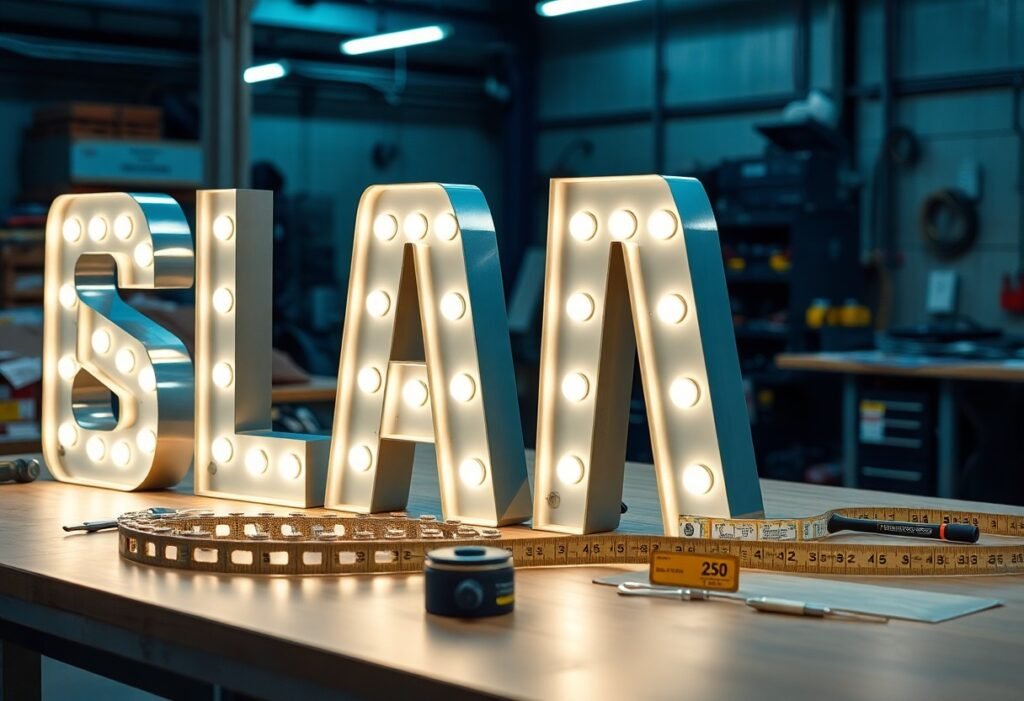
There’s more to the price of LED channel letters than the diodes themselves; you pay for design, custom fabrication, durable materials and finishes, power supplies and wiring, engineering for brightness and visibility, installation labor, permits and electrical work, and warranties or maintenance agreements – each element affects your upfront cost and long-term performance.
Key Takeaways:
- Material & construction – aluminum returns, acrylic or polycarbonate faces, trim caps, and fabrication labor (bending, welding, painting) drive base costs.
- Lighting system & electronics – LED type/quality, diode density, color/brightness, and the required drivers/transformers affect performance and price.
- Design & fabrication complexity – custom fonts, logos, multi-color faces, routed vs. trim-cap construction, and CNC/routing time increase cost.
- Installation & electrical work – raceway vs. flush mount, mounting hardware, conduit, electrician labor, permits, and structural supports add significant expense.
- Ongoing costs & warranties – energy consumption, maintenance/repairs, weatherproofing, warranty coverage, and shipping/lead times influence lifetime value.
Understanding LED Channel Letters
Definition and Characteristics
You’re dealing with individually fabricated metal letters, typically aluminum returns and acrylic faces, populated with LED modules rated for roughly 50,000-100,000 hours. They offer high lumen output with 60-120 lm/W efficiency, IP65 options for wet locations, and weight that varies by size – a 24″ letter often weighs 6-12 lb. Fabrication adds trim caps, welding and paint time, and affects final tolerances to ±1/8″.
Types of LED Channel Letters
You’ll encounter front-lit (most common), reverse/halo-lit for backglow, combination front-and-halo, open-face with exposed LEDs for maximum brightness, and letters on raceways to simplify wiring; front-lit letters typically cost $150-$800 per letter depending on height, while halo and combination styles can add 20-40% in fabrication and installation costs.
- Front-lit maximizes face visibility and is ideal for high-traffic storefronts.
- Reverse/halo-lit creates a premium silhouette effect on painted walls.
- This delivers different ROI profiles: front-lit for daytime readability, halo for upscale nighttime branding.
| Front-lit | Bright acrylic face, 150-800 lm/letter, $150-$800/letter |
| Reverse/Halo-lit | Backlit halo, needs 1.5-3″ return depth, adds ~20-30% cost |
| Combination | Face + halo, higher visual impact, fabrication time +30-50% |
| Open-face | Exposed LEDs for max lumen output, common for venues, maintenance higher |
| Raceway-mounted | Letters wired on a single box, lowers install time and electrical runs |
You should note that materials and LED choices change durability and color quality: typical CCTs run 3000K-6500K, CRI usually 70-90 depending on modules, and using high-density SMD strips can boost brightness by 30-60% at the expense of heat management; combination letters often require 20-40% more engineering time and can increase per-letter cost by roughly the same margin.
- Choose LEDs with higher CRI when color accuracy matters for brand logos.
- Account for thermal management-higher density LEDs need better heat dissipation.
- This affects lifecycle cost: better components reduce maintenance and replacement frequency.
| Permitting | Local sign permits vary; budget $100-$1,000+ |
| Electrical | Dedicated circuits often required; plan 0.5-2 A per large letter |
| Mounting | Flush vs. raceway impacts install time by 1-4 hours per cluster |
| Visibility | Viewing distance determines letter height; 1″ height per 10′ viewing |
| Maintenance | Annual cleaning and occasional LED module replacement; budget 3-7% of install/year |
The Cost Breakdown
You pay for more than LEDs: manufacturing, electrical components, installation, permits, and ongoing maintenance all add up. Manufacturing and materials often represent 40-60% of the total price, while installation, engineering, and site-specific needs (crane rental, scaffolding, traffic control) can be 20-35%. For a typical storefront run of 8-12 letters you might see $3,000-$10,000 total, depending on size, illumination type, and local labor rates-so budget beyond the diode line item.
Manufacturing Costs
Materials and fabrication dominate manufacturing cost: aluminum returns, acrylic or poly face, trim caps, mounting studs, LED modules, drivers, and wiring. You’ll pay for CNC cutting, metal bending, welding, painting and assembly labor; small 12-18″ letters can cost $150-400 each to build, while large 3-4′ letters often run $500-2,000+ apiece. Design complexity, custom paint or finishes, and high-IP LEDs push prices higher, so material choices directly influence your per-letter price.
Installation Expenses
Installation expenses include crew labor, lift/crane rental, electrical hookup, permits, and potentially structural engineering. Expect boom lifts at $100-250/hr, cranes $1,200-3,000/day for heavy installs, electrician rates $75-125/hr, and permits $50-500 depending on municipality. Installation typically totals 20-40% of project cost, and hard-site conditions-height, hoisting constraints, or required traffic control-can quickly double on-site time and your final invoice.
For example, installing 12 channel letters that take 8 hours with a two-person crew might break down as: boom rental 8 hrs × $200/hr = $1,600; crew 2 × $85/hr × 8 hrs = $1,360; electrician 3 hrs × $100/hr = $300; permits $300; misc hardware/transport $200 – roughly $3,760 total, or about $313 per letter. If your site needs a crane, lane closures, or a structural engineer (often $500-1,500), that per-letter figure climbs substantially, so plan for site-specific contingencies.
Factors Influencing Pricing
Several elements determine what you pay for LED channel letters, from raw materials and LED type to installation complexity and local permitting; labor rates and shipping also have measurable impact. Custom finishes, multi-color faces, and electrical work raise labor and component counts. This list summarizes the main cost drivers:
- Material quality and thickness (aluminum returns, acrylic/polycarbonate faces)
- Letter size, depth, and stroke complexity
- LED type, density, and power supply choice
- Customization level (paint, vinyl, routed logos)
- Mounting method and electrical/permit needs
- Fabrication labor and lead time
Material Quality
You’ll pay more for thicker, marine-grade aluminum (e.g., 5052) and 1/4″ acrylic or polycarbonate faces versus budget 0.04″ returns and 1/8″ acrylic; upgrades can add 15-40% to base cost. Polycarbonate resists vandalism and UV better but is 20-50% pricier than acrylic. Powder-coated paint, stainless hardware, and trim caps each increase material and prep time, especially for coastal or high-exposure installs.
Customization and Design
You incur higher costs for custom fonts, multi-color faces, internal logos, and complex returns-expect $150-$600+ per letter for large bespoke pieces versus $40-$120 for standard shapes. Routed details, face-cut logos, or acrylic laminates add CNC time and setup. High-density SMD2835 or SMD5630 LEDs for brighter, uniform output also raise component expense and power requirements.
Design-specific costs include artwork prep, proofing, and tooling: a one-off router template or custom trim cap can add $200-$800 in setup fees, and lead times often extend from 1-4 weeks for bespoke builds. You benefit from volume-batch runs spread setup over units-but unique color matching, face textures, or electrical integrations (RGB controllers, dimmers) increase both time and per-unit price.
Energy Efficiency and Long-term Savings
When you factor runtime and utility costs, LEDs can use up to 80% less energy than neon and last 50,000-100,000 hours, so higher upfront for quality components often pays back in 1-3 years. For example, replacing a 100W neon run with a 20W LED array that runs 12 hours/day saves about 131 kWh/month; multiply by your rate to see ROI. Compare build specs and labor at Channel Letters.
LED Technology Benefits
Beyond lower wattage, you get better color control (CRI 80-95), programmable RGB options, and superior uniformity with modern SMD modules. Typical high-quality LEDs achieve L70 lumen maintenance at 50,000-100,000 hours and support dimming or networked controls for additional savings. You should prioritize drivers with surge protection and proper heat sinking to preserve color consistency and maximize lifespan.
Maintenance Considerations
You should budget for periodic cleaning, driver inspections, and weatherproofing checks-especially in coastal or industrial settings where salt and grime accelerate wear. Expect driver or modular board replacements every 5-10 years depending on component quality; designs with removable faces, back-access or modular strips cut service time and costs.
You should plan inspections every 6-12 months: check seals, gaskets, connectors, and for corrosion on screws or aluminum returns. Specify IP65+ for wet locations, insist on silicone potting or sealed connectors for exposed wiring, and design access panels so technicians can swap LED strips or drivers in under an hour to minimize downtime and protect warranties.
Comparing LED Channel Letters to Traditional Signage
Quick comparison
| LED Channel Letters | Traditional Signage |
| Higher upfront cost for custom aluminum fabrication and LED systems; long-term energy savings. | Lower initial cost for painted or printed panels; may require replacement sooner. |
| Energy use typically 5-15 W per letter face for standard modules; low operating cost. | Non-illuminated signs use no power; lightboxes and neon consume more energy. |
| Lifespan 50,000-100,000 LED hours; common warranties 3-10 years on LEDs/drivers. | Material-dependent: painted wood 5-10 years, aluminum panels 10-20 years with repainting. |
| Low maintenance: occasional LED/driver swaps, face cleaning, caulk checks. | More frequent repainting, refacing, or structural repairs due to weather and UV fading. |
| 24/7 visibility, color control (RGB/warm/cool), strong night presence. | Excellent daytime presence; poor night performance unless illuminated. |
Durability and Lifespan
You can expect LEDs to last 50,000-100,000 hours under normal use, which translates to many years of nightly operation, while quality aluminum returns resist corrosion and polycarbonate faces withstand impact better than acrylic; cheap drivers often fail in 3-5 years, so choosing reputable brands with 5-10 year warranties on LEDs and drivers preserves your investment and reduces long‑term replacement costs compared with painted or wooden signage that fades, warps, or needs refinishing every 5-15 years.
Visual Impact and Visibility
You get continuous night visibility with LED channel letters-legibility commonly ranges from about 150-500 feet depending on letter height and mounting-and front‑lit letters deliver uniform glow while halo (backlit) styles improve contrast against building facades, so your marque stays readable after dark where traditional, non‑illuminated signs lose effectiveness; color temperature (3,000-6,500K) and brightness control let you match brand tone and adapt to ambient lighting.
Digging deeper, front‑lit channel letters use translucent acrylic faces and evenly spaced LED modules (common SMD types: 2835 or 5050) to avoid hotspots, while halo letters place LEDs to create a silhouette that increases perceived letter size and depth from up to several hundred feet; you should evaluate driver quality, CRI (70-90 for typical modules), and lumen output per module when comparing suppliers, and specify 3,000-4,000K for warmer brand cues or 5,000-6,500K for high‑contrast retail environments to maximize nighttime conversion.
Making an Informed Purchase Decision
When choosing channel letters, prioritize total cost of ownership over sticker price: calculate energy savings (LEDs can cut lighting costs by up to 80% vs neon) and factor lifespan (50,000-100,000 hours), maintenance, and installation labor. You should request itemized quotes showing material, fabrication hours, mounting hardware, permits, and electrical work so you can compare apples-to-apples across vendors and avoid surprise fees during installation.
Key Questions to Ask
Ask about LED binning and color consistency (ANSI bins or SDCM ≤3), lumen output per letter, warranty duration (typical 3-5 years for parts, 5-10 for LED modules), and ROI estimates. Also verify whether power supplies are UL-listed, whether letters meet local sign code and permit assistance, and if shipping and installation are included in the quote so you can assess risk and timeline before committing.
Evaluating Suppliers
Vet suppliers by reviewing project portfolios, client references, and on-site photos showing installation quality; aim for vendors with at least 5 years’ experience and examples of similar work (mall façades, highway-facing signs). You should request LM-79/LM-80 reports or test data, confirm lead times (typically 2-6 weeks), and compare warranties and service response times for repairs or replacements.
Beyond documentation, visit a fabrication shop or ask for factory video to inspect aluminum bending, weld quality, and silicone seams; verify ISO 9001 or similar quality controls and ask for production samples and a mock-up to test color, brightness, and weatherproofing (IP65+). You should confirm spare parts availability, emergency response SLAs, and whether the supplier supplies installation crews and coordinates electrical permits to minimize onsite delays.
Conclusion
The cost of LED channel letters reflects your choices in materials, LED quality, power supplies, skilled fabrication and installation, custom design and permits, and ongoing maintenance and warranties; when you compare quotes, prioritize durable materials, high-quality LEDs, and experienced installers so you minimize lifetime expenses and keep your signage consistently effective.
FAQ
Q: What components and materials am I paying for with LED channel letters?
A: You pay for the shell (aluminum returns and back), the face material (acrylic or polycarbonate), the trim cap and mounting hardware, internal LED modules and wiring, power supplies/drivers, paint or powder-coat finish, and any structural supports or raceways. Material gauge, acrylic thickness, paint quality, and the type of LEDs all change cost: thicker aluminum and higher-grade acrylic last longer and cost more, as do premium finishes and certified electrical components.
Q: How do the LEDs and power supplies affect price and performance?
A: Higher-quality LEDs and drivers cost more but deliver better lumen output, color consistency, efficiency, and longer life. Factors that raise price include LED binning (tight color tolerances), higher CRI or specialized color temperatures, waterproofing for exterior use, dimmable or programmable drivers, and UL or ETL listings. Cheaper LEDs save upfront money but can degrade faster, require more maintenance, and produce inconsistent color/brightness.
Q: How does design and fabrication complexity influence cost?
A: Custom fonts, 3D shapes, dual-color faces, routed or coated finishes, deeper returns, halo/backlighting, and tight tolerances increase labor, machine time, and setup costs. Installation complexity-raceway-mounted versus flush-mounted, conduit routing, permit coordination, lifts/crane rental, and on-site electrical hookups-also adds significant expense. Off-the-shelf, simple front-lit letters are the least expensive; bespoke, precision installations are the most costly.
Q: What ongoing costs should I account for after purchase?
A: Expect electricity for continuous lighting, periodic maintenance (cleaning, tightening fasteners, seal checks), eventual replacement of drivers or LED modules, and repainting or touch-ups for corrosion or fading. Service calls, access equipment for rooftop or high-face signs, and possible permit renewals or inspections are additional recurring costs. Warranty terms affect who pays for replacements and labor.
Q: How do I evaluate quotes to avoid hidden costs and low-quality shortcuts?
A: Ask for a line-item breakdown: material specs (aluminum gauge, acrylic thickness), LED brand/model and spacing, driver brand and ratings, finish type, mounting method, electrical labor, permits, and warranty details (labor vs parts). Request a photometric report, installation timeline, references, and examples of completed work. Beware very low bids that omit proper drivers, thinner materials, non-listed electrical components, or exclude installation and permits-these often create higher lifetime costs.