
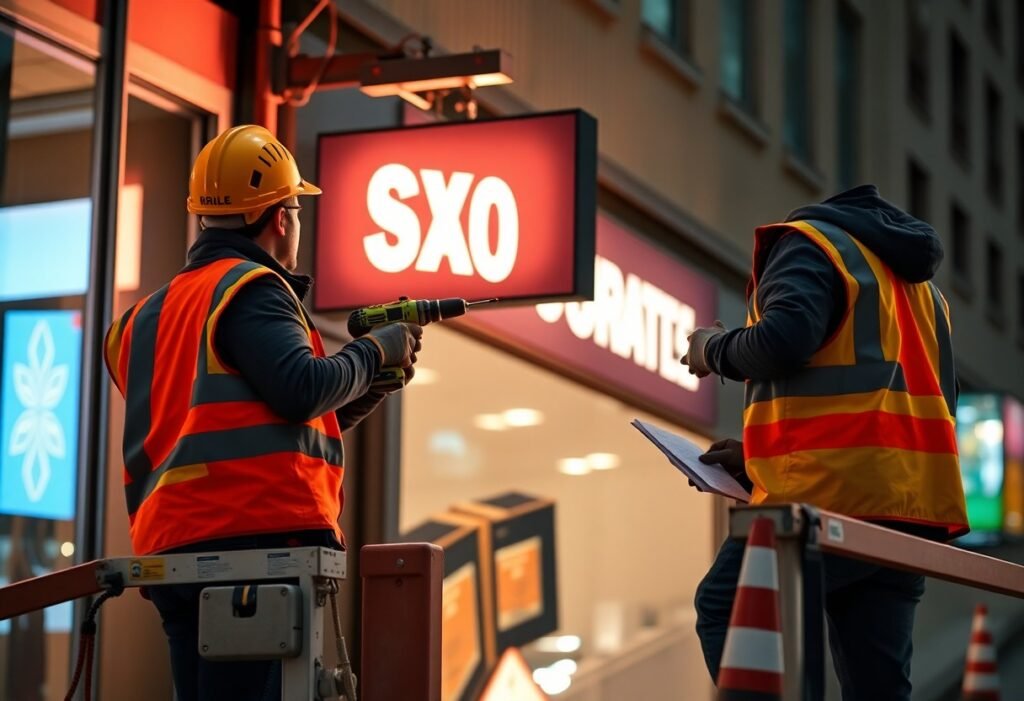
Most professional sign installations provide comprehensive services including site survey and permitting guidance, precise measurements and structural assessment, expert mounting or footing construction, secure electrical wiring and lighting integration, weatherproofing and finishing, and final inspection with cleanup; your installer coordinates local codes, safety protocols, and documentation so you receive a durable, compliant, and visually optimized sign ready for use.
Key Takeaways:
- Site assessment and permitting – measurements, utility locates, zoning checks and permit procurement.
- Engineering and mounting preparation – structural review, load calculations, brackets, anchors and compliance with building codes.
- Electrical and lighting work – wiring, conduit, power hookups, transformers, grounding and photometric testing to meet electrical codes.
- Foundations and physical installation – footings or pole setting, anchoring, weatherproofing and secure mounting of the sign body.
- Testing, inspections and project closeout – functional tests, final inspections, cleanup, handover documentation, training and warranty information.
Importance of Professional Sign Installation
When you hire pros, they handle permits, structural and electrical compliance, wind-load engineering, proper anchoring, and warranty preservation. For example, installers calculate wind loads (common design range: 90-120 mph) and select anchors for soil or masonry, preventing failures that often occur within the first year. Proper installation also reduces your liability exposure and often extends manufacturer warranties to 5-10 years.
Impact on Business Visibility
You get better visibility through correct placement, height, angle, illumination and contrast. A channel-letter sign readable from 250-400 ft boosts roadside recognition; after upgrading to LED-lit letters with 30° downlighting, one cafe documented an 18% rise in evening foot traffic and improved brand recall in customer surveys.
Benefits of Professional Expertise
You gain precise site surveys, CAD drawings, permit management, certified electricians, and documented testing. You avoid costly reworks-typical reinstallation can add 25-50% to initial costs-and certified installers provide load calculations, as-built records, and maintenance plans to protect your ROI.
You’ll also receive structural-engineer-signed drawings for oversized pylons, UL-listed components, NEC-compliant wiring, LED color-temperature calibration (3,000-5,000 K), photometric reports to limit light spill, and routine maintenance schedules. Installers coordinate crane lifts, traffic control, and typically secure electrical inspection sign-off within 7-14 days in many municipalities, streamlining project timelines and reducing downtime.
Types of Signs Commonly Installed
You’ll encounter a wide range of signs on projects: interior wayfinding, illuminated storefront channel letters, freestanding monument signs, pylon signs, and short-run vinyl banners for events. Typical commercial installs include electrical hookups for LEDs (about 60% of jobs), concrete footings for freestanding units, and permit submissions that can add 3-14 business days. Install crews usually size from 2 people for wall-mounted signs to 4-6 for large pylons or rooftop units.
| Channel letters | Illuminated acrylic faces on aluminum backs; require 120V wiring, wall mounting or raceways; common heights 8-30 in. |
| Monument signs | Low-profile masonry or aluminum units on concrete footings; often used for campuses and retail centers; foundation depth depends on local frost line. |
| Pylon / pole signs | High-visibility roadside signs 12-40 ft tall; need engineered concrete pier, anchor bolts, wind-rating calculations, and electrical service for illumination. |
| Vinyl banners & A-frames | Short-term solutions: printed PVC or mesh, grommets or hemmed edges; installed in hours with clamps or portable stands; ideal for promotions. |
| Wayfinding & directories | ADA-compliant plaques, tactile signs, and illuminated directories; materials include ADA-grade plastics and brushed metals; typical install time 1-3 days per building. |
Indoor Signs
You’ll often install interior signs like ADA-compliant room IDs, lobby logos, and directional panels using adhesives, VHB tape, or concealed anchors. Typical sizes range from 6×9 in plaques to 4×8 ft lobby signs; materials include acrylic, brushed aluminum, and PVC. Lead times for custom printed graphics are usually 3-7 days, while fabricated metal letters may take 2-3 weeks depending on finish and routing complexity.
Outdoor Signs
You’ll deal with outdoor signs that must withstand UV, moisture, and wind: aluminum faces, powder-coated frames, LED modules rated IP65, and marine-grade wiring are common. A standard pylon might be 15-25 ft tall with a concrete pier 3-4 ft deep; channel letters typically require a licensed electrician for 120/277V service. Permit turnaround often adds 1-2 weeks, and installers will verify site utilities before mobilizing.
For a real example, a recent retail install included a 20 ft pylon requiring a 48-inch-deep footing, M24 anchor bolts, and a wind-load stamp from an engineer; crew size was four with a small crane for placement. You should expect coordination with utility locates and an inspection after electrical hookup. LED maintenance access, gasketed seams, and drainage weep holes reduce long-term failures on outdoor builds.
- Use engineered foundations for freestanding units to meet local wind and seismic codes.
- Plan for electrical disconnects and fused circuits when ordering illuminated signs.
- Specify IP65+ LEDs and marine-grade wiring for coastal or high-moisture sites.
- Coordinate permit drawings and structural calculations early to avoid schedule slips.
- Recognizing local zoning, setback, and lighting ordinances before fabrication prevents costly rework.
Site Assessment and Planning
You collect precise site data-elevations, substrate type, measured clearances and utility locates-then map permit zones and setback requirements to the sign footprint. You document photos and GPS coordinates, confirm available electrical feed and breaker capacity, and flag any special engineering needs (wind-load designs often sized for 90-120 mph regions). All of this informs permit drawings, materials lists and a realistic install timeline tied to local inspection windows.
Location Analysis
You evaluate sightlines, approach speeds and viewing distances using the one-inch-per-10-feet rule for legibility, and note whether the sign faces pedestrians, a 25-45 mph street, or a highway. You check obstructions-trees, awnings, utility poles-and measure setback limits (commonly 5-25 ft in commercial zones). You also record parking flow and lighting conditions to decide illumination levels and mounting height for optimal visibility day and night.
Design Considerations
You select materials and lighting that match site constraints: aluminum or stainless steel cabinets for corrosive coastal sites, acrylic faces for backlit channel letters, and LED drivers with IP65 or higher for wet locations. You specify structural attachments based on substrate-concrete, CMU or steel-size anchors accordingly, and size electrical circuits (many medium illuminated signs require a dedicated 20A circuit) while factoring in maintenance access.
You further refine typography, color contrast and serviceability: choose open-face or front-service LED modules if access is restricted, specify LED modules with ~50,000-hour life and 3-5 year driver warranty, and pick fonts with at least a 1:6 stroke-to-height ratio for readability. You also detail finish specs (powder coat, Kynar), seam treatment for weatherproofing, and maintenance intervals to keep luminance and color consistent over the sign’s service life.
Installation Process
Preparation and Equipment
During prep you perform a site survey, secure permits and utility locates (permits often take 1-2 weeks), and stage tools-cordless hammer drill, SDS bits, impact driver, 4′ level, torque wrench, scaffold or 20 ft lift-and materials like anchors, concrete mix and silicone sealant. You plan crew size: a typical storefront sign needs 2 technicians with 30-60 minutes prep; pylon or multi-panel LED installs require 3-5 technicians and heavy equipment.
Preparation & Equipment Breakdown
| Site survey | Measure, photograph, note obstructions and line-of-sight |
| Permits & locates | Local permit 1-2 weeks; call 811 for utility locates |
| Tools | Hammer drill, impact driver, torque wrench, level, lift/scaffold |
| Materials | Anchors, brackets, sealant, wiring, concrete for footings |
| Crew | 2 techs (storefront) or 3-5+ for large/pylon signs |
Step-by-Step Installation
You begin by marking mounting points, verifying plumb and level, then drill and install anchors or pour footings; a standard cabinet sign mounts in 1-3 hours. You mount the cabinet or panels, run conduit and wiring to code, splice and test LEDs, apply weatherproof sealant, then perform a final inspection and client sign-off with photo documentation for the warranty file.
For complex installs you coordinate crane lifts and concrete cure (24-48 hours), perform load and pull tests-commonly 500-1,000 lb for freestanding posts-and record torque specs (for example 80-120 ft·lb for M16 anchor bolts) and expansion gaps to ensure long-term stability and easier maintenance.
Step-by-Step Breakdown
| Layout & marking | Stake out, measure, plumb, mark anchor locations |
| Anchoring/foundation | Drill anchors or pour concrete footing; allow 24-48 hr cure if required |
| Mounting | Lift and secure cabinet/panels; use crane or lift for heavy units |
| Electrical | Run conduit, splice LEDs, follow NEC/local code, test operation |
| Finish & QA | Seal joints, torque bolts per spec, perform pull/load tests, document |
Compliance and Regulations
Codes and permits determine your sign’s allowable size, placement and electrical hookup; wall signs are commonly limited to 1-2 sq ft per linear foot of storefront while freestanding signs often top out at 6-20 ft in height and 32-100 sq ft in area depending on zoning. You should expect standard permits to take 1-2 weeks, with historic-district or variance reviews adding 30-90 days. For more on why professional handling matters see The Importance of Professional Sign Installation.
Local Signage Laws
Your local municipality will specify zoning districts, permitted sign types, and density rules – for example commercial C‑2 zones may allow one primary façade sign per tenant, while residential areas ban illuminated signs. You’ll face setback, height and lighting caps, plus permit fees and required proof of property ownership; plan for variance requests if your design exceeds limits, since those hearings can add 4-8 weeks to project timelines.
Safety Standards
You must meet structural and electrical standards such as ASCE 7 wind‑load criteria, NEC requirements for sign circuits, and UL listings (UL 48 for electric signs is common). Signs over roughly 10 sq ft or taller than about 8 ft often require stamped engineering drawings and anchor calculations to satisfy the authority having jurisdiction (AHJ) and to ensure resistance to 90-120 mph design winds in many regions.
On the electrical side, you should insist on UL‑listed components (drivers and fixtures per UL 1598 where applicable), proper grounding and conduit runs, GFCI protection when required, and weather ratings like IP65 for exterior LED modules. Final sign approval usually follows a field inspection by the AHJ; failing to provide engineer stamps, wiring diagrams or load calculations will delay your certificate of compliance.
Maintenance and Support
You get ongoing service options that include scheduled inspections, warranty management, and emergency response. Standard plans usually cover two inspections per year, with more frequent quarterly checks in coastal or high-pollution areas; service-level agreements commonly promise a 24-48 hour response for non-emergencies and 6-12 hours for urgent safety issues. Documentation, photo reports, and parts tracking are included so you can audit performance and costs.
Routine Maintenance
You should expect cleaning, LED or bulb replacements, hardware torque checks, and sealant renewals as part of routine care. Typical tasks include washing faces and trim every 3-6 months, replacing LEDs on average every 5-7 years, and touch-up painting on a 5-10 year cycle. Technicians use checklists and photo logs to confirm work and schedule the next visit, reducing unexpected downtime.
Repair Services
You receive on-site repairs for electrical faults, damaged faces, or structural issues, with crews carrying 90% of common parts for same-week fixes. Teams are certified for boom or rope access and follow load calculations and engineering guidance for replacements. Billing options include hourly rates, flat-fee repairs, or service-contract credits to control your maintenance spend.
For example, after a windstorm a retail client required a 12-ft channel-letter replacement: a three-technician crew arrived within 8 hours, deployed a 10-ton boom, swapped the damaged unit, rewired the circuit, and completed testing in six hours total. Your repairs include safety documentation, updated structural notes for future inspections, and recommendations for upgrades-such as stainless hardware in coastal installations-to minimize repeat calls.
To wrap up
Taking this into account, professional sign installation includes site survey and permit handling, structural design and secure mounting, electrical wiring and testing, adherence to codes and safety standards, project management and scheduling, final inspection and documentation, cleanup, and post-installation warranty and support so you get a reliable, compliant, and documented installation for your site.
FAQ
Q: What does a professional sign installation package typically include?
A: A full installation package usually includes a pre-installation site survey, engineered mounting plans, required permits or permit support, fabrication inspection, delivery, mounting hardware and anchors, electrical hookup for illuminated signs, final testing and adjustments, cleanup and waste removal, and a handover with documentation and warranty information.
Q: How is the site survey and permitting handled?
A: The installer conducts a site survey to verify dimensions, structural attachment points, clearance, sightlines, and utility locations. They confirm local zoning and building-code requirements, prepare and submit permit applications if needed, and coordinate inspections with authorities to ensure compliance before and after installation.
Q: What structural and safety measures are included during installation?
A: Installers provide engineered mounting details and appropriate hardware for wind, seismic, and load conditions, perform structural attachment or reinforcement where required, use certified lift equipment and fall protection, follow lockout/tagout for electrical work, and document inspections and safety checks performed on-site.
Q: What electrical and lighting services are part of the installation?
A: Electrical services include assessing existing power availability, installing or extending circuits and conduit to code, connecting sign drivers and transformers, grounding, programming LEDs or controllers, performing electrical testing, and coordinating final electrical inspections with local authorities.
Q: What post-installation support, documentation, and warranty are provided?
A: After completion installers provide as-built drawings, electrical schematics, maintenance recommendations, and warranty documents for workmanship and components. They typically offer a final walk-through, address punch-list items, and can provide scheduled maintenance, emergency repairs, or service contracts on request.