
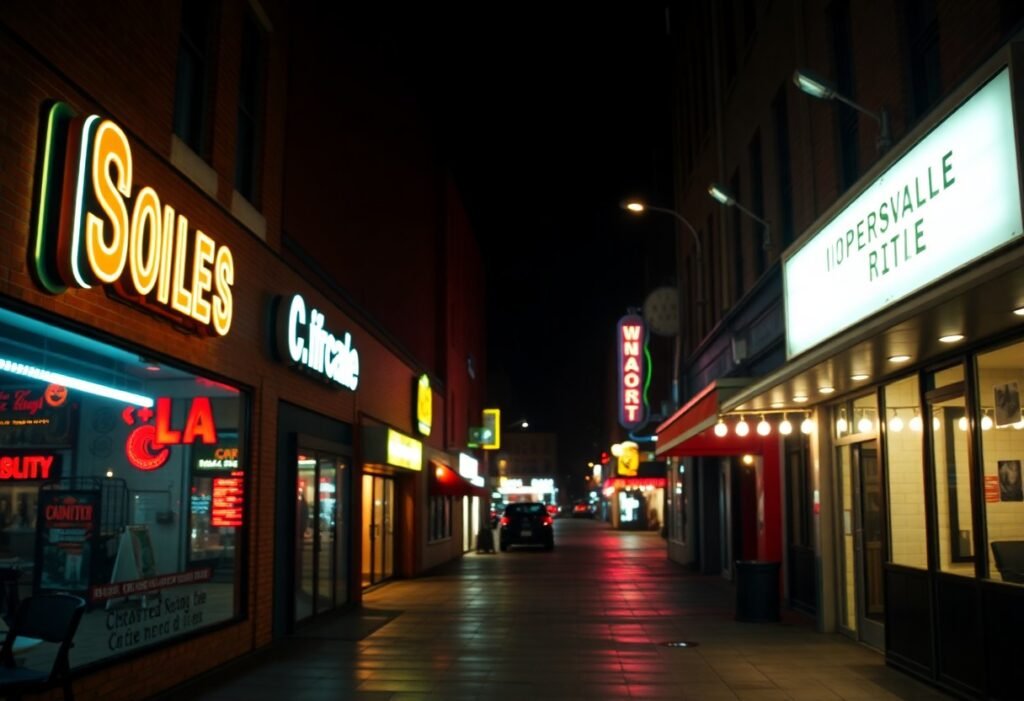
Lighting choices for storefront signs range from classic neon and fluorescent to energy-efficient LEDs, backlit channel letters, and spot or wash lighting; each option affects visibility, brand perception, maintenance, and energy costs, so you should weigh brightness, color temperature, durability, and budget to select the best fit for your facade.
Key Takeaways:
- Built-in backlit (illuminated channel letters) – internal LED modules provide bright, even face illumination for high nighttime visibility and low energy use.
- Front-lit and halo-lit channel letters – front-lit sends light forward for clear legibility; halo-lit (reverse channel) creates a soft glow around letters for depth and style.
- Lightbox/cabinet signs – full-panel illuminated signs with LED backlighting deliver uniform coverage for large graphics and branding.
- Neon and LED neon flex – glass neon offers a classic, vibrant look; LED neon flex mimics neon with greater durability, lower power draw, and easier installation.
- External fixtures and digital displays – gooseneck/spotlights add focused accent lighting; programmable LED video or matrix signs enable dynamic messaging and promotions.
Types of Lighting
You can choose neon, LED, fluorescent or halogen for storefront signs, and each option differs in lumen output, lifetime, maintenance and upfront cost so you should match choice to your visibility and budget goals. The table and quick bullet list below break down typical lifespan, energy draw and best-use scenarios to help you compare options.
- Neon – iconic glow, strong color saturation, glass tubing requires skilled repair.
- LED – long life (50,000+ hours), energy-efficient, flexible mounting and color control.
- Fluorescent – bright, cost-effective for lightboxes but contains mercury and needs ballasts.
- Halogen – very bright with excellent color rendering, shorter life and high heat output.
| Type | Quick Specs |
|---|---|
| Neon | Vibrant colors, ~10-15 years, moderate energy, glass tubes, high-voltage transformer |
| LED | 50,000+ hours, 60-120 lm/W, low heat, dimmable, IP-rated options for outdoors |
| Fluorescent | 7,000-20,000 hours, good for diffuse panels, requires ballast, regulated disposal |
| Halogen | 2,000-4,000 hours, high CRI (≈95), intense heat, simple fixtures, higher energy use |
Neon Lighting
You’ll appreciate neon for its unmistakable saturated glow that travels well across distances; signage-grade neon typically lasts about 10-15 years with proper transformers and gas mixes, and you should plan for periodic resealing or tube repairs-glass fabrication costs vary but skilled artisans can recreate custom colors and shapes for heritage or high-impact brand looks.
LED Lighting
You can expect LEDs to deliver the longest service life (commonly 50,000+ hours) and the best energy economy, often reducing power draw by 60-80% versus older technologies while offering flexible color temperatures (2,700-6,500 K) and RGB control for dynamic faces and edge-lit channel letters.
You’ll benefit from LED specifics such as 60-120 lm/W efficacy, IP65+ outdoor strip and module options, and high reliability in cold weather; a typical retrofit example replaces a 120 W fluorescent array with a 30 W LED system, cutting consumption by ~75% and often paying back in 1-3 years depending on runtime and local electricity rates.
Fluorescent Lighting
You’ll find fluorescent useful for even illumination in lightboxes and sign trays, with lamps lasting roughly 7,000-20,000 hours depending on type and ballast; the trade-offs include ballast maintenance, slower warm-up in cold climates, and compliance needs for mercury-containing disposal.
You should consider electronic ballasts to reduce flicker and improve startup, and note typical fluorescent efficacy of 60-100 lm/W with CRI commonly between 70-90; routine replacements every few years are common in high-use storefronts, and retrofits to LED often yield immediate energy and maintenance savings.
Halogen Lighting
You may choose halogen when you need high-intensity, high-CRI spot or accent lighting-halogen lamps give near-instant full brightness and excellent color rendering (often CRI ≈95) but run hot and usually last only 2,000-4,000 hours, increasing replacement frequency and ventilation needs behind acrylic faces.
You should plan for thermal management and fire-safety clearances when using halogen fixtures, expect higher wattages (20-500 W depending on application), and anticipate that many storefronts are converting halogen spots to LED alternatives that match color quality while cutting heat and lowering operating costs.
Lighting Techniques
Applying backlighting, front lighting and spot lighting lets you sculpt depth, legibility and mood; modern LEDs deliver 80-150 lm/W and 2700-5000K color temps so you can match brand tone precisely. Use backlit channel letters for halo effects, gooseneck front lights for even washes, and 10°-35° spots to create focal highlights that guide passerby attention.
Backlighting
When you opt for backlighting, hide LED strips behind acrylic or routed faces to create a halo or silhouette; typical setups favor 3000-4000K for warmth or 4000K for neutral retail tones. A 1-3 inch setback on channel letters produces an even glow, and LEDs at 80-120 lm/W cut energy use versus traditional neon while reducing maintenance.
Front Lighting
Front lighting uses external fixtures-gooseneck lamps, linear wall washers or trough lights-to wash the sign face; fixtures in the 800-3,000 lumen range are common and 3000K-4000K helps maintain accurate product colors. Proper aiming avoids hotspots and preserves contrast between letters and background for clear nighttime legibility.
Mount fixtures roughly 1-1.5 times the sign height apart to produce uniform coverage, and tilt them 30°-45° to minimize glare; choose IP65-rated, dimmable LEDs with CRI ≥80 for faithful color rendering. You can add photocells, timers or zoning so brightness drops during low-traffic hours, often reducing energy use by 30-50% compared with continuous operation.
Spot Lighting
Spot lighting accentuates logos, textures or architectural features with narrow-beam fixtures; select optics from 10° to 35° depending on distance, and 6-30W LED spots to balance output and control. RGB or color-filtered spots let you run seasonal campaigns or dynamic effects without changing the sign face.
Choose 10° beams to isolate individual letters and 30° beams for broader highlighting, spacing fixtures to layer light and avoid harsh single hotspots. Prioritize precision optics and aimable mounts for repeatable alignment, and always test the setup from typical pedestrian and vehicular sightlines at night to confirm perceived brightness and color.
Energy Efficiency
Energy Consumption Comparisons
You can see LEDs dominate efficiency: modern LEDs deliver roughly 100-150 lm/W and often use 60-80% less power than neon or incandescent alternatives. For example, a 6‑ft LED channel‑letter run commonly draws 60-150W total versus 300-800W for comparable neon, cutting nightly consumption and utility costs. Fluorescent options fall in between but usually need more frequent replacement and ballast maintenance, which raises lifecycle energy and service costs.
Typical Energy Use Comparison
| Light Type | Typical Power Use / Notes |
|---|---|
| High‑efficiency LED | 60-150W (per 6‑ft run); 50,000-100,000 h life; 60-80% energy savings vs neon |
| Neon | 300-800W (per 6‑ft run); 10,000-20,000 h life; higher maintenance and transformer losses |
| Fluorescent | 150-300W (per 6‑ft run); 7,000-20,000 h life; moderate efficiency, ballast upkeep |
Eco-Friendly Options
You should pair efficient LEDs with low‑voltage drivers, timed dimming, and recyclable housings to minimize environmental impact; ENERGY STAR or DLC‑listed fixtures cut wasted power and improve longevity. Solar‑assist systems with battery storage can offset roughly 30-100% of nightly signage load depending on site exposure, and choosing powder‑coated aluminum and recycled acrylic reduces embodied carbon across the sign’s lifecycle.
Additionally, employ photocells, occupancy or centrally scheduled controllers that dim to 30-50% overnight-many retailers achieve 50-70% annual lighting savings this way. Seek manufacturers offering modular LED boards and take‑back or recycling programs (examples: Signify, Cree) so you can repair rather than replace and recover metals at end‑of‑life, lowering both costs and landfill waste.
Installation Considerations
When planning installation you should factor in power access (most commercial signs run on 120-277V), IP ratings (IP65 or higher for exterior LED modules), structural loads (typical fabricated signs weigh 5-15 lb/ft and must meet local wind-load ratings of ~20-30 psf), and maintenance access with 18-24″ clearance. For component sourcing and prewired modules consider LED Signage vendors that supply UL-listed drivers and mounting kits.
Mounting Options
You can choose through-bolts for masonry, Z-channels for flush mounting, raceway-mounted power boxes to conceal wiring, or French cleats for removable panels; standoffs of 2-6″ create depth for halo/backlighting. Use 1/2″ or 3/4″ anchors for concrete, 5/16″ toggle bolts for hollow walls, and support spacing every 24-36″ for thin-faced cabinet signs to prevent sagging under wind and thermal cycling.
Placement Guidelines
For legibility follow the 1″ letter height per 10 ft viewing-distance rule (so 10″ letters for 100 ft), mount pedestrian signs 6-12 ft above grade and roadside signs 12-20 ft, and aim for high contrast between face and background; you should also confirm local setback, height and illumination limits before final siting to avoid rework.
Pay attention to ambient conditions: choose 3000K-4000K LEDs to balance warmth and contrast, select beam angles of 30°-60° to control spill, tilt fixtures 5°-10° downward to reduce glare, and avoid placement that competes with streetlights or headlights-conduct a mock nighttime view or lumen-mapping study to validate visibility from primary approach angles.
Maintenance and Longevity
Maintaining signage extends service life and protects visibility; you should schedule cleaning every 3-6 months, inspect IP65 seals for water ingress, and expect modern LEDs to reach 50,000-100,000 hours (L70). Components like LED drivers and transformers typically age out in 5-10 years, while acrylic faces yellow over time and reduce contrast. You can cut long‑term costs by tightening mounts biannually, documenting lumen output, and replacing parts proactively when performance drops by 10-20%.
Routine Checks
Monthly perform visual inspections for loose wiring, condensation, lens cracks and insect nests; use a voltage meter to confirm 120-277V feed. Every six months measure face luminance (aim within ±10% of original), torque mounting bolts to spec, clean polycarbonate or acrylic faces with mild detergent, and note any driver hum or LED flicker so you can schedule targeted repairs before full failure.
Replacement Strategies
When LEDs hit L70-typically 50,000-70,000 hours (about 6-8 years at 8-12 hours/day)-plan module replacement; expect drivers to fail around 5-7 years and neon transformers 5-15 years. Use the rule of thumb that if repair costs exceed ~50% of new sign price, full replacement often yields better ROI and delivers improved energy performance and warranties.
You should adopt a planned replacement approach: rotate consumables, keep one spare LED driver per 8-12 signs and spare modules for high‑footfall locations. Modular channel letters let you swap a module in 30-60 minutes versus several hours for full-face work, cutting labor and service incidents by roughly 30-50%. Also verify manufacturer warranties (commonly 5 years for LEDs) and negotiate 7-10 year service contracts for multi‑site deployments to stabilize maintenance budgets.
Regulatory Compliance
You’ll need permits, zoning approval, and sometimes historic-district sign-off before lighting a storefront. Many municipalities require stamped drawings, electrical inspections, and an energy-compliance statement; permit turnaround commonly ranges from 2-8 weeks. Pay attention to district-specific rules-downtown commercial zones often allow brighter, illuminated signs than residential-adjacent strips, and failing to secure approvals can force costly removal or retrofits.
Local Signage Laws
You should verify sign area, height, and placement limits set by your city or county-limits frequently range from 32-200 sq ft depending on zoning. Municipalities also control illumination hours (for example, some towns cap on-time at 11:00 PM), require setbacks from sidewalks, and distinguish store-front signs from billboards; expect to submit scaled elevation drawings and pay permit fees typically between $50 and $500.
Safety Standards
You must use UL-listed fixtures and drivers, meet NEC/NFPA 70 wiring and grounding requirements, and choose IP-rated enclosures (IP65 or higher for exposed LEDs). Install surge protection and GFCI where required, and ensure temperature-rated components for local climate ranges; inspectors will check junction boxes, conduit, and disconnect access during final approval.
For structural safety, you’ll often need engineer-stamped calculations for freestanding or oversized signs-commonly required when a sign exceeds about 100 sq ft or stands taller than 12 feet. Wind-load and seismic considerations dictate anchor bolt size and mount design, and coastal locations typically mandate corrosion-resistant fasteners like 316 stainless steel. Maintaining a record of load calculations, material specs, and certified installer documentation speeds inspections and reduces liability.
Summing up
Drawing together, you have a range of storefront lighting options: LED backlit cabinets and channel letters, halo/edge-lit and front-lit signs, neon and cold-cathode for retro looks, spot and flood accent lighting, and dynamic digital displays. Choose fixtures, color temperature, and mounting that suit your brand, visibility and budget to maximize legibility, curb appeal, and energy performance.
FAQ
Q: What are the most common lighting technologies for storefront signs?
A: LEDs (modules, strips, and integrated channel letters) are the dominant choice – high efficiency, long life (typically 50,000+ hours), wide color and dimming options, and low heat. Neon glass offers a distinctive glow and vintage look but is fragile, uses higher voltage, and requires more maintenance. Fluorescent tubes are used in older lightboxes and can provide even illumination but are bulkier and less efficient than LEDs. Backlit cabinet signs use fluorescent or LED arrays behind translucent faces for uniform panel lighting. Specialty options include fiber optic for pinpoint effects, electroluminescent panels for thin uniform light, and projection/LED video for dynamic displays.
Q: What’s the difference between front-lit, back-lit (face-lit), halo/halo-lit, and edge-lit signs?
A: Front-lit signs have light shining directly onto the face or channel-letter fronts and are simple and bright for night visibility. Back-lit (face-lit/push-through) signs place illumination inside a cabinet and allow light to shine through cut acrylic faces for even, vibrant color. Halo-lit (reverse channel letters) mount solid-faced letters with LEDs inside that cast a soft glow onto the wall behind for a premium, dimensional look. Edge-lit uses LEDs along the edge of clear or frosted acrylic to light the surface from the side, producing a sleek, uniform glow ideal for thin panels and modern aesthetics.
Q: How should I select lighting for legibility, color accuracy, and brand consistency?
A: Prioritize brightness (measured in lux or candela) to ensure readability at typical viewing distances, and choose a color temperature that matches brand tone – warmer whites for traditional/warm brands, cooler whites for modern/tech aesthetics. Check CRI (color rendering index) when color fidelity matters. Use consistent LED bins or calibrated RGB/DMX controllers for multi-unit installations to avoid color drift. Consider contrast between illuminated elements and background, anti-glare finishes, and programmable color-changing options only where permitted and aligned with brand identity.
Q: What are typical energy, lifespan, and maintenance differences among lighting options?
A: LEDs use the least energy and often include dimming and scheduling, reducing operating costs; typical lifespans are 50,000-100,000 hours. Neon consumes more power, has shorter effective life (often 15,000-30,000 hours), and needs gas refills and glass repairs. Fluorescent tubes require periodic replacement and ballast service. Maintenance factors include transformer or driver accessibility, ingress protection (IP) for outdoor use, suitability for temperature extremes, and ease of swapping modules. Plan for periodic cleaning, inspections of seals and wiring, and access provisions when mounted high.
Q: Are there outdoor- or code-specific considerations and specialty options to know about?
A: Use fixtures rated for wet locations and appropriate IP ratings for exposure, and ensure electrical components meet local code and UL/CE listings. Check local ordinances for brightness limits, permitted colors or animations, timer/curfew rules, and sign permits. Specialty outdoor options include solar-powered LED signs for low-power needs, dynamic RGB/DMX systems for programmable effects (often requiring additional approvals), and high-output LEDs for large-distance visibility. Specify surge protection, photocells or timers for automatic dusk-to-dawn operation, and contractor-supplied compliance documentation when applying for permits.