
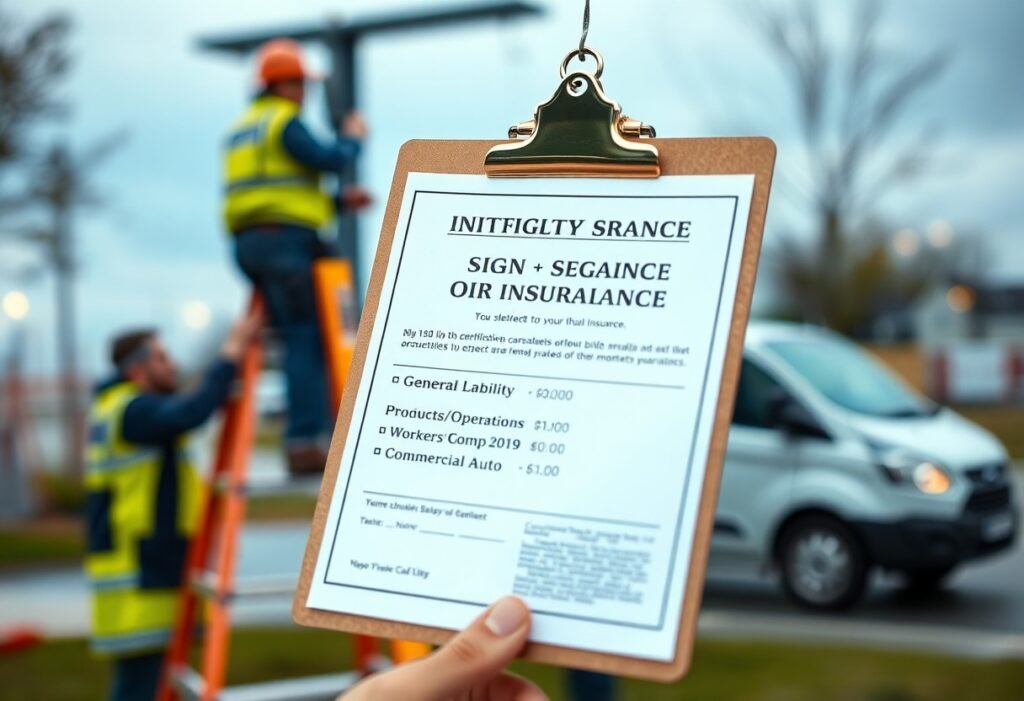
Just because signs often seem small, your project can face significant exposure without proper sign liability insurance: you need general liability for third-party injury or property damage, product and completed operations coverage for defects and post-installation claims, professional liability for design errors, inland marine for transit, and an umbrella policy to extend limits; also ensure workers’ compensation and permit-specific endorsements are included.
Key Takeaways:
- Match coverage to exposures: commercial general liability for bodily injury and third‑party property damage, plus products/completed operations for post‑installation claims.
- Include ancillary policies as needed: commercial auto for transport, inland marine/equipment floaters for materials and tools, and builder’s risk if the sign is part of construction.
- Obtain professional liability/errors & omissions for design, engineering or electrical work on signs; product liability for manufacturers and installers.
- Confirm contract endorsements: additional insured status, primary/non‑contributory wording, waiver of subrogation, and project‑specific certificates of insurance.
- Set appropriate limits and exclusions: choose per‑occurrence and aggregate limits that reflect project size and public exposure, and review exclusions (faulty workmanship, collapse, pollution) before signing.
Understanding Sign Liability Insurance
When you evaluate coverages for a sign project, focus on the specific exposures-overhead collapse, electrical shocks, wind damage and installation mishaps-that drive claims and contract requirements. Many incidents lead to third‑party injury or property damage with losses commonly ranging from $50,000 to $250,000 per event; without proper endorsements you can face stop‑work orders, indemnity disputes, and protracted litigation that delays completion and increases costs.
Definition and Purpose
Sign liability insurance protects you against third‑party bodily injury and property damage tied to manufacture, transport, installation and maintenance of signage. It typically combines commercial general liability (BI and PD), products/completed operations, and optional coverages like installation floater, commercial auto and umbrella limits. You use policy limits, deductibles and endorsements to transfer financial risk and meet owner/GC contractual requirements.
Importance for Projects
You need this insurance because owners and general contractors commonly demand certificates showing specific limits (often $1M per occurrence/$2M aggregate) plus additional insured and waiver of subrogation endorsements; absence of compliant coverage can bar you from site access or trigger contractual liability for repair, lost rent or tenant claims. Claims handling and defense costs alone frequently exceed policy retentions and can create cash‑flow pressure.
To manage exposure, require the right combination: an installation floater for in‑transit and site work, completed operations for post‑installation failures, products liability when you manufacture components, and umbrella limits for catastrophic loss (stadium or façade projects often call for $5M-$10M). Also enforce primary and noncontributory wording and per‑project aggregates where the scope or public exposure is high.
Types of Coverage Needed
You should match policy types to exposures: bodily injury and third‑party property damage, completed operations and products liability, on-site installation risks, electrical/equipment failure, and design/specification errors that can trigger large claims. Assess site-specific factors like work over public sidewalks, heights above 15 ft, and expected project value; a $250,000 sign failure claim is not uncommon when it damages vehicles or causes injury.
- Commercial General Liability (CGL) for BI/PD and completed operations.
- Professional Liability for design, engineering, and specification errors.
- Workers’ Compensation for on-site injuries and statutory wage replacement.
- Inland Marine/Installation Floater for transit, storage and installation of expensive sign components.
- The Pollution, collapse or electrical-specific endorsements when hazardous materials or high-voltage systems are involved.
| Coverage | Why it matters / Typical limits |
| Commercial General Liability | Protects BI/PD, common limit $1M per occurrence/$2M aggregate; covers completed operations. |
| Professional Liability (E&O) | Covers design/spec errors, often claims‑made; typical limits $250k-$1M depending on exposure. |
| Inland Marine / Installation Floater | Covers materials in transit or during install; values often itemized per sign (e.g., $50k+). |
| Workers’ Compensation | Statutory coverage for employee injuries; includes employer liability for third‑party suits. |
| Pollution / Electrical Endorsements | Addresses contaminant runoff, PCB ballast disposal, and high‑voltage failures-limits and language vary. |
General Liability Insurance
You should maintain CGL with limits that reflect project scale-commonly $1M per occurrence/$2M aggregate-because a falling sign or failed anchor can cause severe BI and third‑party PD; for example, a downtown storefront sign collapse in 2019 produced a $475,000 settlement for vehicle and pedestrian damages. Include completed operations and products coverage to protect you after installation is finished.
Professional Liability Insurance
You need professional liability if you provide design, engineering, shop drawings or load calculations; claims-made E&O policies typically have limits from $250,000 to $1,000,000, and errors like incorrect wind‑load assumptions or omitted grounding details have resulted in six‑figure claims within two years of installation.
When you evaluate E&O, verify the policy is claims‑made with a favorable retroactive date and adequate defense‑within‑limits terms; require subcontractor evidence of similar coverage and consider higher limits for large, illuminated or structurally complex signs-one case study showed redesign errors leading to a $320,000 repair and settlement cost, where a $500,000 policy absorbed both defense and indemnity.
Factors Influencing Coverage Needs
Several variables shape the insurance you should buy: sign type, installation method, exposure to pedestrian traffic, and whether you handle electrical connections or crane lifts. For example, a $2,000 channel‑letter sign has far lower risk than a $75,000 LED pylon; similarly, rooftop work with a 30‑foot drop demands higher limits. Any change in height, value, or complexity usually pushes you toward broader limits or specific endorsements.
- Project value and replacement cost
- Installation method (ladder, lift, crane)
- Sign type (channel letter, pylon, billboard)
- Site conditions and pedestrian exposure
- Permits, bonds and local insurance requirements
Project Size and Scope
If you oversee a single storefront sign, you often need $1M general liability with completed operations; when you manage multi‑site rollouts or a $100k+ custom illuminated pylon, consider $2M limits and inland marine for materials in transit. A 30‑foot rooftop installation can add exposure to bodily injury and third‑party property claims, so you should quantify contract value, number of sites, and the maximum potential third‑party loss when choosing limits.
Location and Local Regulations
Zoning, permitting timelines, and local building codes directly change your exposures: some Florida counties require wind‑load certification, New York City commonly asks for $1M/$2M liability and specific additional‑insured wording, and many municipalities require performance bonds. You should check permit conditions for insurance clauses, inspection schedules, and whether utility disconnection or traffic control obligations increase your liability during installs.
Local codes often reference standards like ASCE 7 for wind loads and require engineered, stamped drawings for signs above certain thresholds-commonly anything over 10 feet or 50 square feet-so you should confirm size limits in advance. Permit applications frequently demand endorsements such as additional insured, waiver of subrogation, and evidence of auto and workers’ compensation; while $1M per occurrence/$2M aggregate is a common baseline, property owners or municipalities may insist on higher limits.
Evaluating Risks in Signage Projects
You should break the project into design, fabrication, installation and maintenance to quantify exposures. Use OSHA construction data-falls and structural failures dominate claims-to prioritize controls, specify wind/snow design criteria per local code (often 90-150 mph), confirm NFPA 70 electrical compliance, and estimate maximum probable loss so you can align CGL/umbrella limits (commonly $1M/$2M) and endorsements with actual exposure.
Common Risks and Liabilities
You routinely face overhead collapse from faulty anchors, electrical shock during wiring, installer falls from heights, and third‑party property damage from falling components. Product defects or improper materials can generate completed‑operations claims months after handover. Weather‑related failures (gusts above design rating) and vehicle strikes to ground‑mounted signs are frequent loss drivers that inflate claim severity and repair costs.
Assessing Risk Management Strategies
Assess controls by combining engineering and administrative measures: require PE‑stamped shop drawings, conduct pull tests at 2-4× working load, use licensed electricians and hot‑work permits, and demand COIs with primary coverage and 30‑day cancellation notice; typical contract minimums are $1M per occurrence/$2M aggregate. You should tie indemnity language to insurance verification and clarify post‑installation maintenance responsibility in the contract.
Document mitigation with photos, inspection logs and signed client acceptance forms; schedule inspections at 6 and 12 months, then annually for high‑exposure sites. In practice, documented PE calculations and pull tests have prevented six‑figure claims (>$100,000) by proving correct installation and supporting denial or subrogation of third‑party claims, which also reduces carrier disputes during audits.
Choosing the Right Insurance Provider
Focus on insurers that specialize in sign and electrical contractors; you want an underwriter with rooftop, illuminated and highway signage experience. Seek an AM Best rating of A- (or better) and capacity of at least $1M per occurrence; confirm claims turnaround time and a local claims rep. Use brokers who shop 3+ carriers and can add endorsements like completed operations extension, subcontractor waiver of subrogation, and project-specific aggregate adjustments.
Key Considerations
Check limits and aggregates-standard CGL is commonly $1M/$2M but large installations often require $2M/$4M. Verify completed operations coverage for 2-5 years, confirm additional insured wording for owners/GCs, and demand primary/non-contributory endorsements when contractually required. Also review sublimits for electrical and offsite storage, deductible sizes tied to cash flow, and whether the insurer provides loss-control/site-inspection services.
Key Considerations
| Limits | Per-occurrence and aggregate (e.g., $1M/$2M vs $2M/$4M) |
| Completed Operations | Length of coverage post-completion (common 2-5 years) |
| Additional Insured | Wording (CG 20 10 vs. broader forms) and primary/non-contributory |
| Subcontractor Coverage | Certificates vs. policy-backed evidence; waiver of subrogation |
| Endorsements | Electrical, pollution, collapse, and aggregate erosion protections |
Comparing Quotes and Policies
Compare at least three quotes and weigh premium against exclusions, endorsements, deductibles and retroactive dates (for claims-made forms). You should request full policy forms, sample endorsements, and any industry-specific sublimits for illuminated signs. Factor in insurer loss history and ask for turnaround metrics-faster claims handling can materially reduce project disruption and expense.
Dig into policy language beyond premium: a low quote that excludes illuminated or rooftop work or limits completed operations to 90 days creates major exposure. For instance, a $800 annual premium that omits electrical work could still leave you with $50k-$200k in uncovered liability after a single claim; quantify potential retained loss when comparing options.
Comparing Quotes and Policies
| Premium vs Coverage | Is lower premium offset by narrower scope or higher out-of-pocket exposure? |
| Exclusions | Check for electrical, collapse, or pollution exclusions that affect sign projects |
| Deductible | Amount and applicability (per claim, per occurrence, or aggregate) |
| Retroactive Date / Claims-Made | Does retro date cover prior work? Occurrence forms avoid this issue |
| Claims Handling | Past settlement speed, local adjuster availability, and dispute history |
Claims Process and What to Expect
When a claim is filed, you should expect an initial acknowledgement within 24-72 hours, assignment of an adjuster, and an early reserve estimate; complex sign collapse or electrical claims often take 30-90 days to fully investigate. Provide your install records, maintenance logs and photos to speed resolution, and consult guidance on General Liability Insurance for Contractors to align coverages and limits with your exposures.
Steps to Take When Filing a Claim
Document the scene immediately with timestamped photos, witness contact info and an incident log, then notify your insurer within 24-48 hours while preserving evidence and preventing further damage. You should supply estimates, invoices, COIs for involved subs, and avoid admitting fault; expect adjuster site visits and provide written responses to information requests to keep the claim moving and protect policy coverage.
Common Challenges and Solutions
You will often face late notice denials, disputed responsibility between installer and manufacturer, missing certificates of insurance, and policy exclusions; mitigate these by obtaining additional-insured status, primary/noncontributory endorsements, and clear contractual indemnities before work starts. Routine prequalification and documented post‑installation inspections reduce attribution disputes.
For example, a bracket failure that causes $50,000 in damage can become a denied claim if you lack installation records or an additional‑insured endorsement; securing a 1M/2M GL limit, products/completed operations coverage lasting 3-5 years, and written maintenance agreements often prevents denials and speeds settlement.
Conclusion
Hence you should ensure your project carries tailored sign liability coverage: commercial general liability with product and completed operations, installation/inland marine floater for transit and on-site work, professional liability if design or engineering is provided, property coverage for the sign itself, workers’ compensation for installers, and an umbrella policy to raise limits. Reviewing contract requirements and coordinating with your insurer helps you avoid gaps and protects your project budget and reputation.
FAQ
Q: What coverages are imperative for sign installation, repair, or removal projects?
A: General liability with products-completed operations, commercial auto liability for vehicles transporting crews and signs, workers’ compensation for on-site labor, inland marine/installation floater for signs in transit and during installation, and property insurance for owned signs or materials. For projects involving design or engineering of sign systems, professional liability (errors & omissions) is needed. An umbrella/excess policy is commonly added to raise limits above primary policies.
Q: How should project limits and retentions be determined?
A: Set limits based on contract requirements, project value, expected foot and vehicle traffic near the sign, and owner/GC risk tolerance. Typical minimums start at $1,000,000 per occurrence/$2,000,000 aggregate for general liability, with many projects requiring $2-5 million or an umbrella. Choose retentions that balance premium cost and your cash flow; lower retentions reduce out-of-pocket risk but raise premiums. Confirm limits meet permit and owner-specified minimums in the contract.
Q: Which policy endorsements and certificate details do project owners usually require?
A: Owners/GCs commonly require additional insured status (including ongoing and completed operations), primary-and-noncontributory wording, and a waiver of subrogation in favor of the owner/GC. Certificates of insurance should list policy numbers, limits, effective/expiration dates, and endorsements attached, and typically demand advance notice of cancellation (often 30 days, 10 days for nonpayment). A per-project aggregate endorsement is frequently requested for long or high-risk jobs.
Q: How do installation and maintenance activities change insurance needs for a sign project?
A: Installation introduces elevated third-party injury and property-damage exposures (working at height, cranes, traffic control), so ensure completed operations and installation floater coverages are active during and after work. Maintenance contracts extend long-term exposure to deterioration and failures, increasing the importance of products-completed operations coverage and adequate limits. Safety protocols, certificates from subcontractors, and site-specific endorsements (if required by the owner) help align coverage with the operational risk.
Q: What are common insurance gaps or mistakes contractors make, and how can they be prevented?
A: Frequent gaps include lacking additional insured endorsements, insufficient completed operations tail, excluding inland marine/installation floaters, accepting inadequate limits, and relying on certificates without reviewing policy endorsements. Prevent issues by having the insurer issue required endorsements in writing, verifying subcontractor coverage with COIs and endorsements, negotiating contract language that matches insurance products (primary/noncontributory, waiver of subrogation), and obtaining project-specific policies or increased umbrella limits when standard coverage is inadequate.