
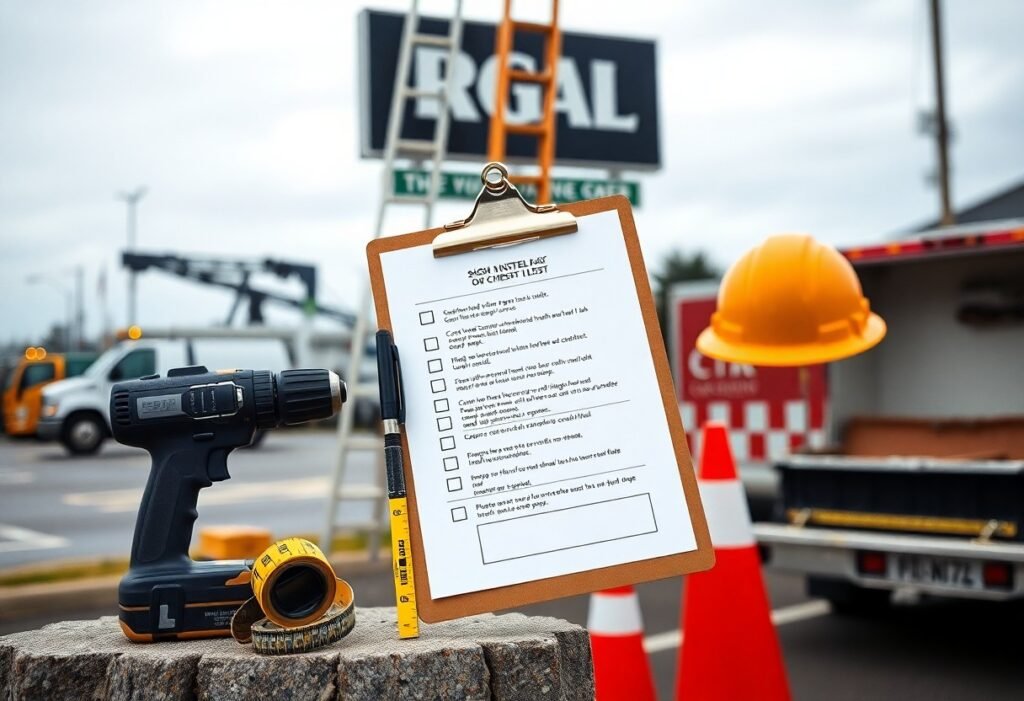
checklist: on install day you should verify permits and site plans, confirm equipment and hardware, inspect your sign for damage, check anchoring points and substrate, ensure power and electrical connections are prepared, review safety procedures and PPE with your crew, confirm traffic control and access, test mounting alignment before final fastening, document as‑installed conditions and take photos, and confirm client sign‑off before leaving the site.
Key Takeaways:
- Confirm permits, site access, utility locates, and exact installation location before arrival
- Verify materials, hardware, mounting brackets, anchors, and spare parts are on-site and in good condition
- Ensure tools, lifts, ladders, PPE, and a trained crew are available and briefed on roles and safety procedures
- Check weather, traffic control, and schedule contingencies; communicate timing with stakeholders
- Perform final alignment, secure connections and electrical checks, tidy the site, document the install, and obtain client sign-off
Pre-Installation Preparation
Before crews arrive, you should confirm permits, traffic control, site access and a detailed install timeline. Verify crane or lift requirements, onsite power (120/240 V) for sign testing, and a 48‑hour low-wind window (winds <20 mph) for aerial work. Assemble bolt templates, torque specs, LED driver spares, anchorage hardware, and a printed plan set so you can resolve discrepancies within 30 minutes on site.
Verify Sign Design and Specifications
Cross-check shop drawings against the approved permit set for overall dimensions, mounting-hole centers, weld details and finish code. Confirm LED specs (CCT 3000K/4000K, 5,000-10,000 lm modules), driver voltage, IP rating and UL listing, plus total power draw in watts. Keep the as-built cut sheet and torque values on hand so you can prevent field modifications or ordering errors.
Confirm Installation Location
You should verify that the stake or surveyed coordinates match the site plan and permit callout, using a GPS or total station to within 1-3 ft. Confirm setbacks from property lines, sidewalk and roadway clearances, overhead lines, and vehicle sightlines; mark staging and crane zones and confirm truck access and turnaround space.
Walk the site with the installer and the plan, measuring from fixed features (curb, pole) to reproduce distances on the drawing. Call 811 at least 48-72 hours before any digging and obtain utility markups; locate shallow utilities within 18-24 inches. Verify the anchor-bolt template against the poured foundation or, for new foundations, follow geotech guidance (example: a 12 ft pylon often needs 4-6 ft embedment; increase depth for wind zones >100 mph).
Required Tools and Equipment
Your sign install kit should include power tools, measuring and layout gear, fasteners, lifting gear, and spares – think an 18V brushless impact, hammer drill, tape measure (25 ft), laser level, stud finder, and a set of masonry bits (3/16″-1/2″). Pack anchor options (wedge anchors 3/8″-1/2″, toggle bolts), silicone sealant, extra bolts and washers, battery chargers, extension cords with GFCI, and a compact tool bag so you can adapt quickly to site conditions.
Essential Tools for Installation
You’ll rely on an 18V impact driver, torque wrench calibrated to expected specs (e.g., 10-150 ft·lb), and a hammer drill for concrete or masonry. Include a laser level with ±1/16″ accuracy at 30 ft, 25 ft tape, chalk line, and masonry/metal drill bit sets. For lifting and positioning, bring a 300 lb-rated extension ladder, a 1,000 lb-capacity hoist or block-and-tackle for larger panels, and ratchet straps to secure loads during drilling and anchoring.
Safety Equipment and Precautions
You must wear ANSI-rated PPE: hard hat (ANSI Z89.1), safety glasses, cut-resistant gloves, and high-visibility vest; for elevated work use a full-body fall arrest harness and shock-absorbing lanyard rated to 5,000 lb. Set up guardrails or use controlled access zones, employ a ground spotter during lifts, de-energize circuits and use lockout-tagout for electrical work, and stop work if wind or lightning exceed safe limits.
Before each use inspect harness webbing, snap hooks, anchors, and lifelines for wear; conduct a fit test and verify anchor points meet a 5,000 lb single-anchor or a 3,000 lb average for multiple anchors per OSHA 29 CFR 1926.502. Use GFCI protection for powered tools, inspect ladders for defects and set at a 4:1 angle, and document inspections on your daily safety checklist so any failure is caught before you climb or torque fasteners.
Weather Considerations
Treat weather as an active scheduling factor: wind, temperature, and precipitation each affect lifting limits, adhesive cure, and electrical safety, so build buffer time into your install window and a clear go/no‑go table for crews. Check site microclimates – urban canyons amplify gusts, coastal sites add salt spray – and factor in a practical delay allowance (commonly 1-4 hours) for short storms or to let sealants begin curing before energizing equipment.
Checking the Forecast
Consult a 72‑hour forecast then switch to hourly radar and METAR/TAF data the day of install; use NWS warnings, local weather apps, and live radar to watch approaching squalls. Set operational cutoffs (for example, suspend aerial lift use if sustained winds exceed ~25 mph or gusts top ~35 mph) and log expected precipitation rates – delays are typical when forecast shows >0.1-0.2 in/hr, which impairs adhesive application and electrical work.
Preparing for Unforeseen Weather
Keep a weather contingency kit on site: 2-3 heavy tarps, ratchet straps, extra stainless fasteners (304 grade), covered bins for electronics, GFCI extensions, and waterproof PPE for crew. Brief your team on rapid‑secure procedures so you can batten down panels in under 15 minutes, and preposition a sheltered area for sensitive testing and final wiring if rain appears suddenly.
Plan specific mitigation steps: after unexpected rain, recheck anchor torque and torque marks within 2-4 hours; allow adhesives and sealants 24-48 hours to cure and follow manufacturer temp ranges (many are rated 40°F-95°F). Bring portable heaters or heated blankets to raise local substrate temps by ~10-20°F for cold installs, and keep desiccant packs and silicone grease for electrical connectors to prevent corrosion when humidity spikes.
Installation Team Readiness
By install day you must ensure your crew, tools, and permits are staged: assign a lead and backup, load one service van per two installers, and confirm a 4-hour client window. Bring a torque wrench set, 6′ and 10′ ladders, two fall-arrest harnesses, ratchet straps, and extra stainless fasteners. Cross-check against a preflight list-see Installation Checklist | AlphaGraphics West Valley for a complete offsite checklist.
Roles and Responsibilities
You should assign clear roles before arrival: 1 lead installer to direct placement, 1 site supervisor to handle permits and client liaison, 1 rigger for lifts, 1 electrician for wiring, plus 1 driver/helper. Schedule a 30-minute site walk, 90-180 minutes for mounting, and 30-60 minutes for electrical hookup and testing. Log certifications, vehicle IDs, and tool assignments on your job sheet.
Team Briefing and Safety Protocols
Hold a 10-15 minute toolbox talk on arrival covering access routes, fall zones, traffic control, emergency contacts, and stop-work authority; verify PPE-hard hat, hi‑vis vest, gloves, rated harness-and confirm radio channel and 30-minute check-ins.
During the briefing, inspect all lifting gear and anchors with you performing a visual pre-use check and noting any defects; follow manufacturer torque specs (for example, 80 ft‑lb on typical 1/2″ anchor bolts) and don’t attempt lifts if wind exceeds 25 mph. Assign a rescue-trained person and confirm an on-site first aid kit, AED, and fire extinguisher. For electrical work, implement lockout/tagout and ensure utility locates are documented. Use MUTCD-compliant traffic control when working near roadways (cones, signage, and a trained flagger if speeds exceed 25 mph). Record the toolbox talk with names and signatures, photograph the site pre- and post-install, and upload notes to your project app so you can audit compliance and resolve disputes quickly.
Installation Steps
Site Assessment
You should verify substrate type, structural capacity, and clearances before any holes are drilled. Measure mounting height and maintain a minimum 80-inch pedestrian head clearance for projecting signs; photograph elevations, mark power runs (120V/240V/low-voltage), and scan for underground utilities within 2-3 feet of anchor locations. Also confirm permits, local wind-load requirements, and available lifting equipment so you can choose anchors and rigging that match on-site conditions.
Sign Mounting Techniques
Choose anchors and hardware to match your sign weight and substrate: for concrete use 1/2″ wedge or sleeve anchors, for brick or CMU use epoxy-set or 3/8″-1/2″ anchors into solid mortar or cores, and for wood-frame walls use 1/4″-5/16″ lag bolts into studs with backing plates for signs over 50 lb. Employ standoffs for illuminated faces, through-bolts for heavy loads, and corrosion-resistant stainless fasteners in coastal zones.
Example: a 6×4 ft aluminum sign (~35-45 lb) on brick commonly uses four 1/2″ wedge anchors with ~2.5″ embedment and neoprene washers to seal penetrations; a 10 ft channel-letter assembly (~150-250 lb) needs a welded steel frame, 5/8″ through-bolts, diagonal bracing, and grounding per electrical code. Use templates for drilling, follow manufacturer torque specs, and apply silicone or gaskets to prevent water ingress.
Post-Installation Checklist
After the install is complete, close out with documentation, client sign-off, and site restoration: capture a minimum of eight as-built photos (overall, close-ups, electrical labels), record serial numbers and torque readings, complete the permit final inspection form, collect final payment or lien waiver, and schedule a 30-day follow-up to verify performance and address any warranty items.
Quality Inspection
You should verify alignment, structural fastening, and electrical performance: confirm plumb/level within 1/8″ tolerance, check anchor torque to the manufacturer’s spec (e.g., 50-80 ft·lb), measure LED drive current and voltage, inspect seams and gaskets for water intrusion, and run a 15-30 minute burn test to detect flicker or thermal issues before leaving site.
Clean-Up Procedures
You must leave the site safe and tidy: collect all hardware into labeled bags, remove packaging and sharp debris, sweep or vacuum within a 10 ft perimeter, and stack removed scaffolding and protection materials for removal. Recycle metal and cardboard where possible and secure small fasteners so they don’t create hazards for the client or landscapers.
For hazardous or electronic waste, segregate batteries, ballasts, and LED drivers into clearly labeled containers, retain disposal receipts, and follow local disposal rules; perform a magnet sweep for nails and a final client walkthrough to confirm areas are clear. Document cleanup with before/after photos and a short checklist for the client that includes recommended first-maintenance at 30 days and contact details for warranty service.
Summing up
To wrap up, you should confirm permits and site prep, verify measurements and layout, have required anchors, mounting hardware and tools, and ensure utilities are located and weather is suitable; assign clear crew roles, use your PPE, follow safety procedures, document the installation with photos and checklists, perform a final inspection and client walkthrough, and schedule cleanup and follow-up to address any adjustments.
FAQ
Q: What pre-arrival checks should be completed before sign install day?
A: Verify permits and approvals are on site and valid; confirm as-built drawings, site survey, and exact mounting dimensions; complete utility locates and mark underground services; confirm site access, staging area, and vehicle/equipment clearance; check weather forecast and reschedule criteria; notify property owner, tenants and local authorities if traffic control is required.
Q: What tools, equipment, and materials should the crew bring?
A: Bring lifting equipment (boom lift, crane, or scissor lift) sized for sign weight and height; hand and power tools (drill, impact, torque wrench, levels, plumb bob), fall-protection gear and PPE; anchoring materials, bolts, washers, grout or concrete anchors, and sealing compounds; electrical supplies (conduit, connectors, weatherproof boxes, junctions, fuses), testers, and replacement lamps/LED drivers; spare fasteners, mounting brackets, paint touch-up, and a small parts kit for unexpected repairs.
Q: What safety and site control measures should be implemented during installation?
A: Establish a site safety plan and hold a brief pre-job toolbox talk; set exclusion zones with cones, barriers and signage; implement fall protection for elevated work and ensure harnesses and lanyards are anchored correctly; use spotters for vehicle and crane movements; control pedestrian and vehicle flow with flaggers or temporary traffic control where needed; have first aid, emergency contacts, and a fire extinguisher on site.
Q: What are the key installation and electrical checks to perform while mounting the sign?
A: Verify mounting points align with shop drawings and tighten anchors to specified torque; ensure sign is plumb, level and secured with proper hardware and backing; weatherproof penetrations with approved sealant and install vibration-resistant fasteners where specified; complete electrical wiring per code, verify proper grounding, polarity and strain relief, then test circuits, drivers and lighting for correct operation and brightness; confirm timers, photocells, or controls function as intended.
Q: What post-installation tasks, documentation, and customer handoff are required?
A: Inspect and document installation with labeled photos showing anchors, wiring, and final appearance; remove debris, grind or touch-up exposed metal, and restore disturbed surfaces; perform final electrical safety tests and record readings; collect factory warranties, maintenance instructions and parts lists; obtain client sign-off on acceptance form, note any punch-list items with completion deadlines, and provide emergency contact for post-install issues.