
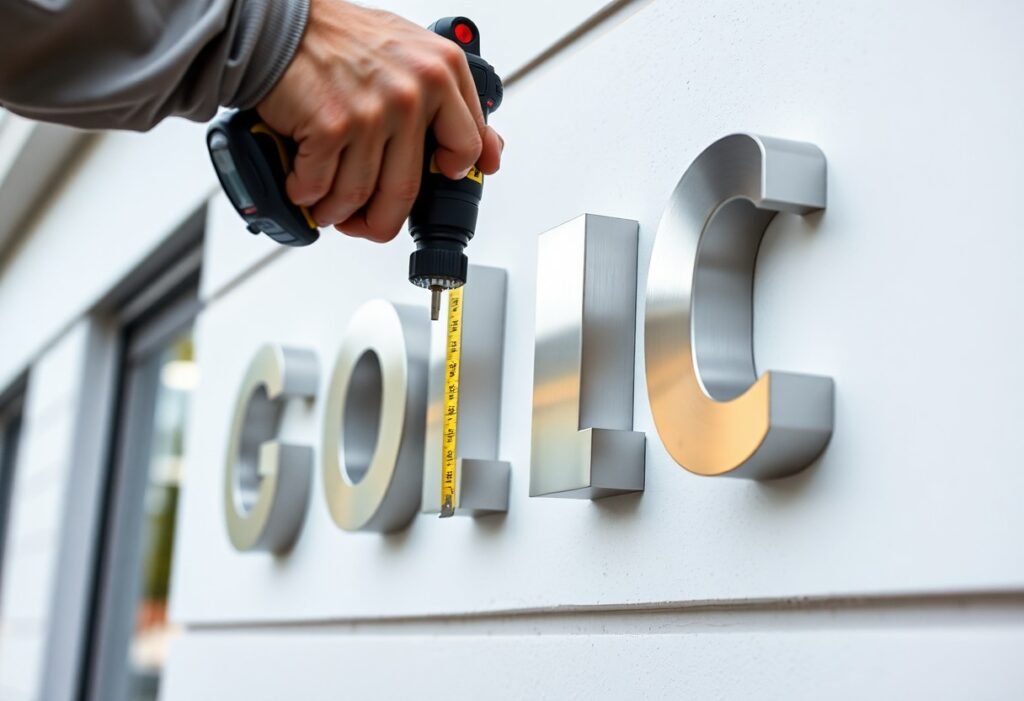
You begin by assessing the substrate and measuring precisely, then create or use a durable template to mark locations; select appropriate mounting hardware (studs, anchors, or adhesive) based on material and weight, drill and install anchors, apply sealant where needed, mount letters using level and spacer guides to ensure consistent reveal and alignment, tighten securely, and perform a final inspection for plumb, spacing, and finish touch-ups to ensure longevity and professional appearance.
Key Takeaways:
- Inspect and prepare the substrate: confirm flatness, structural support, and code requirements; clean and mark precise anchor locations.
- Establish an accurate layout: measure twice, use a full-size template or laser level/gridlines, and tape templates securely before drilling.
- Choose proper mounting hardware: select studs, stand-offs, or structural adhesive sized for letter weight and substrate; drill pilot holes and use appropriate anchors.
- Handle electrical and illumination correctly: run conduit/wiring and mount drivers before final placement, test lighting, and weatherproof all penetrations with silicone or gaskets.
- Finish and verify: tighten fasteners evenly, caulk seams, touch up finishes, confirm alignment and spacing from multiple viewpoints, and document installation details.
Tools and Materials Required
You’ll need a compact set of tools and supplies that match your letter type and substrate: power drill with masonry and metal bits, 4′ level or laser, torque driver, rivet gun, silicone gun, assorted anchors and studs, marine‑grade fasteners, and safety gear for heights. For a typical 4 ft × 8 ft channel‑letter panel plan on 8-12 anchors and 2-3 people to handle alignment and secure fastening safely.
Essential Tools
Use a hammer drill with 3/16″ and 1/2″ bits for metal and concrete, a 4′ spirit level or rotary laser for ±1/8″ accuracy over 8′, a torque‑controlled drill (20-40 in‑lb range), stud finder, magnetic level, rivet gun, and clamps. You’ll also want a template saw or jigsaw for backing cuts, measuring tape, chalk line, and PPE: gloves, eye protection, and fall arrest when working above 6 ft.
Materials for Installation
Choose materials based on exposure and weight: acrylic, aluminum composite (ACM), or stainless steel letters; studs typically 1/4″-5/16″ (M6-M8); anchors such as sleeve anchors, toggle bolts, or epoxy anchors rated per shear loads; 316 stainless fasteners for coastal sites; marine silicone sealant; and backing plates or mounting rails to distribute load over 12-18 in spans.
For adhesive and corrosion protection, specify a structural epoxy with 3,000-6,000 psi bond strength for hollow block or concrete, UV‑stable silicone for perimeter sealing, and Loctite threadlocker on stainless fasteners. In practice, a 50 lb fabricated letter often uses two 250 lb‑rated anchors plus silicone beads; use backing plates when letters exceed 30 in width or overhang is present to prevent distortion and wind uplift.
Preparing the Installation Site
Before you mount letters confirm substrate flatness (<=1/8" over 10 ft), structural backing, and local permit or code constraints; verify safe access for lifts or ladders and clear a 3-5 ft staging zone for tools and templates, then check weather-avoid installing in rain or temps below 40°F-and ensure power and compressed air are available if using drills or impact drivers.
Measuring and Marking
Set a horizontal datum and vertical centerline, then measure twice and mark once: use a laser level and chalk line for long runs, templates for exact letter spacing, and mark anchor locations to within 1/16″ for premium signage; place top, bottom and midline references every 24-36″ so you can cross-check during installation.
Surface Preparation
Clean the mounting surface with a degreasing agent or 70% isopropyl alcohol and allow 10-15 minutes to dry, scuff glossy paint or metal with 120-150 grit, and fill cracks or voids with epoxy or cement so anchors seat fully; prime porous masonry with a manufacturer-recommended primer and wait the specified flash time (typically 30-60 minutes).
For mechanical fastening use stainless steel hardware: Tapcon screws are common-use a 5/32″ pilot for 3/16″ screws and 3/16″ pilot for 1/4″ screws-and sleeve anchors for heavy letters; for adhesive mounts choose structural epoxy or neutral-cure silicone for exterior seals, follow curing times and ambient temp limits, and trial a test piece to verify bond before committing to the full installation.
Installation Techniques
Choose techniques based on substrate and letter weight: pin-mount, standoffs, through-bolts, or structural adhesive. Use 1/4″ (6 mm) studs for letters under 24″ and 3/8″ (10 mm) studs for larger pieces, spacing anchors 6-12″ apart; letters over 36″ generally need three or more anchors. For adhesives select a structural silicone or epoxy rated 3,000-4,000 psi. Consult The Architect’s Guide To Dimensional Lettering for template and tolerance charts.
Mounting Methods
Pin (blind) mounting gives a clean float-drill holes to match stud diameter and use a torpedo level for alignment; for masonry use 3/8″ sleeve anchors or chemical anchors in drilled holes. Standoffs work well on glass or stone and commonly use 1/2″ caps; through-bolts are best when you can access the backside. Raceway mounting centralizes wiring for LED letters and simplifies maintenance, especially for runs over 10 linear feet.
Securing the Letters
Secure letters with threadlocker on studs, nylon or rubber washers to damp vibration, and stainless steel fasteners (316 grade in coastal zones). Tighten set screws snugly without deforming the letter, then seal penetrations with exterior-grade silicone or polyurethane to prevent moisture ingress and corrosion at the fastener interface.
After fastening, perform pull tests on representative letters-50-100 lbf per fastener is a common field check for small to medium signs; for large or high-wind installations obtain engineered pull-out values. Use rivnuts for thin-metal substrates, backing plates behind EIFS or drywall to distribute load, and chemical anchors for hollow or lightweight block. For illuminated letters provide strain relief for wiring and design removable modules or access panels for serviceability; record anchor types, adhesive batch numbers and cure times (typical epoxy cure 24-48 hours) for quality control.
Common Challenges and Solutions
Weather Considerations
You should schedule installs for temperatures between 5-30°C whenever possible, because many adhesives and tapes require 24-72 hours to cure and lose bond strength below 5°C. High humidity slows curing; wind over 25 mph complicates lifting and can misseat letters. If you must work in cold, use cold-weather primers and low-viscosity epoxy rated to -40°C, and in heat expect metal expansion-aluminum expands ~23×10⁻⁶/°C, so allow for thermal movement in your mounting system.
Misalignment Issues
You can avoid visible offsets by holding tolerances to ±1/16″ (≈1.6 mm) for short runs and using a laser level, full-size templates, or jig systems. Dry-fit every letter, clamp temporarily, then fasten progressively from the datum line outward. For example, a 12-foot row will show a 3 mm shift easily, so use stainless alignment studs, shims, and a 4′ level to keep spacing consistent.
You should transfer a single strong datum line across the façade, verify with diagonal measurements, and use progressive tightening to lock position-start center, then opposite sides. Employ feeler gauges to check uniform gaps, shim up to 3 mm with nylon or aluminum spacers, and re-drill anchors only if offsets exceed about 5 mm. In one case study a 10-letter logo was corrected in 45 minutes by re-establishing the datum, using a laser template and incremental torque (20-30 in·lb) on mounting screws to prevent pull-through and final shift.
Post-Installation Care
Cleaning and Maintenance
After mounting, allow adhesives and sealants to cure for 24-72 hours before applying any load or cleaning; keep scaffolding and lifts off letters during that period. You should document as-built photos, verify electrical connections under load, and note expected maintenance intervals on the project sheet to protect warranty and lifespan.
Periodic Inspections
For routine upkeep, inspect fasteners, anchors and sealants monthly for the first three months, then quarterly; coastal sites should move to bi-monthly checks. Verify anchor torque to manufacturer specs with a calibrated torque wrench, check runout within 1-2 mm, and test LED drivers with a multimeter for stable output under load.
Use a standard checklist: photograph each letter, log torque values, note corrosion (replace mild steel with 316 stainless in marine environments), inspect silicone joints for gaps greater than 2 mm and schedule reseal after 3-5 years. You should also perform a wet-ingress check after heavy storms and keep inspection records for warranty support and lifecycle planning.
Safety Precautions
For every install you should enforce a written safety plan that assigns roles, outlines fall-protection systems, and logs PPE and equipment inspections. Use OSHA 29 CFR 1926.501 as your baseline for construction work above 6 ft, document anchor ratings (5,000 lb per person minimum), and require toolbox talks before mobilizing crews; projects with rooftop or façade work often reduce incidents by over 60% when these controls are consistently applied.
Personal Protective Equipment
You must supply and enforce PPE tailored to the task: ANSI Z87.1 safety glasses, cut-resistant gloves (ANSI/ISEA Level A4) for sheet-metal letters, ASTM F2413 steel-toe boots, hearing protection when noise exceeds 85 dB, and respirators-N95 for dust or P100/organic-vapor cartridges for silicone solvent fumes. Also use high-visibility vests and impact helmets when cranes or lifts operate within the work zone.
Working at Heights
You should use fall protection for work over 6 ft, applying full-body harnesses meeting ANSI Z359 with anchors certified to 5,000 lb per person or a certified engineered system. Position ladders at a 4:1 base-to-height ratio, maintain three points of contact, and prefer aerial lifts or scaffolds with outriggers for sustained work; calculate fall clearance per manufacturer, typically allowing ~6 m (20 ft) for a 2 m lanyard with deceleration.
Plan for rescue and inspection: train crews annually, inspect harnesses and lanyards before each shift, and retire components per manufacturer or after a significant fall. Use shock-absorbing lanyards or self-retracting lifelines when overhead anchors are limited, locate anchors within 6 ft of the work to reduce swing fall, and ensure a rescue capability that retrieves a suspended worker within minutes to prevent suspension trauma.
Conclusion
Following this, you ensure accurate dimensional letter installation by verifying measurements and templates, preparing and leveling the mounting surface, selecting appropriate anchors or adhesive and following manufacturer torque and curing specs, aligning letters with guides and a level, wiring and testing illuminated units before final sealing, and documenting placement for future maintenance.
FAQ
Q: How do you perform dimensional letter installation correctly?
A: Follow a systematic process: survey the site and verify substrate type, utilities and mounting surface condition; choose a mounting method (studs, construction adhesive, raceway) based on letter weight, material and exposure; create and position a full-size paper or vinyl template and snap chalk lines or use a laser level; mark and drill holes with the correct bit and depth stops; install anchors or set structural adhesives per manufacturer’s cure times; dry-fit each letter, then mount starting from a reference point using a level and consistent spacing; secure fasteners or finish adhesive bonds, seal around studs and edges to prevent moisture ingress, remove protective films, and test any illumination before final cleanup.
Q: What tools and materials are required for a proper installation?
A: Essential tools: laser level or transit, spirit level, tape measure, plumb bob, chalk line, drill and hammer drill, masonry and metal bits, torque wrench, stud punch or hammer, caulking gun, clean rags and solvent. Materials: full-size template, stainless-steel studs/anchors or wedge/sleeve anchors suited to substrate, structural adhesive options (epoxy or approved polyurethane/modified-silane adhesives), 3M VHB tape for flat lightweight letters, marine-grade silicone or polyurethane sealant, backer plates or raceways for heavy/illuminated letters, protective film on faces, and stainless fasteners for outdoor installations. PPE: gloves, eye protection, hard hat and fall protection equipment when working at height.
Q: How do you prepare different substrates (masonry, metal, glass, stucco) before mounting letters?
A: Clean the surface of dust, oils and loose material; for porous surfaces like masonry or stucco, remove loose mortar and fill or patch irregularities so the template lies flat; for metal or painted surfaces, degrease and abrade lightly if adhesive is used and apply a compatible primer; for glass or glazed tiles, use approved structural adhesives and avoid mechanical anchors unless engineered supports are added; verify substrate thickness and backing-if the substrate cannot hold anchors, install mounting plates or a plywood backing secured to structural members. Allow primers and repair compounds to cure fully and verify flatness with the template prior to drilling or bonding.
Q: What are the correct methods for mounting illuminated letters and routing power safely?
A: Use a raceway or backer rail sized for transformer and wiring if letters are powered; mount the raceway with anchors into structure before attaching letters; run conduit or flexible conduit from power source to the raceway, install a weatherproof junction box and access panel for service; pull and secure low-voltage wiring inside the raceway, leaving service slack and strain relief on wire entries; test LED modules and transformers before sealing; use grommets or silicone around wiring penetrations and apply appropriate outdoor-rated sealants. Ensure installations comply with local electrical codes and, where required, have electrical connections performed or inspected by a licensed electrician.
Q: What post-installation checks and maintenance extend the life of dimensional letters?
A: Inspect anchor torque and adhesive bonds after initial cure and again at 30-90 days, then on a regular maintenance schedule (every 6-12 months). Check sealant joints for separation and reapply marine-grade sealant where needed. Clean faces with manufacturer-approved cleaners to avoid damage to finishes; remove bird nests and debris from raceways and behind letters. For illuminated signs, verify LED drivers and connections are dry and secure, and replace failing modules promptly. For any sign showing movement, corrosion or water ingress, remove affected letters and repair substrate or fasteners before reinstallation to prevent further damage.