
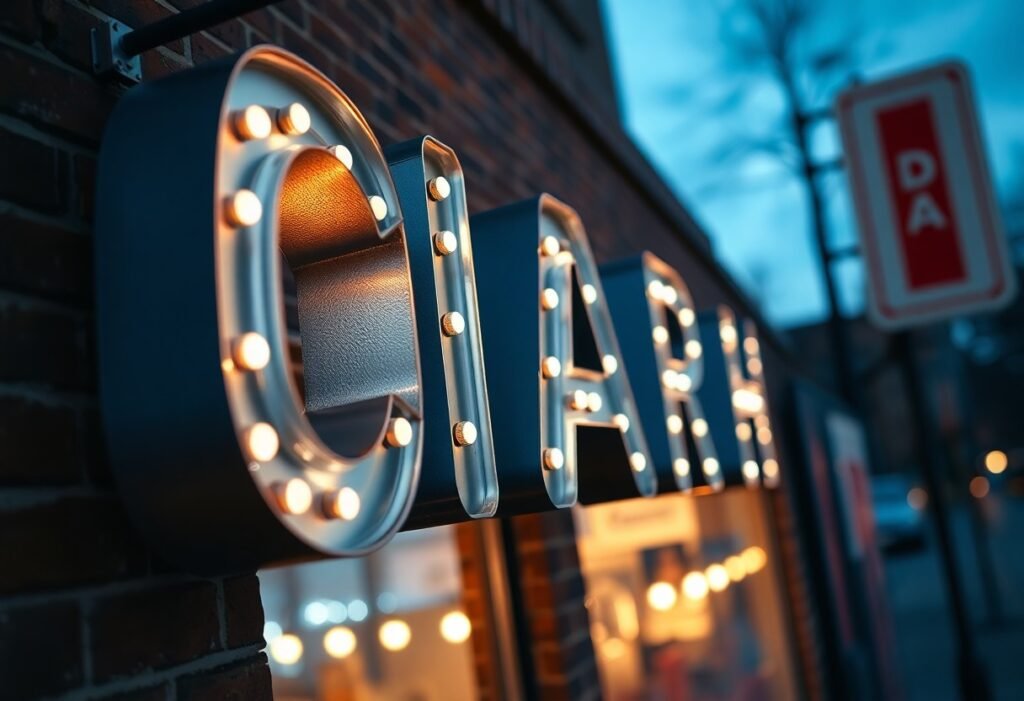
Channel letters with open faces expose internal illumination, giving you vibrant, direct lighting that enhances visibility and brand presence; open face channel letters work best when your storefront needs high-impact, straightforward typography and bold color contrast. You’ll find them ideal for retail, hospitality, and urban signage where the goal is maximum nighttime readability, simple maintenance, and an industrial, contemporary aesthetic.
Key Takeaways:
- Open-face channel letters are three-dimensional letterforms with no solid front so the lighting element (neon or exposed LED) is visible through the face.
- They create a vivid, direct-illumination look-often retro or industrial-producing bright, saturated outlines rather than diffused color.
- Best for storefronts, bars/restaurants, retail and brand signage that needs high nighttime visibility or a neon-style aesthetic on flat building facades.
- Work best with simple, sturdy typefaces and even lighting runs; thin strokes or heavily detailed logos can show uneven illumination.
- Typically cost-effective and easier to service than fully faced letters but provide less uniform light diffusion and may be subject to local sign regulations.
Understanding Open Face Channel Letters
As you evaluate signage options, open face channel letters stand out because their lighting element is intentionally exposed, creating bold linework and visible illumination. You’ll see them used for storefronts, theaters, and restaurants where readability and personality matter; typical letter depths range from about 3 to 8 inches, and they perform especially well at dusk and night when the exposed neon or LED defines the letterform.
Definition of Open Face Channel Letters
Open face channel letters are three-dimensional letterforms without an opaque front, so the neon tubing or exposed LED modules are visible inside the return. You get direct, unfiltered light and crisp contours instead of a diffused face, which differs from front-lit or halo-lit letters and is often chosen when you want a raw, vintage neon look or a modern exposed-LED aesthetic.
Key Characteristics and Design Features
You’ll notice several consistent traits: metal returns (usually aluminum or steel), an open front revealing neon or LED, and variable depths that affect brightness and shadow. Typical mounting options include direct-stud for flush installation or a rear raceway for serviceability. As a rule of thumb, letters 18-24 inches high are easily readable from 50-100 feet, making size and stroke width important design decisions.
Lighting choice shifts performance and maintenance: neon gives continuous, warm lines and strong color saturation but requires higher voltage and regular servicing; exposed LED modules offer up to about 70% energy savings, easier replacement, and cooler color temperatures down to 3000K-4000K for crisp whites. Materials matter too-use stainless or powder-coated metals in coastal environments to resist corrosion, and plan for weatherproofing gaskets and proper conduit access when you specify wiring and mounting options.
Advantages of Open Face Channel Letters
Open face channel letters deliver intense direct illumination, lower maintenance, and broad design flexibility. You get brighter night-time presence with simple LED modules, reduced shadowing on façades, and easier on-site servicing compared with enclosed cabinets. Installations commonly range from 12 inches to 6 feet tall and are compatible with various mounting systems and finishes, letting you balance upfront cost, energy use, and branding impact efficiently.
Enhanced Visibility and Readability
By exposing LEDs directly through the open face, you get higher lumen output per letter and crisper letter edges at night. For typical retail sizes (12-36 inches), readability extends roughly 50-150 feet under street lighting; larger letters push that distance further. You also avoid diffusion loss from acrylic faces, so your brand stays legible from angled views and faster-moving traffic.
Customization Options
Open face channel letters let you mix metals, depths, and lighting to match your brand: brushed stainless or folded aluminum returns, powder-coat in any RAL color, and LED color temperatures from 2700K to 6500K or RGB for dynamic effects. You control size, font weight, and mounting to suit façades from storefronts to pylon signs.
Deeper dives show practical specs: returns commonly span 3-8 inches to balance shadow and depth, letters over 4 feet often use internal cross-bracing, and LED modules rated IP65/IP67 handle wet exteriors. You can choose 1-2 inch module spacing for uniform fill or pixel-addressable RGB for animated effects controlled via DMX or Wi‑Fi. Service panels or rear access simplify future lamp replacement, so your maintenance and upgrade path stays straightforward.
Ideal Situations for Open Face Channel Letters
When you need bold, direct illumination that reads clearly at night and draws attention from blocks away, open face channel letters are ideal; typical installations remain legible from 100-300 feet in urban settings. You’ll find them most effective where energy efficiency and low maintenance matter-LED open-face options use roughly 60-75% less power than older neon fixtures and offer 50,000+ hour lifespans-making them practical for continuous, high-impact signage on busy commercial corridors and entertainment districts.
Best Applications and Locations
You should prioritize open face channel letters for storefronts, bars, restaurants, theaters, casinos, and entertainment venues where nighttime visibility drives traffic. They work well on building façades 20-60 feet wide, rooftop signs, and mall entrances; placement 8-30 feet above the sidewalk maximizes pedestrian sightlines. Also consider historic downtowns and arts districts where exposed neon or retro styling enhances local character while competing effectively with dense visual clutter within 100 feet.
Branding Impact and Marketing Benefits
You gain stronger brand presence because exposed lighting emphasizes stroke, color, and material-boosting nighttime recall and perceived value. Open-face letters can convey a handcrafted or high-energy look (exposed neon for vintage, RGB LEDs for dynamic color), and some operators report double the evening visibility versus halo-lit signage. With 24/7 visibility, your sign becomes a continuous marketing asset that supports wayfinding, promotions, and brand differentiation.
Delve deeper into materials and controls to amplify impact: neon tubing gives saturated hues and classic appeal with typical lifespans of 8-15 years, while LEDs provide programmable color shifts, DMX control, and lower operating costs. You can measure ROI through reduced energy bills and maintenance intervals, and tailor luminance, color temperature (2700-6500K), and animation to match campaigns-just verify local lumen or hour restrictions to remain compliant.
Installation and Maintenance Considerations
For installation and upkeep, you should budget time and roughly 10-15% of the sign price for professional mounting and 5-10% annual for maintenance. Expect a licensed electrician for wiring, local sign permits, and UL-listed components; many municipalities require a permit and inspection. Choose IP65-rated housings in wet climates, and plan spare LED modules and drivers since typical LEDs last ~50,000 hours while neon runs closer to 15,000-30,000 hours.
Installation Process
You or your installer will follow a set sequence: verify wall structure, install a welded mounting rail or backer, anchor with sleeve or wedge anchors into masonry, and route low-voltage wiring to a labeled transformer box. Use LED modules spaced 2-3 inches for even brightness and calculate voltage drop for runs over 20 feet. Typical field install for a standard storefront (8-12 letters) takes 2-6 hours with a lift and two technicians.
Maintenance Requirements
You should schedule visual inspections every 6 months and routine cleaning every 3-6 months to remove dirt and pollen that reduce output. Check gaskets, screw torque, and sealant for water intrusion, test drivers and replace any dimming modules, and keep a log of repairs; swapping a failed 24V driver often restores a sign within 30-60 minutes on-site.
More maintenance detail: establish a parts kit with extra LED strips, drivers (12V/24V as used), silicone gaskets, and stainless fasteners; document IP rating and replace degraded silicone every 3-5 years. In one retail case study, a chain of 20 stores cut outages by 80% after instituting biannual inspections and replacing drivers at year five, saving several hundred dollars per store annually. Always disconnect power before servicing.
Comparison with Other Signage Options
When evaluating sign types you’ll find open face channel letters combine direct illumination with strong night legibility; for design fundamentals see Channel Letter Signage 101: What You Need to Know for technical specifics and installation guidance.
Quick comparison
| Visibility | High night contrast from exposed LEDs; reads well at 100-300 ft depending on size. |
| Energy use | LED open-face systems typically use 60-80% less power than comparable neon fixtures. |
| Maintenance | Lower maintenance than neon; individual LED modules are replaceable without removing faces. |
| Design flexibility | Excellent for bold, see-through illumination and custom tubing or cluster LED effects. |
| Typical cost | Mid-range: usually cheaper than custom neon but pricier than flat printed or PVC signs per square foot. |
Open Face vs. Closed Face Channel Letters
You’ll notice open face letters expose the light source for a raw, glowing look, while closed face letters diffuse light behind a solid acrylic face; open-face often wins for up-close impact and easier service, whereas closed-face gives a cleaner, softer halo usable for refined brand tones.
- Open face: punchy, visible from greater distances at night.
- Closed face: uniform color, better for detailed logos and softer branding.
- Perceiving open face as edgier helps you match signage to high-traffic, nightlife, or industrial brand identities.
Open Face vs. Other Types of Signage
You’ll compare open face channel letters to neon, backlit cabinet signs, and flat graphics: open face outperforms for three-dimensional night impact and lower long-term maintenance than neon, but cabinets can offer larger graphics and flat signs cost less per square foot for daytime-only needs.
Open face vs other signage
| Day vs night performance | Open face excels at night; flat graphics are stronger in daylight without illumination. |
| Brand impact | Three-dimensional presence of open face boosts perceived premium value versus flat signage. |
| Installation complexity | Moderate: requires wiring and secure mounting; simpler than large cabinet installs but more than vinyl. |
| Lifespan | LED open-face systems often last 7-10 years with proper maintenance; LED modules are replaceable. |
| Cost per sq ft | Generally higher than flat printed panels, lower than custom neon or full-architectural cabinet builds. |
In practice you’ll weigh location, viewing distance, and budget: choose open face for exterior storefronts on busy streets or entertainment districts, pick cabinets for large-scale branded graphics, and use flat signs for economical daytime-only placements.
- Use open face when you need three-dimensional night presence.
- Choose cabinets or flat panels when graphic area or daytime cost-efficiency is the priority.
- Perceiving open face as a tactical investment helps you balance upfront cost against long-term visibility and maintenance savings.
Cost Factors and Budgeting
Budgeting for open face channel letters hinges on material, lighting, size, installation and permits; a typical 10-foot storefront word with exposed LEDs usually costs $1,500-$4,000, while custom neon or larger installations can run $5,000-$12,000. You should factor shop drawings, electrical hookup and potential façade repairs. Expect downtown or historic-district permits and labor to add 10-30% to estimates, especially where lift rentals or specialized anchors are required.
- Materials: aluminum returns, thicker gauge metal and exposed lighting increase fabrication time and expense.
- Lighting: exposed LEDs generally cost 20-40% less to install and maintain than custom neon tubing.
- Size & complexity: large letters or script fonts can double labor hours and shop charges compared with block type.
- Installation & electrical: rooftop or high-wall installs often require lifts and certified electricians, adding $500-$2,000 to the job.
- Perceiving maintenance frequency-daily cleaning vs annual service-will materially affect lifecycle cost and depreciation.
Initial Investment
Upfront costs typically include design, fabrication and installation; you’ll often see $150-$400 per letter for standard open-face LED letters on small storefronts, while larger custom letters or neon can run $600-$1,200 each. Shop drawings and proofing commonly add $200-$600, and municipal permits or electrical hookups can tack on $200-$2,000 depending on your location and required inspections.
Long-term Value
Over time you recoup initial outlay through increased visibility and reduced operating costs: exposed LED open-face letters often use 50-70% less energy than neon, and a modest sales lift-10-30% in high-traffic corridors-can pay back signage spend within 1-3 years. You should also factor lower maintenance intervals; LED modules typically last 50,000-100,000 hours versus neon’s higher service frequency.
Consider a midtown café that replaced a backlit cabinet with open-face channel letters: evening customer count rose 18% and monthly revenue increased by about $1,200, helping cover the $3,500 investment in under three months when combined with lower electric bills; you’ll also reduce service calls since quality LEDs cut annual lamp replacements and allow single-letter swaps for rebranding rather than full sign replacement.
Summing up
On the whole, open face channel letters are metal-bodied letters with no front face so the light source (neon or LEDs) is exposed, producing bold, direct illumination and a vintage or industrial look. They work best when you want high nighttime visibility, strong color saturation, and a statement sign for storefronts, restaurants, or entertainment venues; they suit high-contrast backgrounds and locations where maintenance access and waterproofing are manageable, giving you customizable, attention-grabbing branding without the soft halo of reverse-lit letters.
FAQ
Q: What are open face channel letters?
A: Open face channel letters are three-dimensional sign letters whose front faces are open, exposing internal illumination elements (typically LEDs) and a visible internal finish. They usually have a metal or acrylic return (side) and a routed or trimmed face that can be clear, colored, or left completely open to show LED modules, diffusers, or decorative backs. The result is a bold, modern appearance with bright frontal illumination and an emphasis on the letter interior rather than a solid, opaque face.
Q: When do open face channel letters work best?
A: Open face channel letters work best for storefronts, restaurants, bars, entertainment venues, and retail brands seeking a contemporary, industrial, or high-impact look-especially where frontal illumination and visible internal components add to brand character. They perform well in busy pedestrian settings and urban streets where legibility at close to medium range and aesthetic interest are important. They are also effective for accent lighting in combination with backlighting for halo effects.
Q: What illumination, materials, and finishes are common for open face channel letters?
A: LEDs are the standard light source, chosen for brightness, efficiency, and color options. Common materials include aluminum for returns, stainless steel or brass for premium finishes, and acrylic or polycarbonate for components and diffusers. Finishes vary from brushed or polished metals to painted returns and exposed acrylic or plexiglass interiors; translucent diffusers can soften the LED appearance. Designers can leave LEDs fully exposed for an industrial look, cover them with light buckets or strips for even illumination, or use colored LEDs for brand-specific hues.
Q: What are the installation and maintenance considerations for open face channel letters?
A: Installation requires secure mounting to a wall or raceway with proper weatherproofing for electrical connections. Because the faces are exposed, ensure LED modules and wiring are rated for outdoor use and placed behind protective trim or diffusers if necessary. Maintenance includes periodic cleaning to remove dirt and debris from the open face, checking seals and gaskets, and inspecting LED modules for moisture or failure. Plan for easy service access-through removable mounting plates or access panels-so individual modules can be replaced without removing the entire letter.
Q: How should I decide between open face channel letters and other letter types for my brand?
A: Choose open face channel letters when your brand benefits from a visible internal structure, industrial or contemporary styling, or distinctive frontal illumination. If you need even, uniform front lighting with a polished, architectural look, fully faced acrylic letters or reverse-lit (halo) letters might be more appropriate. Consider viewing distance, lighting consistency, budget, and maintenance: open face letters are striking up close and mid-range, offer flexible creative effects, and can be cost-effective, but they may require more frequent cleaning and careful waterproofing than fully enclosed alternatives.