
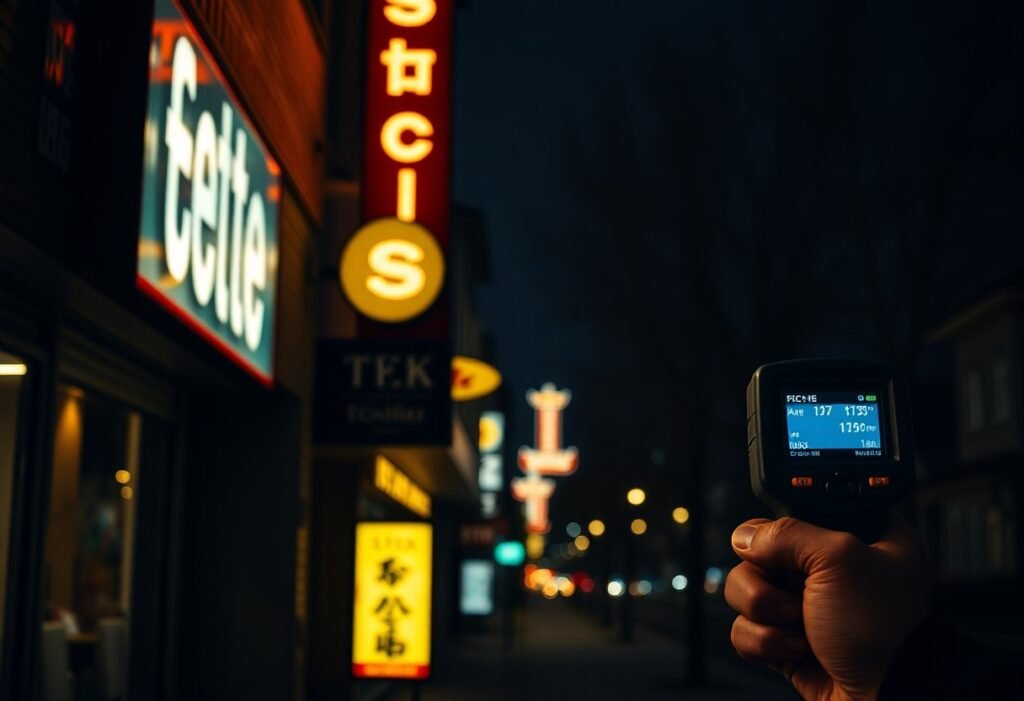
It’s important that you understand how brightness limits, zoning regulations, permitted hours, shielding and aiming requirements, and restrictions on flashing or colored lights directly affect your nighttime signage; following illumination standards, permit conditions, and dark-sky or energy-efficiency rules helps you avoid fines, reduce light trespass, and maintain road safety.
Key Takeaways:
- Brightness and luminance limits (nits/lux/candela) set maximum output and often require automatic dimming for nighttime use.
- Zoning and land‑use regulations dictate where illuminated signs are allowed, allowable sizes, heights, and required setbacks.
- Glare, light‑spill and shielding requirements control fixture aim and cutoff to limit off‑site illumination and roadway glare.
- Animation, color, contrast and flicker rules restrict moving or flashing content, rapid refresh rates, and certain colors that increase driver distraction.
- Permits, inspections and operating‑hour curfews mandate registration, periodic maintenance, and limited illumination times to reduce nighttime impact.
Importance of Sign Illumination Regulations
You rely on regulations to balance visibility, safety, and neighborhood impact: proper rules ensure signs are legible for drivers and pedestrians while limiting glare and light trespass. For example, the FAA requires lighting/marking for structures 200 ft (61 m) and taller, many municipalities cap nighttime digital sign brightness around 300 nits, and switching to LED can lower sign energy use by up to 70%, so compliant illumination also reduces operating costs and environmental footprint.
Enhancing Visibility
You need target luminance, contrast, and uniformity to maximize legibility: aim for consistent face luminance (often 100-300 cd/m² for commercial signs) and uniformity ratios that avoid hotspots (typical maximum/minimum around 4:1). Use letter-height rules-about 1 inch of letter equals 30 feet of readable distance-to size signage, choose backlit or halo lighting to improve stroke contrast, and place signs at sightlines that match approach speeds for motorists.
Safety Concerns
You must mitigate glare, distraction, and spill light because they directly affect reaction time and night vision. Glare from oversized or overly bright signs can obscure road hazards; many local codes limit spill to about 0.5 lux at property lines and require shielded fixtures. Additionally, tall illuminated structures trigger FAA protections and lighting patterns to prevent aviation hazards once they exceed 200 feet.
For practical mitigation, you should specify dimming controls, timers, and adaptive sensors so signs reduce to a safe fraction of peak brightness after late-night hours-many digital billboards dim 30-70% between 11pm and 6am. Also employ backplates, louvers, and cut-off fixtures to limit lateral spill, measure output in cd/m² or lux during commissioning, and document compliance with local ordinances to avoid fines and reduce community complaints.
Local Laws and Ordinances
Your local ordinances set the baseline for illumination: municipal codes commonly specify maximum luminance, night-hour restrictions, allowable sign types, and penalties. For example, many cities cap digital sign brightness at roughly 50-300 nits after sunset and require automatic dimming or timers; historic districts often mandate shielded or indirect lighting. State and federal rules such as the Highway Beautification Act affect roadside advertising along interstates, so you must cross-check local sign chapters with state statutes.
Zoning Regulations
Zoning dictates where you can illuminate signs: residential districts typically restrict lighting to small, wall-mounted or post signs with low luminance and tight setbacks, while commercial and industrial zones allow larger illuminated façades and freestanding pylons. Many jurisdictions require minimum spacing between off-premise billboards-commonly 500-1,000 feet-and limit sign height and total area per parcel. Overlay zones for downtowns or historic cores frequently add style guides, color limits, and curfews.
Signage Permitting Requirements
Permits typically require a detailed application including site plan, elevations, structural and electrical calculations, and an illumination or photometric plan stating luminance in nits or lux. You’ll usually submit manufacturer specs, a proposed dimming schedule, and fees-commonly $100-$1,000 depending on size and jurisdiction-and the review can trigger separate building and electrical permits. Expect inspections for wiring, mounting, and post-installation light-level verification.
During review you may face conditional-use hearings or public notices if variances are requested; digital and moving-image signs often require environmental review for glare and traffic distraction. Typical timelines run 30-90 days for administrative approval but can extend beyond 120 days with appeals or community objections. After installation, many cities mandate a certified photometric test and allow fines or deactivation for exceeding approved lux/nit levels.
Types of Sign Illumination
You’ll see five dominant approaches: internally backlit faces, externally spotlit panels, halo/edge illumination for channel letters, neon tubing for saturated color, and LED/video arrays for dynamic messaging; municipal luminance caps often fall between 200-400 cd/m², so you must balance brightness, uniformity, and spill. LEDs typically deliver 50,000+ hours and far better energy efficiency, while neon offers unique color depth but higher-voltage transformers and periodic servicing; factor viewing distance, mounting, and local zoning when specifying your system.
| Backlit (Internal) | Translucent face with internal LEDs/fluorescent for uniform luminance close to viewers. |
| External (Spotlit) | Flood or spot fixtures illuminate opaque faces; simpler install but risk of glare and shadows. |
| Halo/Edge-lit | Opaque letters with backlight or edge LEDs produce halo glow; good for depth and contrast. |
| Neon | Glass tubing with gas fill for vivid, continuous glow; aesthetic choice with higher maintenance. |
| LED/Dynamic | Pixel or strip-based systems for color control, animation, and high-efficiency operation. |
- Check local luminance and spill limits before selecting brightness or animation settings.
- Plan maintenance access and component replacement intervals (LED modules ≈50,000+ hours; neon ≈10,000-30,000 hours).
- Coordinate mounting, aiming, and shielding to avoid pedestrian or driver glare.
- Assume that permits may require technical specs (cd/m², mounting height, and transformer details) when you submit plans.
Internal vs. External Illumination
You’ll prefer internal illumination when you need even face brightness and color fidelity-common for storefronts and channel letters-using translucent acrylic with LED modules or fluorescent tubes to achieve consistent lux levels across the face. External fixtures work for flat signs and lower upfront cost but can create hotspots and require careful aiming; typical mounting distances are 1.5-3 m to control uniformity. Verify ingress protection (IP) ratings, aiming guides, and local glare restrictions for your installation.
LED and Neon Options
You’ll find LEDs dominate on efficiency and lifespan: linear LED strips often draw 5-20 W/m, offer 2,700-6,500 K color temps, and exceed 50,000 hours, while neon yields unmatched saturated tones with tube diameters 6-15 mm and transformer voltages commonly between 3-15 kV, lasting roughly 10,000-30,000 hours; pick based on your aesthetic, energy budget, and maintenance capacity.
You can weigh trade-offs with real examples: a downtown retailer replacing 12 m of neon with LED flex cut energy use by about 70% and removed high-voltage transformer maintenance from their checklist, whereas an iconic bar retained neon for brand character despite higher upkeep. Also consider CRI for accurate color, PWM dimming impacts on flicker, and whether animated RGB LEDs might trigger stricter municipal rules on dynamic content in your zone.
Brightness and Light Pollution Standards
When planning illumination you must follow maximum luminance and skyglow limits-municipal codes often specify nits/lux thresholds and automatic dimming schedules; see Sign Lighting Regulations: Illuminating the Path to Compliance for a practical summary. Many jurisdictions cap digital signs at 300 nits at night and require full-shielded fixtures to limit uplight, while dark-sky areas enforce stricter color-temperature limits (≤3000K) to reduce blue-rich emissions.
Recommended Lumens for Nighttime Visibility
For digital faces aim for 100-300 nits at night; for static backlit signs plan fixture outputs roughly 1,000-5,000 lumens for small storefronts and 5,000-20,000 lumens for large façades, scaled by viewing distance. You should size output to maintain a contrast ratio of about 4:1 between lettering and background so characters remain legible from expected sightlines.
Mitigating Light Pollution Impacts
Minimize spill by using full-cutoff fixtures, directional aiming, and louvers so uplight is crucially zero (BUG U0), and program dimming-many jurisdictions expect 30-70% reduction during late-night hours; you should also prefer warm LEDs (≤3000K) to reduce blue light scattering.
Also verify compliance with post‑installation photometry: aim for ≤1 lux at adjacent residential property lines where applicable and check glare angles against pedestrian sightlines. Your installer should supply IES files and on-site lux readings; if limits are exceeded, add shields, lower mounting height, or convert to face-backlit designs to quickly reduce spill.
Compliance and Enforcement
Enforcement blends scheduled audits, complaint-driven checks, and permit renewals to keep nighttime signage within code. Inspectors use light meters to verify lux or foot-candle limits at property lines, review wiring and ballast labels, and confirm timers/dimmers function. Municipalities typically allow a cure period-often 7-30 days-before escalating to fines, abatements, or permit suspension, so you should track deadlines and documented repairs closely.
Inspections and Penalties
Inspections can be routine (annual), triggered by neighbor complaints, or part of permit closeouts; they often include photographic evidence and measured readings in lux or foot-candles. Penalties vary widely, commonly ranging from $100-$1,000 per violation or per day, plus orders to dim, rewire, or remove noncompliant signs. If you miss a compliance window, municipalities may contract abatements and bill you for removal and storage.
The Role of Business Owners
You must maintain permits, keep as-built drawings and electrician invoices, and perform regular checks of photocells, timers, and dimming schedules to avoid violations. Many codes require curfews or reduced output-commonly between 10:00-11:00 PM-so program controllers accordingly, document meter readings, and retain 12-24 months of records for inspections.
Practical steps include annual lighting audits, LED retrofits (which often cut wattage 60-80%), installing remote monitoring or smart controllers, and hiring licensed sign contractors for repairs. If cited, you can typically request a hearing or apply for a variance; submitting before the cure deadline often prevents daily fines and preserves your permit standing.
Case Studies and Best Practices
Several municipal pilots and private projects demonstrate measurable impacts when you apply targeted illumination rules: defined lumen caps, timed dimming, and strict shielding cut complaints and energy use. Field audits that paired measured lux against permit limits produced 40-70% complaint reductions and 20-60% energy savings in reported pilots. You should use these quantified outcomes to craft permit conditions and performance-based enforcement.
- City A pilot (2019): you can reduce commercial sign lumen output 40% and achieve a 60% drop in resident complaints; measured energy savings were 120,000 kWh/year, saving ~$13,000 annually.
- Suburb B curfew (11:00pm-6:00am): after enactment, light trespass incidents fell 75% in 12 months; code citations declined from 80 to 20 cases/year.
- Retail chain retrofit (2020): conversion of 1,200 fixtures to dimmable LEDs cut usage by 850,000 kWh/year, lowered CO2 by ~475 metric tons/year, with a payback of 2.8 years.
- University campus wayfinding (2021): standardizing halo-illumination to 8-12 lux reduced nighttime navigation time by 18% and student complaints by 85% while preserving visibility.
- Small-business non-compliance case: a restaurant fined $45,000 for 24/7 full-bright signage; required 90-day retrofit with shields, timers, and a 70% lumen reduction; repeat violations risked permit revocation.
Successful Signage Examples
You’ll find the best results where owners combine dimming schedules, full-cutoff fixtures, and measured lumen limits: one district reported a 32% energy reduction and 70% fewer nuisance calls after requiring automatic dim-to-50% at 10:00pm and using shielded spotlights. Applying objective lux benchmarks at pedestrian and driver heights helped operators meet both visibility and neighborly-impact goals.
Lessons Learned from Non-compliance
When you ignore illumination rules the costs go beyond fines: prolonged non-compliance often triggers expensive retrofits, legal fees, and permit denials. Several cases showed that a single high-visibility violation generated average direct costs of $30k-$60k and indirect losses from reputational damage and operating restrictions.
Practical takeaways for you include proactive audits, phased retrofit incentives, and scalable enforcement: offer technical assistance to reduce retrofit costs, require meter-based verification within 60-90 days, and escalate penalties for repeat offenders to ensure long-term adherence and reduce the administrative burden of repeated complaints.
Final Words
Taking this into account, you must ensure your nighttime signage complies with brightness and lumen limits, shielded and directed fixtures to prevent glare and light trespass, permitted operating hours, appropriate color temperature, setback and spacing requirements, and any historic-district or zoning-specific restrictions; obtaining permits, meeting energy-efficiency standards, and coordinating with local enforcement will keep your signs visible without violating regulations.
FAQ
Q: What brightness limits and measurement standards apply to nighttime signs?
A: Jurisdictions typically control sign brightness by specifying luminance (nits/candela per m²) for illuminated faces and illuminance (lux/foot-candles) at property lines or observer locations. Digital displays often have separate night caps – common limits range from about 100-300 nits for digital billboards at night, while static externally lit signs are regulated by maximum foot‑candles at the nearest residential property line (examples: 0.1-1.0 fc). Measurements follow standards from organizations such as the IES (Illuminating Engineering Society) and use a calibrated luminance meter or photometer at specified distances and angles; some codes require on‑site photometric reports to show compliance under night conditions.
Q: How do glare, light trespass, and shielding requirements influence sign design and placement?
A: Rules often require full or partial cutoff fixtures, louvers, shields or recessed lighting to prevent direct view of the light source from adjacent properties and streets. Light trespass limits are expressed as maximum lux/foot‑candle at property lines or window planes; glare standards address blinding or distracting intensity toward drivers and residents. Setbacks, mounting height limits, and mandated directional aiming help reduce spill and glare. Dark‑sky and residential overlays may require lower color temperatures (warmer LEDs ≤3000 K) and minimal upward light to limit skyglow.
Q: What zoning, permitting, and time-of-night operation rules affect illuminated signs?
A: Zoning codes control where illuminated signs are allowed (commercial vs. residential, historic districts, scenic corridors) and whether permits or conditional use approvals are required. Permit conditions commonly specify hours of operation, curfews, or mandatory dimming/shutdown during late-night hours (for example, reduced output after 10-11 PM or full shutdown after midnight). Variances may be required if proposed illumination exceeds local standards. Historic or conservation districts frequently impose stricter limits or prohibit internal illumination entirely.
Q: Are animated, changing, or digital message signs subject to special nighttime rules?
A: Yes. Animated, flashing, scrolling or video content is often regulated more strictly because of driver distraction and nuisance potential. Rules may set maximum frame/transition rates, minimum dwell times (how long a static message must remain), prohibit abrupt brightness changes, and require lower night brightness levels than daytime. Many codes ban rapid flashing or full-motion video on signs visible from roadways or near residences, and require dimming controls that respond to ambient light sensors or scheduled night reductions.
Q: How are illuminated sign rules enforced and what maintenance or compliance measures are required?
A: Enforcement is handled by building, planning or code‑enforcement departments and may include complaint investigations, on‑site photometric measurements, permit review and periodic inspections. Typical compliance measures include keeping as‑built photometric reports, installing automatic dimmers/photocells or timers, prompt repair of failed lamps or excessive brightness, and retaining manufacturer settings that limit output. Noncompliance can trigger notices, fines, mandatory modification or removal, and requirements to obtain retroactive permits or variances. Some jurisdictions offer appeal or administrative variance processes for technical disputes.