
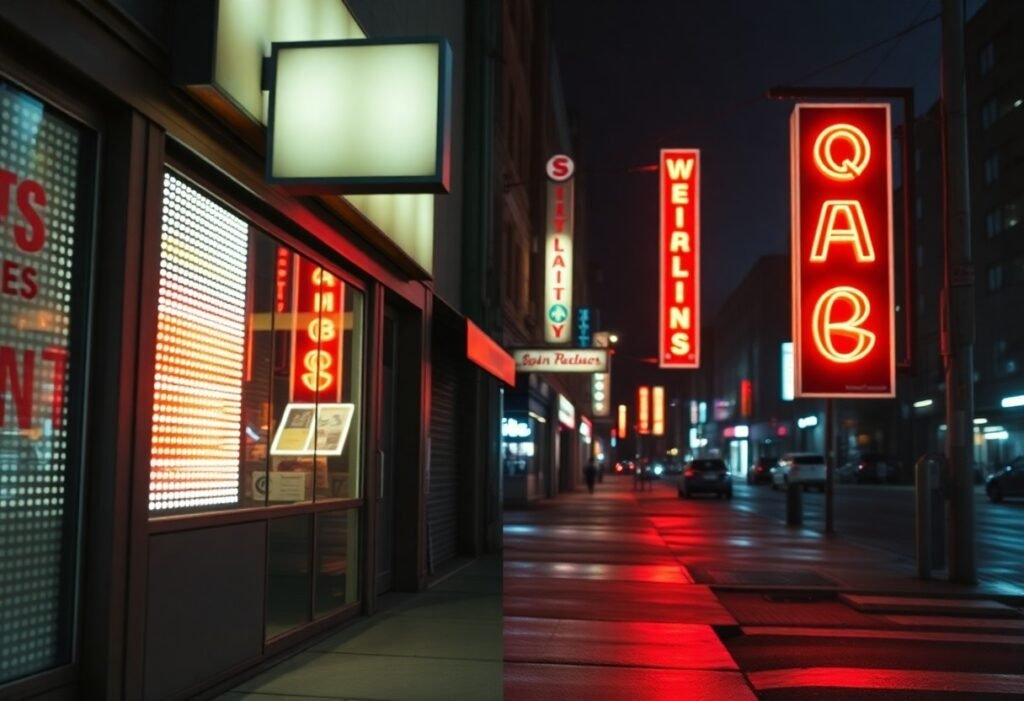
Just because neon carries vintage appeal doesn’t mean it’s superior; you should weigh energy efficiency, durability, maintenance, brightness, and cost when choosing between LED and neon signs. LEDs use far less power, last longer, and offer flexible design and safer operation, while neon gives a warm glow and collectible aesthetic. Assess your budget, display environment, and branding goals to decide which fits your needs.
Key Takeaways:
- Energy & running cost: LEDs use far less power and have much longer lifespans (often 50,000+ hours) than neon, so operating costs are lower.
- Brightness & control: LEDs deliver brighter, more uniform light with easy dimming and color effects; neon offers a softer, continuous glow prized for vintage aesthetics.
- Upfront cost & maintenance: LEDs generally cost less to purchase and maintain; neon requires specialized fabrication and higher repair costs for glass tubes and transformers.
- Durability & safety: LEDs are more rugged and safer (low voltage and solid-state); neon is fragile, high-voltage, and needs careful handling and installation.
- Design fit: Choose LEDs for modern, programmable, energy-conscious signage; choose neon if you want an authentic retro, hand-crafted look despite added expense and upkeep.
Understanding LED Signs
When you look at an LED sign up close, you’re seeing arrays of tiny semiconductor diodes that emit light with minimal heat and very low current draw; typical commercial modules last 50,000-100,000 hours, meaning continuous operation for years before brightness drops noticeably, and you’ll pay far less to run and maintain them compared with older technologies.
Technology Behind LED Signs
Modern LED signs use SMD (e.g., 2835, 5050) or COB chips, constant-current drivers that convert AC to regulated DC, and PWM or current dimming to control brightness; you’ll also find addressable RGB strips for animations, IP-rated housings for outdoor use, and diffusers/composites to create even color and avoid hotspotting.
Advantages of LED Signs
You get significant energy savings (often up to ~80% versus an equivalent neon wattage), instant on/off functionality, full-color gamut and programmable effects, superior cold-weather performance, and reduced maintenance cycles thanks to long lifespans and modular repairability.
In practice, swapping a 100W neon-style fixture for a 20W LED equivalent cuts power draw by roughly 80%, lowering your monthly operating cost proportionally; you’ll also reduce downtime because LEDs rarely need replacement, and the low-voltage design reduces fire risk while simplifying mounting and controls for dynamic campaigns.
Understanding Neon Signs
When you examine neon signage, you see hand-bent glass tubes filled with neon or other noble gases that glow when energized. Neon yields bright reds and oranges, argon with a drop of mercury gives blues, and phosphor coatings expand the palette to pastels and whites. Transformers supply high voltage (typically 1,000-15,000 volts) while current remains in the milliamp range, and skilled glassworkers shape letters and effects that LEDs often struggle to mimic in continuity and warmth.
Technology Behind Neon Signs
How neon works hinges on gas ionization and electrodes: when your transformer applies high voltage, electrons accelerate, ionize the gas, and emit light at characteristic wavelengths. Tubes commonly range from 3/16″ to 1″ diameter, are sealed under low pressure, and rely on ballast or current-limiting transformers to control discharge. Color comes from the gas and coatings rather than pixels, and tube longevity depends heavily on transformer quality and gas purity.
Advantages of Neon Signs
You get unmatched color saturation and a smooth, 360° glow that reads well from multiple angles; neon produces authentic reds and warm ambers without filters. Signwriters favor neon for flowing script, fine-line logos and vintage branding-think diner facades or theater marquees-because it creates a continuous light source rather than discrete points. With routine maintenance, individual tubes commonly last a decade or more.
Beyond aesthetics, neon offers practical benefits you can use: tubes are repairable (broken segments can be reblown or replaced) and custom bending supports complex logos without visible pixelation. For example, a 6-8 foot cursive sign maintains uniform luminosity as a single tube, whereas recreating that effect with LEDs typically requires dense SMD arrays, diffusers and extra labor, raising complexity and cost for an authentic appearance.
Aesthetic Considerations
You’ll weigh clean, modern finishes against handcrafted character: LEDs deliver razor-sharp edges, dynamic color shifts and animation for storefronts and façades, while neon provides a continuous, warm ribbon of light with a tactile, vintage presence that photographs and interiors often favor; designers choose LEDs for versatility and neon for authentic glow, so your decision should match the visual language you want-high-impact, changeable messaging versus artisanal, sculptural ambiance.
Visual Appeal of LED Signs
You get intense control with LEDs: RGB and tunable-white modules offer millions of colors and 2700-6500K temperature range, with pixel-level animation for motion and transitions; brands use LEDs to run time-based promos and dynamic wayfinding that increases visibility after hours, and with typical lifespans of 50,000+ hours your color stays consistent far longer than most legacy lighting.
Visual Appeal of Neon Signs
You interact with a unique aesthetic when choosing neon: hand-bent glass tubes create a seamless, softly diffused line that reads as artisanal and nostalgic, often preferred in bars, boutiques, and gallery installations for its unmistakable warmth and character that LEDs sometimes struggle to replicate.
You should note neon’s customization-different gases and phosphor coatings yield deeply saturated reds, pinks and pastel tones unavailable from basic LED strips, and tube diameter or glass profile gives sculptural depth; with proper upkeep neon can last roughly 10-15 years, but it requires high-voltage transformers (typically in the 3-15 kV range) and occasional servicing, which factors into how your sign will age and perform visually over time.
Durability and Longevity
Compared to fragile glass neon, LED modules resist shock, vibration and moisture better, so your sign survives harsh weather and knocks with less repair. LEDs typically last 50,000-100,000 hours and maintain brightness longer; neon offers a timeless glow but requires more upkeep. For a technical comparison see Neon vs. LED Signs: What’s the Difference?.
Lifespan of LED Signs
Your LED sign commonly reaches 50,000-100,000 hours before output drops to about 70% (L70), equal to roughly 11-22 years at 12 hours/day. Manufacturers publish L70 ratings and warranties (typically 3-10 years); in practice storefront and billboard LEDs often exceed a decade with only occasional power-supply or driver replacement.
Lifespan of Neon Signs
Your neon tubing can glow for 10-15 years under ideal conditions, but real-world life varies: typical service spans 10,000-30,000 hours depending on transformer condition, gas integrity and how often the sign cycles. Expect gradual color shifts and electrode wear that lead to reduced brightness and periodic re-gassing or maintenance.
Environmental stress shortens neon life-moisture, vibration and frequent on/off cycles accelerate electrode erosion and gas leakage. You might replace transformers every 5-10 years in high-use locations, and glass repairs require a specialist; proactive sheltering, proper mounting and routine testing extend service, but overall upkeep tends to be more labor- and cost-intensive than for LEDs.
Energy Efficiency and Cost
You’ll see the biggest operational savings with LEDs: they typically cut energy use by 70-90% compared with neon for similar visual output, translating to far lower monthly bills and less frequent component replacement; for example, a 4×2 ft LED sign drawing ~60 W versus a neon equivalent at ~300 W can save roughly $26/month at $0.15/kWh when run 24/7.
Energy Consumption of LED Signs
You can expect LED signage to draw anywhere from about 10-100 W for small-to-medium signs, with high-brightness outdoor displays rising into the hundreds of watts. Many channel-letter jobs average 2-15 W per linear foot of lit edge, and integrated driver efficiency plus dimming controls let you fine-tune power use and lower operating costs further.
Energy Consumption of Neon Signs
You’ll find neon signs require significantly more power due to high-voltage transformers and continuous gas discharge; typical comparable neon fixtures often draw 150-500 W depending on tube length, color and transformer type, so running costs and heat output rise accordingly.
Beyond raw watts, you should factor transformer losses, aging gas fills and periodic re-fills or tube repairs that increase effective energy use over time; for instance, a 300 W neon running 24/7 uses ~216 kWh/month (~$32.40 at $0.15/kWh) versus ~43.2 kWh/month (~$6.48) for a 60 W LED, and maintenance downtime can further erode neon’s cost-effectiveness.
Environmental Impact
Energy and materials determine long-term footprint; LEDs’ low power draw means your sign emits far less CO2 during operation-typically cutting consumption by 70-90% versus neon-while neon’s high-voltage transformers and heat raise operational emissions. Manufacturing also matters: LED modules use semiconductors and rare-earths, and neon relies on hand-blown glass and inert gases, so your choice shifts impacts from electricity bills to resource extraction and end-of-life handling.
LED Signs and Sustainability
Because you pay for energy over years, LEDs often win on lifecycle emissions: 50,000-100,000 hour lifespans reduce replacements and waste, and lower draw shrinks operational CO2. Many LEDs use aluminum housings that are recyclable, and modular designs let you replace boards instead of entire units. Note that rare-earth mining and e-waste mean you should source recyclable, RoHS-compliant fixtures and use certified electronics recyclers.
Neon Signs and Environmental Concerns
You get handcrafted charm, but neon has drawbacks: glass tubing breaks easily, transformers consume steady power even when dimmed, and some color mixes use argon with trace mercury-typically a few milligrams-making disposal regulated in many jurisdictions. Breakages can release phosphor coatings and contaminate glass, so neon often requires special handling and higher end-of-life costs compared with LED units.
Regulatory and cost realities affect your total impact: in the EU and many US states, mercury-containing tubes are handled as hazardous waste or under WEEE rules, requiring certified recycling and often disposal fees. Small businesses replacing neon frequently face higher removal and transport costs, and reclaimed neon gas or glass has limited market value, reducing salvage returns.
To wrap up
From above, LED signs generally make the better choice today for most applications: you get far greater energy efficiency, lower operating and maintenance costs, longer lifespan, and extensive design flexibility, while neon remains unmatched for authentic vintage glow and artisanal appeal; choose LED if you prioritize cost, durability, and customization, and choose neon if your priority is classic aesthetics or museum-quality authenticity.
FAQ
Q: Which is better overall today: LED signs or neon signs?
A: There is no one-size-fits-all winner; choice depends on priorities. LEDs lead on energy efficiency, lower operating cost, durability, and flexibility for color-changing and animation. Neon retains an unmatched warm, continuous glow and vintage aesthetic that many brands prefer for ambiance or heritage appeal. For high-traffic, long-running commercial use, LEDs are usually the practical pick. For boutique, artisanal, or retro styling where appearance is the priority, neon can still be the better option.
Q: How do LEDs and neon compare on energy use and operating cost?
A: LEDs consume substantially less power than traditional glass neon tubes, so electricity bills are lower and payback on initial investment is faster. LEDs also produce less heat and can be run longer without performance loss. Neon requires high-voltage transformers and typically draws more continuous power, raising operating costs. Installation and long-term energy savings generally make LEDs more economical for 24/7 or large installations.
Q: What about lifespan, maintenance, and durability?
A: LEDs have a long service life measured in tens of thousands of hours and are built from solid-state components that resist vibration and weather. Individual LED modules are easy and inexpensive to replace. Neon tubes are made of hand-formed glass that can break, and they require specialist repair when damaged; performance can also decline over years as electrodes age or gas mixtures change. Neon maintenance and repair costs tend to be higher and require a skilled technician.
Q: Which offers better design options and visual effects?
A: LEDs offer greater design flexibility: almost unlimited colors, RGB or addressable pixels for animations, dimming, and custom shapes using LED neon flex or channel letters. They can be tailored for dynamic signage, color cycling, and timed effects. Neon provides a unique, continuous line of light with soft diffusion and a warm color signature that LEDs imitate but don’t reproduce perfectly. For clean, programmable graphics choose LED; for iconic, glowing script or vintage signage choose neon.
Q: Are there environmental or safety differences to consider?
A: LEDs are generally safer and greener: low-voltage operation, lower heat output, and no fragile glass with potentially hazardous contents. Traditional neon tubes are fragile and some types contain small amounts of mercury or require careful disposal of gases, so end-of-life handling and breakage carry environmental and safety considerations. Both technologies should be installed to code, but for reduced environmental impact and simpler disposal, LEDs are the better option.