
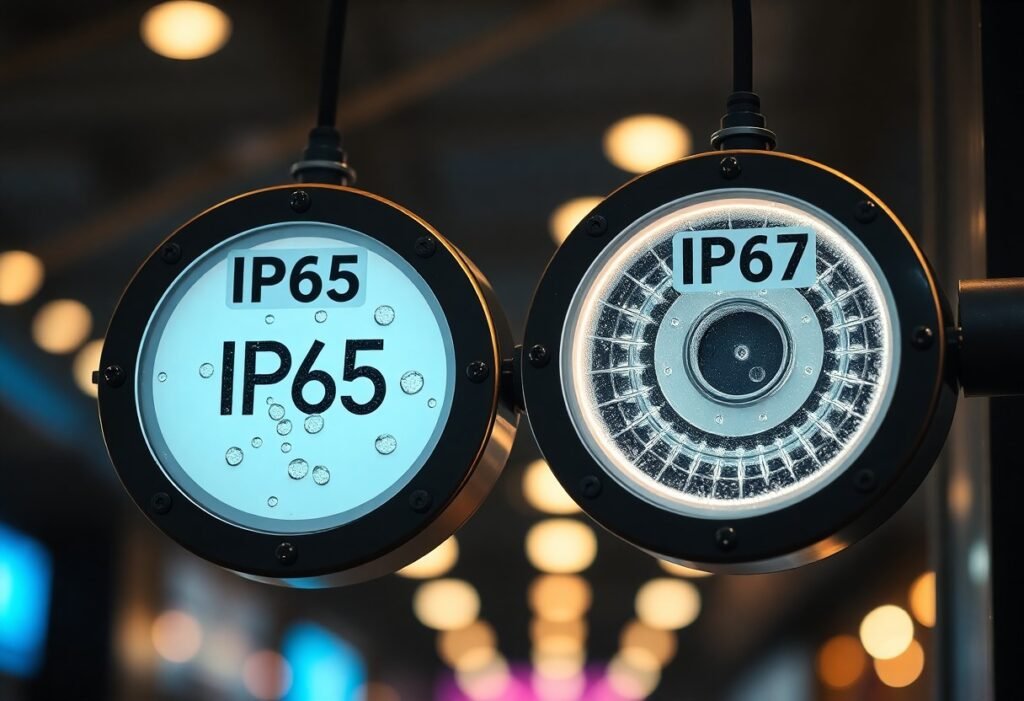
It’s important you understand IP ratings when selecting LED signs: the code (e.g., IP65, IP67) has two digits – the first shows protection against solids (0-6) and the second against liquids (0-9). IP65 means dust‑tight and protected against water jets; IP67 means dust‑tight and protected against temporary immersion to about 1 m. Check the IP rating to match your LED sign to outdoor, washdown, or indoor environments for reliable performance.
Key Takeaways:
- IP stands for Ingress Protection; the first digit (0-6) rates solids (dust), the second digit (0-9K) rates liquids (water).
- IP65 = dust-tight (6) and protected against water jets from any direction (5) – suitable for most outdoor LED signs exposed to rain and splashes.
- IP67 = dust-tight (6) and protected against temporary immersion (7), typically up to 1 m for 30 minutes – used where submersion or heavy washdown is a risk.
- Choose IP65 for standard outdoor exposure; choose IP67 when flooding, immersion, or aggressive washdown is likely-higher IP means more robust sealing and higher cost.
- IP ratings don’t cover UV, impact, corrosion, or electrical safety; inspect enclosure materials, cable entries, and maintenance needs; consider IP69K for high-pressure/steam cleaning environments.
Understanding IP Ratings
Decode the two-digit IP code to assess protection: the first digit (0-6) rates solids – 6 means dust-tight – while the second (0-9K) rates liquids – 7 allows temporary immersion to 1 m for 30 minutes, 9K covers high-pressure, high-temperature washdowns. You should use the IEC 60529 definitions when comparing datasheets to avoid mismatches between marketing claims and tested performance.
What is an IP Rating?
Defined by IEC 60529, an IP rating quantifies enclosure resistance to particles and water using two numerals; for example, IP65 denotes dust-tight (6) and protection from water jets (5), whereas IP67 denotes dust-tight and immersion-safe to 1 m/30 min (7). You’ll also see an X when one of the digits wasn’t tested, and optional letters (e.g., IP66K) for special conditions.
Importance of IP Ratings for LED Signs
When dicking out LED signs you must match IP level to the application: indoor retail can use IP20, street-facing storefronts commonly require IP65 or higher, coastal sites benefit from IP66/67 to resist salt spray, and food or industrial washdown areas demand IP69K. You’ll protect electronics, prevent downtime, and align with warranty terms by specifying the right rating up front.
If you underspec the rating you risk water ingress, corrosion of LEDs and drivers, and voided warranties; installers should verify gasketing, cable glands, and conformal coatings during commissioning. You can also request test reports (IEC 60529) or field-proven case studies – for instance, transit shelter signs specified at IP67 routinely outlast IP54 units in high-exposure sites – to justify the investment.
Breakdown of IP Ratings
The First Digit: Solids Protection
The first digit (0-6) specifies protection against solid objects and dust: 0 = none, 1 = objects >50 mm, 2 = >12.5 mm, 3 = >2.5 mm, 4 = >1.0 mm, 5 = limited dust ingress, 6 = dust-tight. For outdoor LED signs in dusty or sandy environments you’ll typically want a 5 or 6 to prevent particulate buildup that can reduce light output and shorten lifespan.
The Second Digit: Liquids Protection
The second digit (0-9K) rates water resistance: 0 = none, 1-4 cover drips/splashes/spray angles, 5 = water jets, 6 = powerful jets, 7 = immersion to 1 m (usually 30 minutes), 8 = immersion beyond 1 m per manufacturer, and 9K = high‑pressure, high‑temperature wash. IP65 suits rain and light hose-downs, while IP67 protects against temporary submersion.
IPx7 is defined by IEC 60529 as immersion up to 1 m for 30 minutes; IPx8 requires the manufacturer to state depth and duration, so you should verify those specs for long-term underwater exposure. IP69K (from vehicle/industrial standards like ISO 20653) covers high‑pressure, high‑temperature washdowns-useful if your signage faces pressure cleaning in food service, car washes, or heavy‑duty outdoor maintenance. Choose the level based on expected cleaning methods and worst‑case water exposure.
IP65 Explained
When you read IP65 on a LED sign, it means level 6 dust protection (dust-tight) and level 5 water protection (protected against low-pressure water jets from any direction). This makes IP65 suitable for outdoor-facing signs exposed to rain and splashes but not for installations where the unit may be submerged or hit by high-pressure washers; manufacturers commonly specify IP65 for channel letters and illuminated fascias that sit under awnings or open canopies.
Applications of IP65 Rated LED Signs
You’ll find IP65 signs on storefront façades, shopping-mall exteriors, bus shelters, food trucks and stadium perimeter advertising where exposure to rain and street-level spray is expected. Retail chains often choose IP65 for illuminated channel letters and lightboxes because it balances weather protection with cost; typical commercial deployments report multi-year outdoor performance when combined with proper mounting and routine cleaning.
Limitations of IP65 Rated LED Signs
You should avoid IP65 when the sign might be submerged, subject to heavy pressure washing, or exposed to direct sea-spray in marine environments. IP65 resists jets but not immersion-if a location risks flooding or prolonged water contact, you’ll want IP67 (immersion to 1 m for 30 minutes) or IP68 ratings instead; otherwise warranty coverage and long-term reliability can be compromised.
Additionally, you must consider thermal management and ingress via cable glands and connectors: sealing to IP65 can trap heat, which accelerates LED lumen depreciation and may require larger heat sinks or ventilation design. Also check that mounting hardware and escutcheons meet the same IP rating-an IP65 enclosure with unsealed fittings or degraded gaskets will fail in real-world conditions, so inspect seals and service points during installation and maintenance.
IP67 Explained
With an IP67 rating, the “6” means dust-tight protection and the “7” allows temporary immersion up to 1 m for 30 minutes per IEC 60529. You can expect enclosures sealed with O‑rings, welded seams or potting compounds; manufacturers often apply IP67 to the LED module or enclosure, so verify the whole sign assembly, mounting points and cable entries meet the same standard.
Applications of IP67 Rated LED Signs
You’ll see IP67 used for storefront channel letters, fuel station canopies, marina signage and mobile trailer signs where short-term ponding or flash floods occur. Typical scenarios include wall-mounted LEDs exposed to heavy rain, pavement-level displays that may be submerged up to 1 m, and event signs that face unpredictable weather-choose IP67 when temporary immersion is a realistic risk.
Limitations of IP67 Rated LED Signs
Despite immersion resistance, IP67 isn’t certified for continuous submersion beyond 1 m/30 min or for high-pressure, high-temperature washdowns (IP69K). You should also account for weak points: connectors, cable glands and power supplies frequently have lower ratings than the enclosure and are common failure points in the field.
Seals and gaskets age, and salt spray or chemical exposure can induce corrosion even if an enclosure passed IEC 60529 tests; you should specify stainless or marine-grade fasteners, IP-rated connectors and planned re-sealing. Field data often show coastal installations failing in 2-5 years unless materials, drain paths and maintenance plans are upgraded.
Comparison of IP65 and IP67
Directly comparing IP65 and IP67 shows both are dust-tight (6) but differ on liquid protection: IP65 withstands water jets from any direction while IP67 tolerates temporary immersion to 1 m for 30 minutes. You’ll often pick IP65 for elevated outdoor signs exposed to rain and splashes, and IP67 where short submersion or persistent flooding is possible. See IP Ratings Explained: The Mysteries of IP65, IP66, and IP67 for test details.
Quick comparison
| IP65 | IP67 |
|---|---|
| Solids: 6 (dust-tight) | Solids: 6 (dust-tight) |
| Liquids: 5 (water jets from any direction) | Liquids: 7 (immersion up to 1 m for 30 min) |
| Typical use: storefronts, canopy signs, general outdoor exposure | Typical use: low-mounted signs, flood-prone sites, marine splash zones |
Key Differences
You need to focus on the water-test gap: IP65 resists directional water jets, while IP67 allows temporary immersion to 1 m for 30 minutes, so design choices like gasket type and cable entry change. For example, an IP67-rated LED cabinet will use more robust sealing and often higher-cost connectors, making it preferable for signs near docks or at ground level where standing water or short submersion is likely.
Choosing the Right Rating for Your Needs
You should match rating to real exposure: choose IP65 for signs exposed to rain, splashes, and routine outdoor cleaning; opt for IP67 if signs may be submerged or face repeated flooding, coastal spray, or low-level irrigation. Budget accordingly-IP67 enclosures typically cost more due to heavier seals and tighter cable glands.
Consider a short checklist: assess mounting height, local flood history, cleaning method (hose vs wipe), and expected service life, then request IEC 60529 test documentation from suppliers. Also weigh thermal management-tighter seals can raise internal temperature, so confirm driver cooling and warranty terms when upgrading from IP65 to IP67.
Maintenance and Care for IP Rated LED Signs
Routine Maintenance
You should clean lenses with a soft cloth and mild detergent every 3 months, more often in coastal or high-dust sites; inspect seals and cable glands every 6 months and replace silicone gaskets every 2-3 years. Avoid high-pressure washers-use low-pressure rinses compatible with the sign’s IP class-and fit IP-rated (IP68) connectors where possible. After any immersion, dry the housing within 24 hours and run a function check, logging inspections to spot progressive seal degradation.
Conclusion
Hence you should view IP labels as a two-digit code: the first digit rates dust protection (6 = dust-tight) and the second rates water resistance (5 = water jets; 7 = temporary immersion up to 1 m). For LED signs, IP65 suits exposure to rain and jets, while IP67 adds immersion protection for very wet locations. Match the rating to your installation to ensure longevity and reliable operation.
FAQ
Q: What does an IP rating mean for LED signs?
A: IP stands for Ingress Protection and is defined by the IEC 60529 standard. The rating has two digits: the first (0-6) indicates protection against solid objects and dust (6 = dust-tight), and the second (0-9K) indicates protection against water (e.g., 5 = water jets, 7 = temporary immersion, 9K = high-pressure, high-temperature wash). For LED signs, the IP rating tells you how well the enclosure prevents dust, moisture, and water from reaching internal electronics and LEDs.
Q: What do labels like IP65 and IP67 specifically mean for an LED sign?
A: IP65 means the sign is completely dust-tight (6) and protected against low-pressure water jets from any direction (5) – suitable for rain and splashes but not immersion. IP67 means dust-tight (6) and protected against temporary immersion in water up to 1 meter for 30 minutes (7). Practically, IP67 offers higher water resistance than IP65 and better protection against puddles, brief submersion, or deeper exposure during flooding, whereas IP65 handles routine outdoor weather and cleaning with low-pressure jets.
Q: Which rating should I choose for an outdoor LED sign: IP65 or IP67?
A: Choose based on the installation environment. Pick IP65 for signs exposed to dust, rain, and occasional low-pressure cleaning in elevated or sheltered locations. Choose IP67 if the sign may sit low where water can pool, face occasional submersion, be installed near splash zones, or encounter heavy seasonal flooding. Also consider coastal salt spray and frequent high-pressure washing-if those apply, you may need IP67 or additional corrosion-resistant materials and IP69K if high-pressure hot washes are used.
Q: Besides the IP number, what other enclosure details affect LED sign durability?
A: Seals and gaskets quality, proper cable glands and connector seals, vents or pressure-equalization membranes, thermal management (heat dissipation), UV-resistant housings, and corrosion-resistant finishes all matter. Manufacturing quality, assembly torque on fasteners, and how access panels are sealed after servicing influence real-world performance. Verify that wiring entries, mounting points, and any display seams are designed to maintain the declared IP level.
Q: How are IP ratings tested and how reliable are they for predicting real-world performance?
A: IP ratings are determined by standardized lab tests (IEC 60529) – dust chambers for solids and controlled water jets, sprays, immersion for liquids. Tests specify duration, pressure, and distances. Lab conditions can differ from field conditions: mechanical impacts, aging seals, UV degradation, chemical exposure, and installation errors can reduce protection over time. Request manufacturer test reports or third-party certification, inspect seals periodically, and follow recommended cleaning and maintenance to preserve the rated protection.