
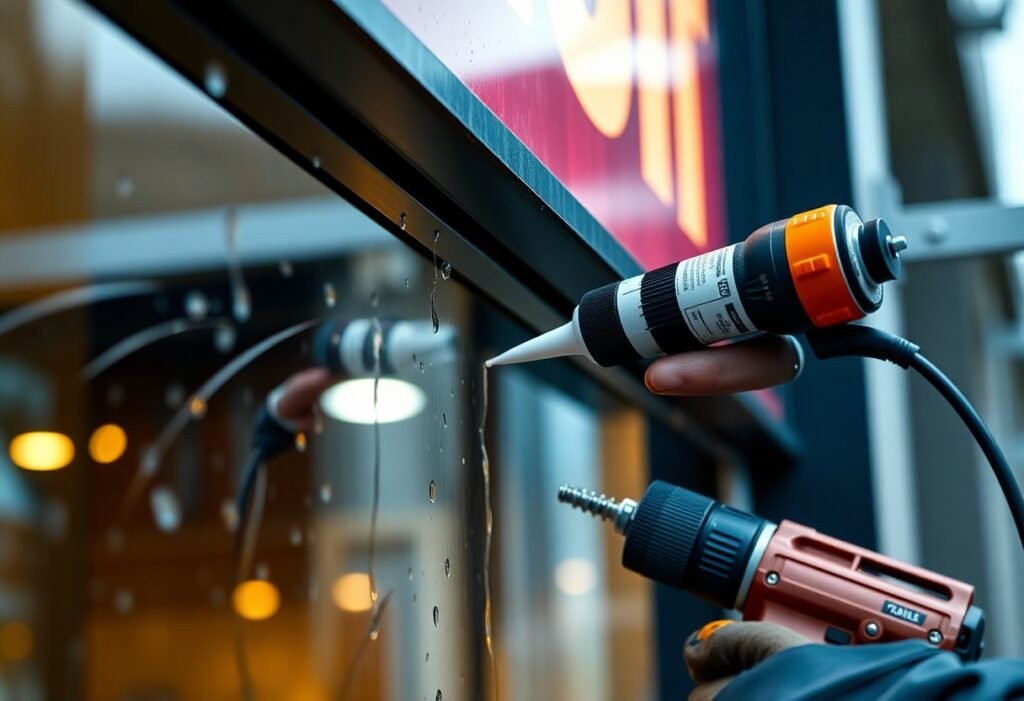
You can protect your storefront signs from weather by selecting durable materials like aluminum or UV-stable acrylic, applying powder coatings and clear UV sealants, sealing seams and fasteners with silicone, using marine-grade hardware and drainage-friendly mounting, adding protective overhangs or covers, and scheduling regular inspections and maintenance to repair corrosion, fading, or water intrusion promptly.
Key Takeaways:
- Choose weather-resistant materials-powder-coated aluminum, acrylic, polycarbonate, PVC foam, or marine-grade stainless steel for frames and faces.
- Protect finishes with UV-resistant paints/coatings, powder coating, or anti-graffiti film to prevent fading and surface damage.
- Seal seams, edges and joints with silicone or polyurethane sealants and use gasketed housings plus corrosion-resistant fasteners to stop water ingress.
- Use outdoor-rated electrical components and lighting (IP65+ enclosures, sealed LED modules, weatherproof conduit and GFCI protection).
- Design for drainage and access-slope faces, provide ventilation, add awnings or shelters where possible, and schedule routine inspections and maintenance.
Understanding the Importance of Weatherproofing
When you leave storefront signs exposed to sun, rain, wind and salt, their lifespan and performance drop quickly: UV can fade pigments within 1-3 years depending on coatings, moisture corrodes non-marine fasteners in months in coastal areas, and wind gusts above 50-70 mph can deform unsupported faces. You reduce replacement cycles and avoid outages by addressing these failure modes with targeted materials and detailing.
Impact of Weather on Storefront Signs
You’ll see vinyl lift after freeze-thaw cycles and LED strips dim when seals fail; specify IP65 or higher fixtures to prevent water ingress and short circuits. In seaside locations you should use 316 marine-grade stainless fasteners, powder-coated mounts, and corrosion-resistant anchors to resist salt spray and galvanic attack that otherwise shorten service life.
Benefits of Weatherproofing Techniques
You gain longer service life, steadier brand appearance, and lower maintenance: powder-coated aluminum and 316 stainless often last 10-20 years outdoors, UV-stable inks and clear coats slow fading, and proper sealing prevents electrical failures that typically cause emergency replacements and lost sales.
When you specify UV-resistant clear coats, silicone gaskets, drainage holes, elevated mounting, and IP-rated drivers, you target main failure modes: gaskets block moisture, drainage prevents standing water, and IP65+ LED modules survive heavy spray or brief immersion. After making these changes, some multi-site retailers report cutting sign-related service calls by over 50%, lowering maintenance spend and minimizing downtime from dark or damaged signage.
Materials for Weatherproof Signage
Materials determine how long your sign survives wind, sun and moisture; aluminum composite panels (3-6 mm) resist rust and flex, while acrylic offers vivid graphics but needs UV protection to avoid yellowing. You can opt for HDU or marine-grade plywood sealed with epoxy for carved textures. For practical waterproofing steps, see How to Make an Outdoor Sign Waterproof?
Durable Materials to Consider
Aluminum and aluminum composite like Dibond or Alucobond give lightweight, rigid faces that won’t corrode; HDU (high-density urethane) resists rot and holds routed detail for years; PVC and polycarbonate work for budget panels, and stainless steel or powder-coated metal are best for structural brackets and posts you want to last decades in coastal conditions.
Weather-Resistant Coatings and Treatments
Use powder coating or anodizing on metal to prevent corrosion and UV fade, and apply two-part marine polyurethane or acrylic clearcoats over printed faces for abrasion and salt-spray resistance; anti-graffiti films and UV-stable UV-curable inks help graphics last under strong sunlight.
Proper application matters: you should prep surfaces (clean, sand, primer), apply coatings per manufacturer cure times, and consider powder-coating ovens or professional anodizing for metals. Plan routine maintenance-inspect seals and recoat clear layers every 3-5 years in high UV or coastal environments-to extend service life.
Installation Techniques for Weatherproofing
You should combine robust anchoring, weather seals, and drainage to lock out moisture and resist wind; aim for an IP65 enclosure rating for illuminated units, slope faces at 5-10° to shed water, and provide 1/8-1/4″ weep gaps where condensation can escape. Use compatible materials-stainless fasteners, powder-coated mounts-and verify local wind-load requirements (e.g., 90-140 mph zones) with your engineer for signs over 16 sq ft or in coastal areas.
Best Practices for Mounting Signs
You should select stainless-steel (316 for coastal) fasteners and match anchors to substrate: sleeve or wedge anchors for concrete, toggle bolts for hollow walls, and masonry anchors with backing plates for brick. Space mounts roughly 24-36 inches for panel signs; increase points for spans over 4 ft or weights above 50 lb. Distribute load with a steel backing plate and torque fasteners to manufacturer specs, then retest pullout strength after installation.
Sealing and Securing Your Sign
You should seal all penetrations with UV-stable silicone or polyurethane sealant and use closed-cell foam gaskets at flanges; combine 3M VHB tape with mechanical fasteners for hidden mounts, and pot LED drivers with silicone potting compound or epoxy to prevent salt and moisture ingress. Fit cable glands on conduit entries, grease connectors with dielectric fluid, and place desiccant packs inside the enclosure to control humidity.
For best results, prep surfaces with 70%+ isopropyl alcohol, apply primer when required (per sealant datasheet), and lay a 3-5 mm continuous sealant bead tooling it to a concave finish at a 45° angle. Allow silicone to cure 24-48 hours (polyurethane may need 72 hours), leave small drainage/weep points at low edges, and verify IP rating with a post-installation water spray test to confirm seals hold under real conditions.
Maintenance Tips for Weatherproof Signs
Routine upkeep keeps weatherproof signs functional and extends service life: schedule quarterly inspections, address salt buildup after storms, and log all work. Use pH-neutral cleaners and soft brushes to avoid coating damage, and tighten mounting hardware after high winds or every 12 months. Replace sealant on exposed joints every 3-5 years depending on UV exposure. Any maintenance program should include a written log with dates and photos.
- Inspect fasteners and mounts every 3 months; re-check after winds over 40-50 mph.
- Clean face and frames monthly in coastal zones, quarterly inland; rinse salt within 48 hours after storms.
- Reseal seams and gaskets every 3-5 years or when gaps appear.
- Test illumination and wiring monthly; disconnect power before servicing electrical parts.
- Replace corroded hardware with marine-grade 316 stainless steel and touch up powder-coat chips within weeks.
Regular Inspections and Cleanings
Schedule visual inspections every three months and increase to monthly in salt-air or industrial environments; you should look for loose fasteners, softened gaskets, and blistering paint. Use a soft brush and pH-neutral detergent for routine cleaning, and apply low-pressure rinses (below ~1,200 psi) to avoid delaminating vinyl or acrylic. Photograph issues and note their location so you can track recurring problem spots.
Repairing Damage Promptly
Address surface damage within days to prevent water ingress and corrosion: you should patch torn vinyl, touch up exposed metal, and reapply silicone or polyurethane sealant where beads have failed. For illuminated signs, always disconnect the circuit before repairs. Small repairs often cost under a few hundred dollars, while delayed fixes can lead to frame replacement or electrical failure.
When damage occurs, triage by severity: document with photos, secure loose panels temporarily with stainless fasteners or straps, and replace compromised seals within 48-72 hours to stop moisture tracking. You should keep a basic repair kit-sealant, spare fasteners, adhesive patches-and schedule professional structural or electrical repairs if mounts are bent, water has reached drivers/transformers, or corrosion has advanced beyond surface pitting.
Case Studies: Successful Weatherproofed Storefronts
These case studies show how targeted material choices, mounting engineering, and maintenance schedules produce measurable improvements in durability, downtime, and long‑term cost; you’ll see exact wind ratings, lifespan projections, and ROI figures that inform your own sign strategy.
- 1) Coastal café, Portland ME (2019): powder‑coated aluminum channel letters on 3 mm ACP, 316 stainless anchors, engineered to 120 mph wind load; installation $4,200, annual inspection, projected lifespan 12+ years, replacement cost cut 58% vs prior PVC letters.
- 2) Downtown retailer, Chicago IL (2021): LED‑illuminated acrylic face with polycarbonate lens, sealed enclosure with desiccant vents, bracket rated for 50 psf wind pressure; retrofit cost $6,800, LED retrofit reduced energy use by 65%, expected service life 8-10 years.
- 3) Mall storefront, Miami FL (2018): PVC foam with anti‑UV coating and internal drainage channels, 316 hardware; survived Hurricane Irma with minor repairs, upgrade cost $12,000, insurer premium lowered 22% after documentation of hardened installation.
- 4) Regional bank, Houston TX (2020): polycarbonate façade, thermal breaks, rapid‑drain mounting system tested to 140 mph; cost $9,500, anchor inspections after storms reduced water intrusion incidents by 90%, uptime improved 0.5% annually.
- 5) Mountain lodge, Aspen CO (2017): CNC HDU with acrylic enamel and heated sign box to prevent ice buildup; initial $7,000, winter uptime 98% across 5 seasons, effective life extended to 10+ years vs 4-6 for untreated wood signs.
Examples from Different Businesses
Across cafes, big‑box retailers, malls, banks and lodges, you’ll notice choices differ by exposure: coastal sites favor 316 stainless and 120+ mph engineering, urban retailers prioritize sealed LED modules for heat and condensation control, and cold‑climate businesses add heat or drainage to prevent ice and snow damage.
Lessons Learned from Each Case
You should match materials and mounting to local hazards, invest 10-30% more up‑front for weather‑rated components, schedule inspections annually (or after major events), and document specifications to claim insurer discounts and extend service life.
For practical application, you can adopt these rules: reapply exterior sealants every 3-5 years, inspect anchors and flashings after any 80+ mph storm, budget for a 10-15% contingency for unexpected water mitigation, and run a simple payback analysis-many projects recover added cost in 3-7 years via reduced replacements, lower energy use, and insurance savings.
To wrap up
Conclusively, you can weatherproof your storefront signs by choosing durable materials (aluminum, acrylic, marine-grade PVC), applying UV-resistant coatings and silicone sealants, ensuring proper drainage and sealed edges, using stainless-steel hardware and vibration-resistant mounts, and protecting electrical components with rated enclosures and conduit. Schedule periodic inspections and cleanings so you catch wear early and extend your sign’s appearance and performance.
FAQ
Q: What materials and finishes resist weathering best for storefront signs?
A: Use corrosion-resistant metals (aluminum, stainless steel) with powder-coat or marine-grade finishes, UV-stabilized acrylic or polycarbonate for faces, and high-density polyethylene or composite backers for moisture resistance. Choose UV-resistant inks and laminates for printed graphics and edge-sealed substrates to prevent delamination. Specify stainless or coated fasteners and hardware to limit rust, and select paint and coatings rated for exterior exposure and salt air if located near the coast.
Q: How should signs be sealed and mounted to prevent water ingress and damage?
A: Create a waterproof envelope by using continuous gaskets, marine-grade silicone, or butyl tape at joints and around mounting points. Install drainage channels or weep holes in enclosed sign housings to avoid trapped water. Mount signs on standoffs or rails that allow airflow behind the sign and keep the bottom edge slightly raised to shed water. Use sealed cable entries and conduit for electrical runs and apply rust-resistant anchors matched to the wall substrate to prevent loosening from freeze/thaw cycles.
Q: What protections are needed for illuminated signs and electrical components?
A: Specify LED modules, drivers, and transformers with appropriate IP ratings (IP65 or higher for wet locations). House electrical components in rated, ventilated enclosures to prevent condensation; include desiccant packs or breathable vents to manage moisture. Install surge protection and GFCI where required, and route wiring through weatherproof conduit with sealed fittings. Position power supplies away from direct exposure and ensure easy access for maintenance without breaking seals.
Q: What routine maintenance keeps storefront signs weatherproof over time?
A: Implement a maintenance schedule: monthly visual checks for loose fasteners, sealant failure, or moisture entry; quarterly cleaning with mild detergent and soft cloths (avoid abrasive cleaners or high-pressure washing that can strip seals); and annual inspections for corrosion, fading, or electrical issues. Reapply sealants and touch-up coatings as needed, replace worn gaskets, and swap degraded lighting components before they fail to prevent water damage inside the cabinet.
Q: How should signs be designed for wind, snow, and extreme seasonal conditions?
A: Have designs verified for local wind loads and snow/ice accumulation; use reinforced frames, cross-bracing, and appropriately sized anchors. Add sloped tops or drip edges to shed snow and prevent pooling, and consider vented or perforated faces in very high-wind areas to reduce sail effect. For regions with severe storms, use quick-disconnect mounts or removable sign sections where practical, and plan seasonal inspections and temporary removal if a major storm or heavy icing is forecast.