
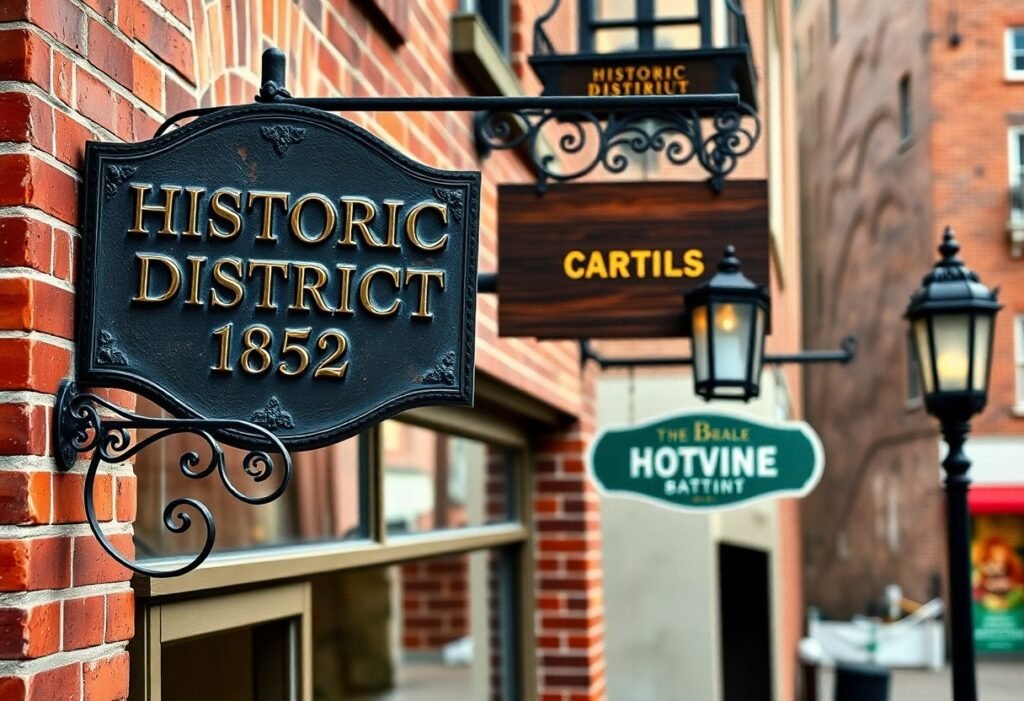
Many historic districts enforce design, size, material, color, illumination, placement and content standards that differ from standard zoning, so you must secure approvals and sometimes permits from preservation commissions before installing signage. Your signs are often limited to traditional materials, muted palettes, smaller dimensions, and restrictions on digital displays or neon; understanding local guidelines and review procedures helps you avoid violations and preserve the district’s character.
Key Takeaways:
- Design, materials, colors and fonts are regulated to match the district’s historic character; modern materials and styles may be restricted.
- Size, placement and mounting are more strictly controlled-limits on sign area, projection, setback and attachment methods protect historic facades.
- Illumination is limited; internally lit boxes, bright LEDs or neon are often prohibited in favor of low‑profile or indirect lighting.
- Most signs require review and formal approval (e.g., Certificate of Appropriateness) from a preservation commission or local review board.
- Temporary, promotional and political signs face tighter time, size and placement limits, and alterations must typically be reversible to preserve original fabric.
Understanding Historic District Signage
When you plan signage inside a historic district you’ll encounter rules that go beyond standard zoning: ordinances often cap sign area (commonly 4-12 sq ft), limit projections to about 4 ft, require mounting heights between 8-12 ft, and restrict illumination to steady, warm lighting. You’ll submit drawings and material samples to a preservation commission or design-review board, which typically takes 30-60 days to review applications and may require revisions to match the district’s architectural rhythm.
Definition of Historic District Signage
Historic district signage refers to any exterior identification-blade/projecting signs, painted wall signs, awning graphics, window lettering or plaques-subject to design review because it affects the district’s visual character. You’ll find rules focus on materials (painted wood, metal, canvas awnings), typefaces that echo period styles, mounting methods that avoid damaging masonry, and limits on size, color and illumination set by local ordinances and the reviewing commission.
Importance of Historic District Designations
You benefit from designation because rules preserve the cohesive streetscape that attracts visitors, supports local businesses, and stabilizes property values; commissions that oversee these districts usually consist of 5-9 members with architectural expertise to enforce consistency and heritage standards. You’ll also find that consistent signage contributes to wayfinding and a stronger sense of place that boosts pedestrian traffic.
In addition, designation unlocks tangible incentives you can use: the federal Historic Rehabilitation Tax Credit provides a 20% credit for certified rehabilitation of income-producing historic buildings, and many local programs offer matching grants, technical assistance, or expedited permitting when your signage and storefront work follow preservation guidelines.
Differences from Standard Signage
You’ll face tighter review, size and placement limits in historic districts: many jurisdictions restrict wall signs to roughly 6-12 sq ft and freestanding signs to 16-32 sq ft, require review by a historic preservation commission, and prohibit internally illuminated plastic cabinets. Your sign permit often requires elevation drawings, material samples and a clear statement of mounting method, and approvals can add 4-8 weeks compared with standard commercial sign permits.
Aesthetic Requirements
Design expectations favor period-appropriate typography, restrained color palettes (commonly 2-3 colors), and hand-crafted finishes; you’ll see serif or script fonts in Victorian areas and stenciled block lettering in early-20th-century commercial cores. Commissions typically ask that graphics, size and placement respect the building’s architectural rhythm-for example, aligning signs with cornices or storefront transoms-and discourage modern logos that dominate historic facades.
Material and Design Restrictions
Accepted materials are usually traditional-painted wood, bronze, cast iron, or porcelain enamel-and prohibited items frequently include backlit plastic, neon tubing, and vinyl banners; mounting hardware is expected to be concealed or historically sympathetic. Projection and clearance rules are common too, with many districts limiting sign projection to about 3-4 feet and requiring minimum sidewalk clearance to preserve sightlines and pedestrian access.
Approval often hinges on construction details: you’ll be asked to submit sections showing fasteners, paint systems and aging treatments, and some boards require physical samples or mock-ups. Maintenance expectations are strict-commissions prefer breathable paints, rust-inhibiting finishes on metals and periodic repainting schedules-so factor ongoing upkeep and repair methods into your budget and timeline.
Regulatory Framework
You work within layered regulation: federal incentives like the Historic Rehabilitation Tax Credit tie you to the Secretary of the Interior’s Standards, states add program-specific rules, and local historic district codes control sign size, placement, materials, and illumination. Many municipalities impose review windows of 30-60 days and require Certificates of Appropriateness or similar permits before installation.
Local Ordinances and Guidelines
You’ll find municipal codes that specify measurable limits-typical sign area caps run about 10-20% of a storefront face, projection limits often near 3 feet, and illumination restricted to low-glare or shielded fixtures. Cities such as Charleston, Savannah, and Boston publish illustrated palettes and material lists that you must match when proposing new signage.
Review and Approval Processes
You generally must apply for a Certificate of Appropriateness (COA) or equivalent permit, submit drawings and photos, and undergo staff review followed by a historic preservation commission hearing for contested cases. Timelines commonly span 30-60 days and administrative fees typically range from $50 to $500 depending on jurisdiction and project complexity.
You should expect documentation requirements beyond basic drawings: elevation plans at scale, material samples or swatches, mounting and lighting details, and context photos. For example, many commissions demand sash-by-sash photos and full-façade elevations, and divergent proposals often trigger public notices and variance procedures. Hiring a local preservation consultant or architect can reduce revision cycles and shorten total approval time by weeks in practice.
Signage Size and Placement
You’ll find strict limits on sign area and mounting height: many historic districts cap wall signs at 8-12 sq ft and projecting signs at about 4 sq ft, with the bottom of projecting signs typically 7-10 ft above the sidewalk to clear pedestrians. You must also avoid covering cornices, window lintels or historic trim; consult the local guide for measured examples and diagrams: Sign Guidelines | Annapolis Historic District.
Height and Width Regulations
Your sign’s area is often limited either by absolute square footage (commonly 4-12 sq ft) or as a percentage of the storefront-frequently no more than 10% of the facade. Width limits can restrict projecting signs to extend no more than 3-4 ft from the building face, and top-of-sign placement is usually required below the second-floor sill or cornice to preserve sightlines and historic proportions.
Location Restrictions
You may only place signage on primary storefronts or approved secondary elevations; rooftop signs, signs overhanging historic cornices, and signage on upper-story windows are typically prohibited. Awnings can carry discreet graphics but full-wall murals or backlit cabinet signs are usually disallowed to protect material authenticity.
In practice, you’ll find micro-rules: sidewalk or A-frame signs are often limited to 3-4 sq ft, must sit flush with the building edge, and are allowed only during business hours. Permit reviewers commonly require scaled drawings showing exact mounting distances from trim, clearance over sidewalks, and how the sign aligns with neighboring signs-prepare measured elevations to speed approval.
Types of Signage Allowed
You’ll encounter a narrow palette of permitted signs-directional, interpretive, informational, business/commercial and temporary-with strict limits on size, placement and materials. Many commissions cap individual sign faces between 4-32 sq ft, favor wood or metal, and require mounting that preserves masonry or original storefront frames; about 70-80% of districts also forbid internally illuminated cabinets, pushing you toward gooseneck or halo lighting.
- Directional (wayfinding and traffic-related)
- Interpretive (historic panels, plaques, exhibit labels)
- Informational (hours, building IDs, accessibility)
- Business/Commercial (wall, projecting, awning signage)
- Thou, must follow temporary/event rules-limited durations and discrete placement
| Wall signs | Typically 6-32 sq ft; painted, pin-mounted, or routed wood |
| Projecting signs | Commonly 4-8 sq ft; max 8 ft above sidewalk; bracket preservation required |
| Freestanding/monument | Often capped at 20-32 sq ft; low-profile bases to protect sightlines |
| Plaques & interpretive | Typical sizes 12×18-24×36 in; bronze, cast aluminum, enamel |
| Temporary/event | Often limited to 14-90 days per year; non-illuminated, lightweight materials |
Informational Signs
You’ll use informational signs for hours, addresses, and ADA notices; commissions often allow small metal or enamel plaques (12×18 in common) and discrete vinyl on glass for hours. When you submit, include scaled dimensions and mounting details-many boards require proof that fasteners won’t damage historic fabric and that lettering height remains readable at 20-30 feet.
Business and Commercial Signs
You can usually have one primary wall sign plus one projecting sign per storefront, with common area caps of 6-32 sq ft and projecting signs limited to 4-8 sq ft; internally lit cabinets are typically prohibited, so you’ll specify gooseneck, concealed LED, or halo illumination and use wood, painted metal, or hand-lettering to match period character.
Review panels focus on placement, proportion and materials: submit elevations, photographs, and mock-ups showing your sign relative to cornices and transoms. Typical approval timelines run 2-6 weeks; a practical example – a 1920s storefront restored with a 4 sq ft hand-painted oak bracket sign and antique iron bracket secured approval after a single HDC meeting when you demonstrated reversible mounting and matching finish.
Enforcement and Compliance
Agencies enforce signage rules through permits, design review, stop‑work orders and civil fines, so you should treat approvals as part of the project timeline. The federal 20% Historic Rehabilitation Tax Credit can be jeopardized if signage conflicts with Secretary of the Interior standards. Local bodies commonly issue daily fines (often $100-$500/day), require removal or restoration at your expense, and may place liens or revoke permits; appeals exist but successful mitigation usually means correcting work quickly and documenting compliance.
Consequences of Non-Compliance
If you install a non‑conforming sign, expect stop‑work orders, mandated removal, and fines that can accumulate into thousands of dollars; you may also forfeit eligibility for the 20% federal rehabilitation credit. Agencies often require proof of restoration and can record liens for unpaid orders. In many districts unresolved violations delay future permits, so prompt remedial action and coordinated appeals with a clear corrective plan typically reduce overall costs and legal exposure.
Best Practices for Signage in Historic Districts
Use historically sympathetic materials-painted wood, hand‑finished metal, and forged brackets-and prefer indirect lighting such as shielded gooseneck fixtures. Keep sign area proportional (many districts limit signs to roughly 6-20 sq ft depending on storefront width), choose period‑appropriate fonts, and mount with reversible attachments to avoid damaging original masonry. Submit scaled mockups to the design review board and engage a preservation‑experienced sign fabricator to streamline approval.
Measure allowed sign area against your storefront width or the district’s percentage cap and prepare full‑size templates and nighttime lighting mockups to aid review; many boards target 30-60 day reviews, so plan accordingly. Budget roughly $500-$2,500 for traditional painted signs and $800-$3,000 for custom iron brackets, and prefer mounting into mortar joints or using removable saddle brackets to preserve historic fabric and speed permit clearance.
Conclusion
Ultimately you need to follow stricter historic-district signage rules than in standard areas: design, materials, size, color, lighting, placement and mounting are regulated to protect character; permits and design-review approvals are required; modern materials and LED illumination are often limited; maintenance and reversibility standards apply. By engaging early with preservation review and matching context, your sign complies while supporting the district’s integrity.
FAQ
Q: What legal framework and review process applies to signage in historic districts compared to standard areas?
A: Historic districts are typically subject to local historic preservation ordinances, design guidelines, and reviews by a historic preservation commission or architectural review board, in addition to standard zoning and sign codes. Applications for new or altered signs usually require a certificate of appropriateness (COA) or similar approval demonstrating compatibility with the district’s period, streetscape, and building features. Public notice and a formal hearing may be required; decisions can be based on historical significance, visual impact, and cumulative effects on the district’s character rather than just compliance with size or setback rules used in non‑historic zones.
Q: How do size, placement, and scale restrictions differ in historic districts?
A: Historic districts emphasize proportionality to the building and streetscape, so allowable sign area, height, and projection are often more restrictive. Signage must not overwhelm architectural features, cover historic materials, or extend above cornices or parapets unless historically appropriate. Restrictions commonly limit projecting signs, require mounting within existing sign bands, and control placement relative to window bays, door surrounds, and transoms. Where standard areas permit larger or freestanding signs, historic districts favor smaller, lower‑profile, and context‑sensitive solutions to preserve sightlines and rhythm of facades.
Q: What materials, colors, and design requirements are enforced in historic districts?
A: Materials and finishes are regulated to match or complement historic fabric; traditional materials like painted wood, carved stone, metal, and hand‑painted or individual mounted letters are often preferred over large plastic panels, vinyl, or backlit acrylic. Color palettes are usually guided by period‑appropriate schemes and may reference historical paint charts. Sign mounting methods must avoid damage to historic masonry or trim (e.g., through straps or existing anchors rather than new penetrations). Sign design is evaluated for craftsmanship, typography, and whether it maintains or restores historic signage patterns rather than introducing contemporary branding that clashes with the district character.
Q: Are illuminated and digital signs treated differently in historic districts?
A: Yes. Historic districts commonly limit the type, intensity, and placement of illumination. Externally illuminated signs with shielded fixtures are often preferred; internally illuminated box signs and neon are frequently restricted or prohibited unless historically justified. Electronic message centers, LED video displays, and rapidly changing digital signs are generally discouraged because they alter the historic nightscape, create visual clutter, and can distract from architectural features. Lighting controls, warm color temperatures, and stationary illumination are typical mitigation measures when some illumination is allowed.
Q: What are the permitting, enforcement, and temporary sign rules that differ from standard areas?
A: Permit processes in historic districts include additional review steps and may take longer; applicants should expect to submit detailed drawings, material samples, mounting details, and photos. Enforcement is often handled by preservation staff or a commission with authority to require removal or modification of non‑conforming signs, and penalties can include fines, stop‑work orders, or orders to restore damaged historic fabric. Temporary signs and banners are more tightly controlled-limits on duration, size, and location are common, and some districts ban vinyl banners on facades. For adaptive reuse projects, signage may be allowed to reference historical identity (e.g., replica blade signs or plaques) but still must receive prior approval to ensure compatibility.