
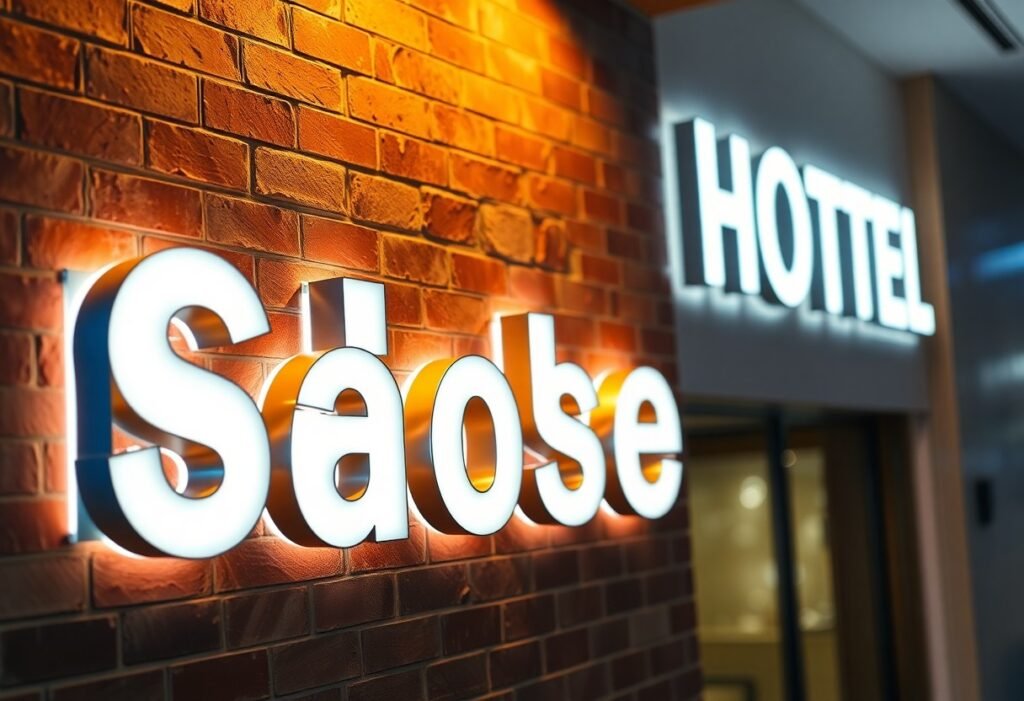
You find halo lit signs are backlit channel letters or panels where LEDs shine from behind, creating a soft, even glow that makes your branding float off the wall; you choose them for upscale retail, hospitality, corporate entrances, heritage facades or any application where subtle architectural illumination, night visibility and a premium aesthetic matter.
Key Takeaways:
- Halo-lit signs are channel letters or logos mounted slightly off the wall with LEDs that cast light onto the background, producing a soft backlit “halo” effect.
- Best for storefronts, hotel lobbies, restaurants, and premium retail where a modern, upscale appearance and strong night legibility are desired.
- Provide excellent nighttime contrast and visual depth; the halo effect is most effective on solid, opaque, or uniform architectural surfaces.
- Design and installation need adequate setback, appropriate wall finish, quality LED modules, and weatherproofing to control halo size and longevity.
- Not ideal for glass, translucent backers, or highly textured surfaces; consider front-lit letters or illuminated panels as alternatives in those situations.
What are Halo Lit Signs?
Definition and Features
You see halo lit signs as channel letters set off the wall so LEDs create a luminous outline; typical depths run 2-6 inches and LED modules deliver roughly 30-150 lumens per foot. Materials commonly include aluminum returns and 3-6 mm acrylic backs, with powder-coat finishes for weather resistance. You can select color temperatures from 2700K to 6500K and diffuse lenses to soften the glow.
- High contrast readability at night and effective brand presence during the day.
- Energy efficient: many systems use 5-15 W per letter foot, lowering operating costs.
- You benefit from long LED lifespans (50,000+ hours) and simple driver replacements.
- Thou can tailor fonts, sizes, and finishes to match building architecture and identity.
Types of Halo Lit Signs
You’ll encounter three primary builds: reverse/backlit channel letters that cast a halo onto the wall, front-face halo letters combining a translucent face with rear glow, and thin edge-lit halo panels using edge-lit acrylic. Typical letter heights range from 12 to 72 inches, and applications span storefronts, malls, and wayfinding; manufacturers often offer single-color or RGB LED options for dynamic effects.
| Reverse / Backlit | Letters set 1-3 in off wall, depth 2-6 in, produces crisp halo on materials like stone or glass; ideal for heritage façades. |
| Front-face with Halo | Translucent face plus rear gap, best for close-view retail; common color temps 2700K-5000K for brand warmth or neutrality. |
| Edge-lit Halo | Thin profiles using edge-lit acrylic, depths 1-3 in, suited to minimalist modern signage where low profile matters. |
| Materials & Specs | Aluminum returns, 3-6 mm acrylic backs, IP65 exterior ratings, typical LED drivers 24-48 V for safety and serviceability. |
| Performance & ROI | LEDs 50,000-100,000 hrs, drivers often 5-7 years; payback commonly 12-24 months versus neon when factoring energy and maintenance. |
When choosing a type, you should weigh viewing distance, mounting surface, and local sign codes: reverse halo preserves masonry on heritage buildings, front-face halo delivers superior legibility at close range for retail, and edge-lit is best for sleek interior branding; specify CRI >80 for accurate logo colors and plan for accessible driver compartments to simplify service.
- Match depth and gap to wall texture to preserve halo definition on rough surfaces.
- Specify 3000K for warm brand tones or 4000K for neutral, widely legible illumination.
- You can reduce downtime by choosing replaceable LED modules and accessible drivers.
- Thou should schedule annual inspections and cleaning to sustain halo clarity and light output.
Benefits of Halo Lit Signs
You get a high-impact combination of visibility, brand refinement and low operating cost: halo-lit letters enhance night legibility while preserving wall texture, LEDs typically cut energy use 60-80% versus neon and often last 50,000+ hours, and the off-wall glow elevates perceived quality for storefronts, restaurants and offices without bulky fixtures-making halo solutions a cost-effective, premium-looking choice for both new installs and retrofits.
Visibility and Aesthetics
You create depth and legibility with a soft luminous halo that improves contrast against facades; selecting color temperatures from ~3,000K (warm) to 6,000K (cool) tailors mood and recognition, and properly sized letters (12-36″ high) remain readable from tens to over 100 feet at night, while the subtle backlight reduces driver glare and integrates well on brick, metal or painted surfaces.
Durability and Efficiency
You benefit from robust construction and low maintenance: common materials like 5052 aluminium channels, UV-stable acrylic faces and silicone gaskets yield weather resistance, IP65-rated LED modules are typical for outdoors, and the efficient LEDs lower both power draw and service intervals compared with older technologies.
Thermal design and driver quality determine real-world lifespan-good systems use heat sinks, waterproof drivers and surge protection, and manufacturers often quote L70 at ~50,000 hours with 3-5 year warranties on LEDs/drivers; you should plan simple maintenance (cleaning and inspect every 6-12 months) and expect modular LED strips to be replaceable. For example, a 200W LED halo sign running 12 hours/day uses about 876 kWh/year (~$131 at $0.15/kWh), versus a 500W legacy solution at 2,190 kWh/year (~$328), so switching typically saves roughly $190/year while cutting maintenance and environmental impact (no mercury, lower disposal needs).
Applications of Halo Lit Signs
Across retail storefronts, hotel lobbies, office façades and museums, halo-lit signs give your brand depth and night-time legibility. You’ll see them on storefronts with 2-4 in letter returns and 3,000-5,000 K LEDs for balanced warm-to-cool tones; LEDs are commonly rated around 50,000 hours. They also suit wayfinding, corporate campuses and trade-show booths where dimmable or DMX-controlled RGB options add dynamic effects to your presence.
Commercial Use
For retail, hospitality and corporate identity, halo signs boost curb appeal and help customers find you after dark. You can mount letters 1-3 in off the wall to create a strong halo visible from 30-100 ft, frequently used on boutique shops, restaurants and multi-tenant plazas. Materials like brushed aluminum or acrylic hold up well; interior LEDs with 10-20 mm module spacing deliver even backlight for letters up to 4 ft tall.
Event Signage
At events, halo-lit logos and monograms offer a photogenic focal point for receptions, trade shows and product launches. You can use lightweight acrylic or PVC letters with quick-connect LED modules and battery packs that typically last 8-12 hours, making them ideal for evening programs. Portable halo signs work well as stage backdrops, registration markers and VIP-area identifiers where soft backlighting photographs exceptionally well.
When planning event installations, consider IP65-rated fixtures for outdoor festivals and modular frames for fast assembly-teams often rig 8-20 sq ft backdrops in 30-90 minutes. You might rent units costing a few hundred to several thousand dollars depending on size and complexity; buying makes sense for recurring events when you need custom colors, DMX control and permanent mounting hardware for reliable repeat use.
Designing Halo Lit Signs
When designing your halo sign, focus on scale, sightlines and contrast: use the 1 inch per 10 ft rule for letter height to match typical viewing distance, keep letter depth between 3-6 in (75-150 mm) for a strong outline, and set the offset at 2-4 in (50-100 mm) from the wall to balance halo spread and readability under ambient light conditions.
Materials and Technology
Choose aluminum or stainless steel returns with cast or formed faces and a diffused acrylic or polycarbonate halo panel; specify SMD LEDs (e.g., 2835/5050) on 12-24V runs delivering ~100 lm/W, CRI ≥80 and 2700-6500K color options, add PWM dimming or DALI/DMX control for dynamic effects, and select IP65+ enclosures for exterior durability.
Best Practices for Design
Prioritize legibility by keeping stroke widths ≥1 in (25 mm) for distance viewing, avoid overly thin serifs that collapse in LED wash, test color temperature against your façade (warm 3000-3500K for hospitality, 4000K for retail), and mock up at night on the actual wall to verify halo softness and shadowing.
Dig deeper by planning driver placement and ventilation to prevent thermal rollback-mount drivers in ventilated boxes with service access and target LED operating temps below 60°C; consider backplates or baffles on highly textured or dark walls to contain reflected light, and prototype a 1:1 section: many installers find a 4 in offset with 3500K LEDs and stainless returns gives the most consistent halo on brick facades while keeping maintenance access straightforward.
Proper Installation Techniques
You’ll get the cleanest halo when alignment, mounting depth and LED placement are precise: aim for a 1-2 in. standoff to produce a crisp glow on most façades, space LED modules every 3-4 in. to avoid dark bands, and choose 3000-4000K LEDs for balanced warmth and contrast; installers who follow these metrics typically see uniform illumination out to 30 ft and reduce rework by over 40% on commercial façades.
Site Assessment
Before drilling, survey substrate type, wind loads and ambient night lux-concrete and brick usually accept wedge anchors, while metal panels need stud mounts; measure wall flatness with a 4 ft straightedge and note any texture that will affect halo diffusion, and log electrical access points and breaker capacity so you can plan conduit runs and transformer placement without last-minute changes.
Installation Guidelines
Use stainless steel standoffs or tapped aluminum backplates, seal penetrations with silicone-rated gaskets and run drivers in weatherproof enclosures (IP65+); wire with 12-14 AWG for runs under 50 ft, select constant-voltage drivers sized 20% above load, and verify polarity and dimming protocols before finalizing mount to avoid thermal or flicker issues.
Leveling with a laser and a custom plywood jig speeds installation and keeps letter spacing within ±1/8 in.; work in two-person crews for letters over 24 in., leave a 2-3 in. service gap for access to drivers, and document as-installed locations and photos for future maintenance and code inspections under the local electrical authority.
Maintenance and Care
To keep your halo sign bright and consistent, schedule inspections every 3-6 months, clean with a soft cloth and mild, neutral‑pH detergent, and monitor LED output-most commercial LEDs last 50,000+ hours but drivers often fail sooner. Check seals and mounting standoffs for gaps that create halos or water ingress, and log parts replaced so you can compare performance over time. For design vs. illumination checks, consult Comparing Lit Styles Between Halo Lit, Face Lit, Combo, …
Routine Maintenance
You should inspect fasteners, LED drivers and gaskets quarterly, clean acrylic returns with a microfiber and 1:10 diluted dish soap solution, and avoid pressure washing above ~1,200 psi to prevent seal failure. Use a multimeter to verify driver output (typically 24-48 VDC for many modules), tighten loose mounts, and replace any IP65+ rated components if you see corrosion or condensation forming inside the cabinet.
Troubleshooting Common Issues
If you see dimming, flicker, uneven halo, or buzzing, start by isolating power and swapping the driver to confirm whether the driver or LED modules are at fault; loose connectors, low input voltage, and degraded diffusers are frequent causes. Record voltage, note ambient temperature (LED output drops ~0.3% per °C above optimal), and check for water staining around gaskets that indicates seal failure.
When deeper diagnosis is needed, test each module under a bench supply to find failing diodes, inspect for thermal damage on PCBs, and measure driver ripple with an oscilloscope-excessive ripple often causes flicker. Replace foam gaskets with closed‑cell EPDM, reseal seams with silicone rated for outdoor UV, and upgrade drivers to constant‑current units with appropriate OVP/OTP protections; in one retail case study, swapping a single failing driver restored full brightness across a 12‑letter façade and avoided replacing costly letter modules.
Summing up
Summing up, halo lit signs use backlighting to create a soft glow around letters, offering elegant visibility and depth; you should choose them when you want sophisticated branding, nighttime readability, and a premium look for storefronts, lobbies, or upscale events. Their low glare and architectural appeal suit modern, professional environments.
FAQ
Q: What are halo-lit signs?
A: Halo-lit signs are typically three-dimensional channel letters or logos mounted on a solid backing or spaced slightly off the wall, with LEDs placed behind the letters so light projects onto the substrate and creates a soft glow or “halo” around each element. Construction usually involves an aluminum or acrylic letter face and returns, a non-transparent backing or mounting plate, and rear-mounted LED modules and drivers. The effect is indirect backlighting rather than direct forward illumination, giving high-contrast silhouettes with a refined, floating appearance.
Q: How do halo-lit signs differ from front-lit and push-through signs?
A: Unlike front-lit signs, which illuminate the letter face for bright, direct visibility, halo-lit signs shine outward from the rear to form a glow behind the letters; this produces a subtler, contour-focused look. Push-through signs use translucent materials pushed through a backing and are lit from behind to illuminate the face itself, whereas halo-lit keeps the face opaque or solid for a silhouette effect. Halo-lit options emphasize shape and depth, reduce glare, and often read better at night while maintaining a cleaner daytime aesthetic.
Q: When are halo-lit signs the best choice?
A: Choose halo-lit signs when you want an upscale, architectural appearance, legible night-time identity without harsh glare, or compatibility with historic or high-end streetscapes. They work well for hotels, restaurants, corporate headquarters, boutiques, and building-mounted signage where subtlety and elegance matter. They are also ideal where city or district codes limit brightness or require non-intrusive lighting, and for locations where contrast between sign elements and the mounting surface will maximize the halo effect.
Q: What design and technical factors affect halo-lit sign performance?
A: Key factors include letter depth and spacing from the wall (deeper letters and 1-3 inches of setback enhance the halo), the mounting surface color and texture (darker, matte surfaces improve halo visibility), LED color temperature and intensity (warmer temps yield softer glows; cooler temps increase perceived brightness), and driver placement and wiring for even illumination. Materials (aluminum returns, opaque faces) and precise internal baffling prevent light bleed. Size, stroke width, and emblem complexity also change how well the halo reads from distance.
Q: What should I know about installation, maintenance, cost, and regulations?
A: Installation requires proper mounting plates or standoffs, weatherproofing (IP65+ LEDs and sealed seams), and accessible driver locations for service. Maintenance is limited – periodic cleaning with mild soap and water, inspection of seals and wiring, and occasional LED/driver replacement – but access planning simplifies upkeep. Costs are generally mid-to-high compared with simple painted or front-lit signs due to custom fabrication and electrical components; energy use is low because of efficient LEDs. Check local sign codes, permits, and any historic-district rules before ordering, and factor in professional installation and electrical inspection fees.