
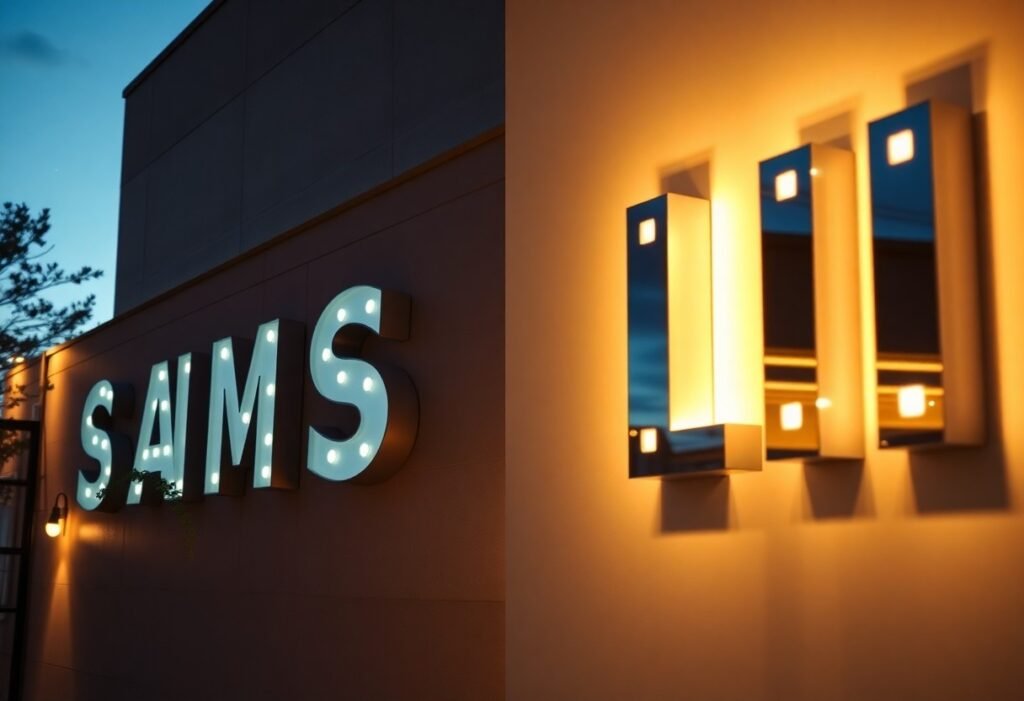
Many businesses choose between front lit and halo lit channel letters when defining your brand visibility; front lit letters illuminate the face for bright, direct signage, while halo lit letters cast a soft glow behind the letters for a refined, backlit halo effect. You should consider viewing distance, aesthetic goals, energy use, and installation constraints to decide which suits your storefront, as each style offers distinct visual impact and practical trade-offs.
Key Takeaways:
- Front-lit channel letters have translucent faces with internal LEDs that shine through the letter front for bright, high-contrast visibility.
- Halo-lit channel letters have opaque faces and rear-mounted LEDs that create a soft illuminated halo on the mounting surface for a premium, architectural look.
- Construction differs: front-lit uses acrylic faces and internal LED placement; halo-lit requires opaque returns, backlighting, and a gap or standoffs to form the halo.
- Halo-lit installations are generally more expensive and require darker or contrasting backgrounds to show the glow; front-lit performs better for long-distance legibility and daytime visibility.
- Many projects combine both (front-and-halo) to achieve bold face illumination plus a surrounding glow when budget and mounting conditions allow.
Overview of Channel Letters
You assess channel letters by face type, lighting method, materials and mounting; typical returns range from 3-12 inches and LED modules commonly last ~50,000 hours, so upfront design affects lifetime costs. Front-lit delivers direct illumination for street-facing visibility, while halo-lit (backlit) uses a standoff-usually 1-3 inches-to create a glow. Installation, maintenance access and local code for electrical and mounting often dictate your final choice.
- Materials: aluminum returns, acrylic faces, or exposed neon for vintage looks.
- Depth: aim for 3-12 inches depending on letter size and lighting type.
- Lighting: LEDs dominate for efficiency and 50,000-hour life.
- The halo effect usually needs a 1-3 inch standoff from the wall.
Definition of Channel Letters
You use channel letters as three-dimensional characters made from formed metal returns and plastic or acrylic faces, internally lit by LEDs or neon. Each letter is wired individually or mounted on a raceway, and they serve as primary identification on storefronts and building façades. Manufacturing tolerances, face color and LED placement determine uniformity and brightness, so specify viewing distance and ambient light when you order.
Types of Channel Letters
You pick from front-lit, halo/back-lit, combination, open-face (exposed neon) and push-through acrylic styles; front-lit maximizes legibility, halo-lit provides a premium, dimensional halo, and combination merges both for layered visibility. Each type has trade-offs in cost, maintenance and mounting-front-lit is typically most cost-effective, halo-lit demands precise standoffs, and combination signs add fabrication complexity.
| Front-lit | Translucent acrylic face, internal LEDs, best for high-contrast street visibility; common on retail and quick-service restaurants. |
| Halo/back-lit | Solid metal face with rear illumination; needs 1-3 in standoff to produce a uniform glow; popular for upscale brands. |
| Combination | Front-lit face plus halo backlighting; increases visual impact and typical cost by roughly 10-25% depending on size and complexity. |
| Open-face / Exposed Neon | No acrylic face; uses neon or LED filaments directly visible; chosen for vintage aesthetics and high color saturation. |
| Push-through acrylic | Acrylic characters set into a metal raceway or pan; offers dimensional depth and is often used for channel letters mounted on panels. |
You should weigh visibility, maintenance and brand alignment when selecting a type: front-lit is economical and bright, halo-lit reads well against dark façades, and combination signs maximize day/night impact. For example, a 6-inch-deep front-lit letter fitted with modular LEDs often yields even illumination, while halo requires precise mounting points and a reflective return to avoid hotspots. The combination typically increases fabrication time and cost but boosts multi-angle visibility.
- Front-lit: best for obvious nighttime legibility and lower fabrication costs.
- Halo-lit: preferred when you want a premium, floating look on darker backgrounds.
- Combination: balances front and back illumination for 24/7 brand presence.
- The selection should align with your brand goals, budget and local mounting codes.
Front Lit Channel Letters
With front-lit channel letters you get translucent acrylic faces-commonly 3/16″ to 1/4″-mounted to aluminum returns in depths from about 3 to 12 inches, filled with internal LED modules that shine forward. You’ll rely on this configuration for high daytime contrast and vivid nighttime color; typical LED color temperatures run from ~2700K to 6500K so you can match warm or cool brand palettes, and module spacing of 1-2 inches is standard to avoid hotspots.
Design Characteristics
You specify materials and geometry to control appearance: aluminum or stainless returns, routed or trimless edges, and acrylic face thickness. Returns between 3-12 inches affect letter depth and internal reflector design, while LED type and spacing (often 1-2″ between modules) determine face uniformity. You can also add diffusers, baffles, or translucent trim caps to tune halo bleed or edge crispness for close-view applications.
Advantages of Front Lit Channel Letters
You gain bright, direct illumination that maximizes legibility and brand color fidelity; front-lit letters generally outperform reverse-lit letters for storefront visibility. They use efficient LEDs with lifespans around 50,000 hours, require less power than legacy neon, and suit high-traffic locations where clear, consistent nighttime recognition at distances of tens to a few hundred feet matters.
In practice, you’ll find maintenance straightforward: modular LED strips and removable faces let technicians replace faulty modules quickly, and predictable specs (50,000-hour life, common 12-24V drivers) simplify upgrades. For instance, spacing LEDs at 1-2″ in a 12″ tall character produces even luminance across the face, keeping brand colors consistent across multiple signs and reducing day-to-day service calls.
Halo Lit Channel Letters
Halo-lit channel letters use opaque or solid faces with LEDs aimed at an open back so the light washes the wall, producing a soft halo outline. You’ll often see 3-6 inch return depths and 1-4 inch standoffs to control halo size; typical LED color temps range 2700K-4000K. Designers pick halo for upscale façades, restaurants and boutique retail where indirect glow enhances brand perception without the glare of front-illumination.
Design Characteristics
Materials usually include extruded aluminum returns, painted metal or acrylic faces, and an open or routed metal back to create uniform bounce light. LED strips are commonly spaced 1-2 inches for even diffusion, and diffusers or reflective backplates can soften hotspots. Mounting options include stud-mounted standoffs or rail systems, and finishes like brushed metal or powder-coat affect halo contrast against different wall colors.
Advantages of Halo Lit Channel Letters
You get an elegant, high-end appearance that reads well at night without direct glare, often preferred for hospitality and premium retail. LEDs deliver 50,000+ hours of life and lower energy draw versus neon, while the indirect glow reduces visual clutter. Fabrication and installation costs tend to run about 10-25% higher than basic front-lit letters due to tighter tolerances and standoff hardware.
Wall color and surface texture directly affect halo intensity: dark, matte walls produce a crisp halo while light or glossy surfaces yield a softer wash. You can fine-tune the effect by adjusting return depth and LED spacing; for example, 4″ returns with 1″ LED spacing give a dense glow, whereas 3″ returns with 2″ spacing produce subtler radiance. Choose 3000K for warm hospitality tones or 4000K for contemporary retail clarity, and plan driver access for straightforward maintenance.
Visual Impact Comparison
At-a-glance visual differences
| Front-lit channel letters | Halo-lit channel letters |
|---|---|
| Bright, direct illumination through translucent faces; high contrast for legibility. | Soft backlight wash that outlines letters; creates depth and a floating effect. |
| Commonly used with 3/16″-1/4″ acrylic faces and LEDs aimed forward. | Often opaque faces or metal with open backs and LEDs aimed at the wall. |
| Better for readability at longer distances and on busy streets (retail, fast food). | Preferred for upscale branding, historic façades, and textured walls. |
| Stronger daytime and nighttime presence; typically requires shallower returns (3-6″). | Nighttime impact is distinctive; achieves best halo with deeper returns (4-8″). |
When weighing visual impact, you’ll see front-lit letters deliver immediate, high-contrast readability-ideal for 24/7 visibility and locations where viewers pass quickly-while halo-lit letters emphasize ambiance and brand tone, casting a 1-3″ soft glow that reads as premium at night. For example, a downtown retail strip may favor front-lit for daytime driving traffic; a law office on a stone façade often chooses halo-lit for an elevated nighttime presence.
Aesthetics and Visibility
You get crisp color and sharp letterforms with front-lit letters, making logos and multi-color graphics pop under streetlights and sunlight; front-lit acrylic faces (3/16″-1/4″) keep contrast high. Conversely, halo-lit letters trade raw brightness for layered depth-your signage separates from the wall with a subtle glow that enhances texture and adds prestige, especially on brick or painted masonry where edge definition complements ambient lighting.
Suitability for Different Environments
You should pick front-lit designs for high-traffic roads, shopping centers, and 24-hour businesses where legibility from 100-300+ feet matters; choose halo-lit when you want to convey sophistication on plazas, hotels, boutiques, or historic districts where light spill is controlled and the backdrop enhances the halo effect.
Also factor in mounting surface, code restrictions and maintenance: if your façade is dark or textured, halo lighting amplifies depth but usually needs 4-8″ returns and careful LED placement; if local ordinances limit light spill or you need maximum daytime legibility, front-lit with shallower returns and efficient LEDs is often the practical choice. Your budget and service access will further steer whether you prioritize bold visibility or refined ambiance.
Cost Analysis
You’ll find upfront material and fabrication costs vary: front-lit letters commonly run $150-$600 per 24-36″ letter, while halo-lit versions often add 10-30% for deeper returns, opaque faces and back diffusers. Labor, engineering and permits can multiply costs on complex façades. For a typical storefront job expect total project budgets between $2,000 and $20,000 depending on letter count, material choices (aluminum vs stainless) and required structural work.
Installation Costs
Installation expenses hinge on mounting method and height; you’ll pay more for rooftop rigs or routed façades. Typical installer labor is $75-$150 per hour per technician, crane or lift rental runs $200-$800/day, and licensed electrical hookup adds $100-$400. Permit and engineering fees commonly add $50-$1,000. For a simple ground-level run expect $500-$2,500; complex installs can exceed $5,000.
Maintenance Expenses
You should budget routine upkeep: LEDs usually last 50,000+ hours but modules and drivers will need replacement over time. Annual cleaning and inspection typically cost $100-$400, and you can expect LED module replacement at roughly $20-$200 each depending on type. Plan on allocating about 2-5% of the initial sign cost per year for normal maintenance and minor repairs.
More detailed examples help you plan: replacing a failed transformer or driver usually costs $100-$400 including labor, while resealing or repainting returns to restore halo effect runs $75-$250 per letter. Moisture infiltration in halo-lit backs can accelerate repairs, so factor in occasional resealing and wall touch-ups; extended warranties or service contracts (1-3 years) often reduce your out-of-pocket spikes.
Choosing the Right Option
When you weigh aesthetics, budget, and site conditions, the choice becomes practical: front-lit letters excel for highway-facing, high-contrast needs and faster fabrication, while halo-lit letters elevate premium façades with a soft back-glow. Consider fabrication cost bands you saw earlier, maintenance intervals (LEDs commonly last 50,000-100,000 hours) and mounting substrate. For a deeper comparison and visual examples, review Halo-Lit vs. Front-Lit Channel Letters: Which One Is Best?
Factors to Consider
Assess viewing distance, ambient lighting, brand tone, installation surface and long-term operating costs when you decide; code and permit requirements can force one option over the other. Assume that your storefront sits 20-40 feet from pedestrian/vehicular sightlines and that substrate (brick, metal, EIFS) will affect halo diffusion and mounting complexity.
- Visibility/distance – front-lit for 0-100 ft, halo more impactful at 15-50 ft on darker walls
- Surface – smooth painted metal or stucco favors halo diffusion; rough stone may need deeper returns
- Brand style – bold, high-contrast identities often use front-lit; luxury brands prefer halo
- Budget – front-lit typically lower upfront; halo adds back pan and dimming options
- Maintenance & energy – LED life 50k-100k hours; consider replaceability and driver access
- Local regulations – check illumination limits and sign permits before finalizing
Common Applications
You’ll see front-lit channel letters on fast-food strips, national retail chains and highway-facing stores where legibility at speed matters; sizes often range 24-48″ per character for roadside readability. Conversely, halo-lit letters are common on hotels, law firms and upscale boutiques where the subtle backlight complements materials like limestone or glass.
In practice, a hotel with a stone façade used 10-24″ halo-lit letters to create an elegant wash without hot spots, while a regional retailer installed 36″ front-lit letters with diffusion lenses for consistent daytime and nighttime contrast; you should match the example to your traffic patterns and façade material to optimize impact and lifecycle cost.
Final Words
With this in mind, you can decide based on desired visibility and style: front-lit channel letters project light forward for bold daytime legibility and direct branding, while halo-lit letters cast a glow behind for a softer, architectural effect at night. Consider placement, logo detail, and maintenance so you choose the option that best meets your visibility, aesthetic, and budget priorities.
FAQ
Q: What are front-lit and halo-lit channel letters?
A: Front-lit channel letters have illuminated faces – translucent acrylic fronts with LEDs behind them that shine forward toward the viewer. Halo-lit (backlit) channel letters have opaque faces and open or translucent backs so LEDs create a soft glow that projects onto the wall behind each letter, producing a halo effect.
Q: How do front-lit and halo-lit channel letters differ in appearance and visibility?
A: Front-lit letters produce direct, high-contrast illumination that reads clearly from a distance and in varied lighting conditions; colors are vivid and faces can use translucent graphics. Halo-lit letters create a floating, three-dimensional backglow that emphasizes shape and edges and works best with a contrasting mounting surface; the effect is more subtle and often considered more elegant or architectural.
Q: How does construction and installation differ between the two styles?
A: Front-lit letters require translucent faces, internal LED modules, and often a return depth optimized to prevent hot spots; they can mount flush, on a raceway, or with stand-offs. Halo-lit letters usually have opaque faces, LEDs directed toward the back, a sealed or open back with a spacer to create the gap for the halo, and must be mounted off the wall (standoffs or welded mounting bars) to allow the backlight to project evenly.
Q: What are the maintenance and performance considerations for each type?
A: Both use LEDs and drivers with similar lifespans, but front-lit letters may show LED hot spots or face discoloration if low-quality materials are used; they require cleaning of faces and periodic driver checks. Halo-lit letters demand careful sealing and proper spacing to avoid light bleed onto the face or wall, and access for rear maintenance is needed. Weatherproofing, ventilation, and high-quality LED placement matter for longevity in both styles.
Q: How do costs differ and when should I choose one over the other?
A: Costs vary by size, materials, mounting complexity, and installation. Front-lit letters are generally simpler and often less expensive to install because they can mount closer to the wall or on a raceway. Halo-lit letters can cost more due to the need for standoffs, precise spacing, and sometimes custom back panels. Choose front-lit for maximum daytime and distance legibility, strong color branding, or when wall contrast is low; choose halo-lit for a premium, architectural look, softer nighttime emphasis, or when you want the sign to feel dimensional and refined. Combination (front + halo) is an option when both impact and halo ambiance are desired.