
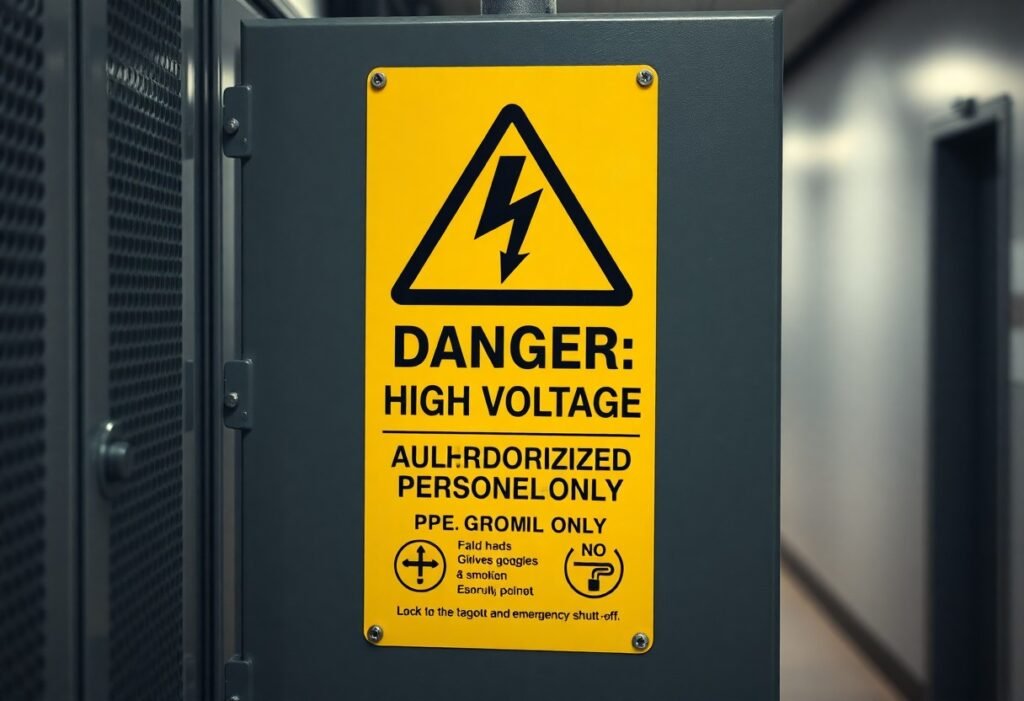
Most of your electrical safety relies on clear, compliant signage placed where staff and visitors can see hazards and emergency information. You should follow standards for color, symbols, wording and illumination; display lockout/tagout, high-voltage and circuit identification warnings; keep signs maintained and unobstructed; and integrate signage into training and risk assessments to meet local codes and reduce incidents.
Key Takeaways:
- Follow applicable regulations and standards (OSHA, ANSI Z535, IEC and local codes); use required signal words and approved symbols.
- Ensure visibility and placement at eye level and every access point: electrical panels, switchboards, equipment rooms; avoid obstructions and poor contrast.
- Provide clear content: hazard type, voltage levels, arc-flash/risk details, required PPE and specific actions; use standardized symbols and multilingual text if needed.
- Use durable, weather- and UV-resistant materials with secure mounting; schedule routine inspections and replace faded or damaged signs.
- Integrate signage with lockout/tagout, emergency procedures and employee training; audit and update signs whenever equipment or procedures change.
Understanding Electrical Safety
When evaluating site risk, you should treat electrical safety as an operational priority: electrical incidents still cause hundreds of workplace injuries and fires each year, and noncompliance can trigger OSHA citations and insurance losses. Practical controls you can apply include NFPA 70E-based arc-flash labeling, lockout/tagout procedures, calibrated torque on connections, PPE selection, and periodic infrared inspections to catch loose or overheating contacts before failure.
Importance of Electrical Safety in the Workplace
For your business, effective electrical safety reduces lost workdays, prevents catastrophic equipment damage, and limits regulatory fines; OSHA citations for electrical violations can exceed tens of thousands of dollars per infraction. Beyond compliance, training your staff and maintaining documented inspection and maintenance records directly lowers downtime and keeps production lines running safely.
Common Electrical Hazards
Typical hazards you’ll encounter include exposed live parts, frayed or damaged cords, overloaded circuits and panels, improper grounding, wet or conductive environments, and lack of lockout/tagout-plus arc-flash and transient overvoltages from switching faults or loose connections. Each hazard increases the risk of shock, burns, fire, or equipment loss if not addressed.
Digging deeper, you should prioritize hazard-specific measures: use GFCIs in wet areas, install ground-fault and overcurrent protection sized to equipment, perform infrared thermography to find hot spots, enforce LOTO for maintenance, replace two-prong-to-three-prong adapters, and require qualified electricians for high-voltage work-these tactics prevent most common failure modes.
Signage Requirements for Electrical Safety
Your signage must meet regulatory and practical standards: follow 29 CFR 1910.145 and ANSI Z535 signal-word rules, and place clear instructions near hazards. Use high-contrast colors, approved symbols, and durable materials rated for the environment; for example, metal or UV-stable polycarbonate for outdoor panels. If you need a refresher on federal sign basics see OSHA Sign Requirements: Everything Employers Need …, and align each sign to the risk level and response expected from your staff.
Types of Electrical Safety Signs
You should classify signs by purpose: DANGER for immediate high-voltage risk, WARNING for serious but not immediate hazards, CAUTION for minor risks, MANDATORY for required PPE, and PROHIBITION for forbidden actions. Include brief action text and a symbol whenever possible, with signal words in uppercase. Recognizing the correct type prevents miscommunication and reduces incident rates.
- Danger – imminent high-voltage hazards
- Warning – potential serious injuries
- Caution – minor or moderate hazards
- Mandatory – required actions (e.g., wear gloves)
- Prohibition – actions not allowed (e.g., no entry)
| Danger | Immediate risk of electrocution; use red/black; clear shutdown steps |
| Warning | Serious hazard; use orange; note required precautions |
| Caution | Lower-level hazard; use yellow; advise safe practices |
| Mandatory | Compulsory actions like PPE; use blue; specify gear type |
| Prohibition | Forbidden activities; use red circle/slash; state the restriction |
Placement and Visibility Standards
Position signs where they are visible from normal approach paths: indoors consider 10-20 ft viewing distances, outdoors 50-100 ft, and mount centerline roughly 60-72 inches (1.5-1.8 m) above walking surfaces for typical sightlines. Ensure contrast and symbol size match expected viewing distance, and place additional signs at all access points to electrical rooms and panels so you don’t rely on a single marker.
Also factor lighting, glare, and obstructions: use reflective or illuminated signs for low-light areas, keep pictogram stroke widths and letter heights proportional to distance (e.g., 1 inch letters for ~25 ft sightlines), and include redundant markings on doors and equipment. Inspect signs during routine safety audits (monthly or quarterly as your program dictates), replace faded or damaged signs immediately, and document placements on site maps so contractors and new staff can locate hazards quickly.
Training and Awareness
Make training a measurable part of your electrical safety program by combining annual formal sessions with quarterly toolbox talks and task-specific hands‑on drills for qualified staff; track participation and outcomes, keep records for at least three years, and use near‑miss data to target gaps – one mid‑size manufacturer cut electrical near‑misses 40% after monthly audits and focused retraining on lockout/tagout and arc‑flash hazards.
Employee Training on Electrical Safety
Require initial qualification and documented competency for anyone working on or near energized equipment, covering NFPA 70E principles, correct PPE selection from arc‑flash analysis, lockout/tagout procedures, and lock removal authority; validate skills with written tests and supervised practicals, and provide refresher or task‑specific training whenever procedures, equipment, or personnel change.
Promoting a Safety Culture
Lead by example: ensure supervisors perform weekly walkarounds, encourage reporting of signage defects or unsafe conditions without penalty, and tie safety goals to performance reviews so your team treats electrical safety as operational, not optional – firms that combine visible leadership and anonymous reporting typically see faster hazard correction.
Operationalize culture with measurable actions: set KPIs (signage audit pass rate, corrective action closure time), run monthly safety dashboards, conduct biannual sign legibility checks, and hold cross‑functional safety committees that review incidents with root‑cause analysis; this makes continuous improvement visible and gives your people clear channels to influence electrical safety outcomes.
Regular Inspections and Maintenance
Importance of Routine Checks
You should perform visual inspections monthly for water ingress, corrosion, frayed wires and damaged insulation, and schedule full electrical testing annually per manufacturer guidance; use a multimeter to verify voltages and an infrared camera to spot hotspots, which helps reduce unexpected outages at high-traffic sites like retail storefronts and petrol stations.
Identifying and Addressing Potential Risks
During inspections you should test connections for looseness and measure insulation resistance with a megger; address signs of overheating, such as discolored wiring or softened plastic, by replacing drivers and connectors promptly and documenting repairs so trends reveal recurring failures across locations.
If you detect moisture or corrosion, isolate power, dry and replace corroded terminals, and reseal enclosures with IP65 or higher gaskets; use a thermal camera to find hotspots before they fail, log insulation-resistance readings (values below 1 MΩ warrant investigation), and coordinate repairs with certified electricians while updating site records for proactive replacement planning.
Emergency Procedures
When an electrical incident occurs, you must have a documented emergency plan aligning with OSHA (29 CFR 1910.38) and NFPA 70E, clear shut‑off locations and ANSI Z535 signage. Aim for evacuation and headcount within 2-3 minutes, maintain a current emergency contact list, and ensure lockout/tagout points are accessible and labeled. Establish who will liaise with emergency services and keep a laminated site map at each control room.
Creating an Emergency Response Plan
Your plan should list primary and secondary responders, switchgear and main breaker locations, isolation procedures, evacuation routes and two external assembly points. Train staff at hire and then at least annually, run tabletop drills quarterly and a full evacuation drill twice a year. Include supplier and utility contacts, spare key locations, and a one‑page quick actions sheet posted at panels.
First Aid and Accident Reporting
Assign at least one trained first‑aid and AED responder per shift and keep a stocked, inspected first‑aid kit within 50 feet of high‑risk areas. Report fatalities to OSHA within 8 hours and inpatient hospitalizations within 24 hours; retain incident records for five years per 29 CFR 1904. Perform immediate scene control, then document injuries with photos and witness statements within 24 hours.
After securing power and scene safety, you should apply first aid or AED treatment immediately and summon EMS; do not move a person with suspected spinal injury unless danger is imminent. Collect serial photos (wide, mid, close) of equipment and signage, gather three witness statements within 72 hours, run a root‑cause analysis (5 Whys or fault tree) and implement corrective actions within 30 days.
Compliance and Legal Responsibilities
Meeting legal obligations means aligning your program with OSHA, NFPA 70E and the NEC (NFPA 70), plus local authority having jurisdiction (AHJ) requirements; you must document procedures, training, inspections and signage, and keep records for audits. For example, lockout/tagout falls under 29 CFR 1910.147, signage under 29 CFR 1910.145, and arc-flash labeling per NFPA 70E; failing to maintain records or certifications often triggers citations during OSHA inspections.
Understanding Regulatory Standards
Standards like NFPA 70E define safe work practices, approach boundaries and PPE categories 0-4 while the NEC governs installation; IEEE 1584 guides arc‑flash incident‑energy calculations in cal/cm². You should perform an arc‑flash study, apply incident‑energy labels to equipment, and ensure task-specific training and retraining whenever duties, equipment, or layouts change to meet documented compliance expectations.
Consequences of Non-Compliance
Non-compliance can trigger OSHA citations, civil lawsuits, higher insurance premiums and forced shutdowns; OSHA penalties often exceed $15,000 per serious violation and rise for willful or repeated breaches. You also face worker injury claims, regulatory orders to halt operations, and reputational damage that can cost customers and contracts-especially after an incident that reveals neglected documentation or missing PPE.
Beyond fines, direct remediation costs hit quickly: an arc‑flash study typically costs $3,000-$30,000 depending on facility complexity, panel upgrades and labeling can run into tens or hundreds of thousands, and severe injury claims frequently reach six- to seven-figure settlements; a two-week shutdown for repairs and investigations can easily produce similar losses in lost revenue and penalties.
To wrap up
Conclusively, you must enforce clear, standardized electrical safety signage, place warnings at hazards and isolation points, comply with local codes and standards, inspect and maintain signs, implement lockout/tagout procedures, provide PPE and training to staff, and keep emergency shutdown and contact information visible. By making signage part of your safety management system and auditing compliance regularly, you reduce risk and show regulatory due diligence.
FAQ
Q: What national and international standards should businesses follow when creating electrical safety signs?
A: Follow applicable standards such as OSHA 29 CFR 1910.145 for accident prevention signs, ANSI Z535 series for sign design and colors (signal words DANGER, WARNING, CAUTION), ISO 7010 for standardized pictograms, NFPA 70E and IEEE 1584 for arc-flash labeling requirements, and any local electrical codes. Use the most restrictive requirement when standards differ and document which standards apply to each facility or piece of equipment.
Q: Where should electrical safety signs be placed and how should they be sized and mounted?
A: Place signs at entrances to electrical rooms, on distribution panels, circuit breaker enclosures, near disconnects, at boundaries of high-voltage areas, and on equipment with arc-flash hazards. Mount signs at eye level and ensure they are unobstructed and visible from typical approach paths. Size text so it is legible from the expected viewing distance (common rule: 1 inch of letter height per 10 feet of viewing distance), use durable mounting hardware, and select materials rated for indoor or outdoor exposure as required.
Q: What information, colors and symbols should be included on electrical safety signs to communicate risk effectively?
A: Use a clear signal word (DANGER, WARNING, CAUTION) per ANSI Z535, a concise hazard statement, required safe work instructions, and pictograms per ISO 7010 when applicable. For arc-flash labels include incident energy (cal/cm2) or PPE category, nominal system voltage, available fault current, and working distance as required by NFPA 70E. Employ high-contrast colors, sans-serif fonts, and photoluminescent or reflective materials where lighting is poor. Provide translations if workforce language diversity warrants it.
Q: How often should signs be inspected, maintained, or replaced and how does that integrate with lockout/tagout procedures?
A: Inspect signs during routine safety audits and after any maintenance or environmental event; many facilities schedule visual checks quarterly and full audits annually. Replace signs that are faded, damaged, illegible, or no longer accurate. Integrate temporary warning tags into your lockout/tagout program (OSHA 29 CFR 1910.147): use durable LOTO tags during maintenance, ensure tags include author and date, and remove tags only by authorized personnel following LOTO procedures.
Q: What administrative actions and training should businesses implement to ensure sign effectiveness and legal compliance?
A: Maintain a written signage program that lists required signs, locations, standards referenced, inspection schedules, and replacement criteria. Train employees on the meaning of signal words, pictograms, arc-flash labels, required safe work practices, and actions to take when encountering a sign. Provide initial training for new hires, task-specific training for electrical workers, and periodic refresher training. Keep records of signage inventories, inspections, maintenance actions, and training to demonstrate compliance during audits or inspections.