
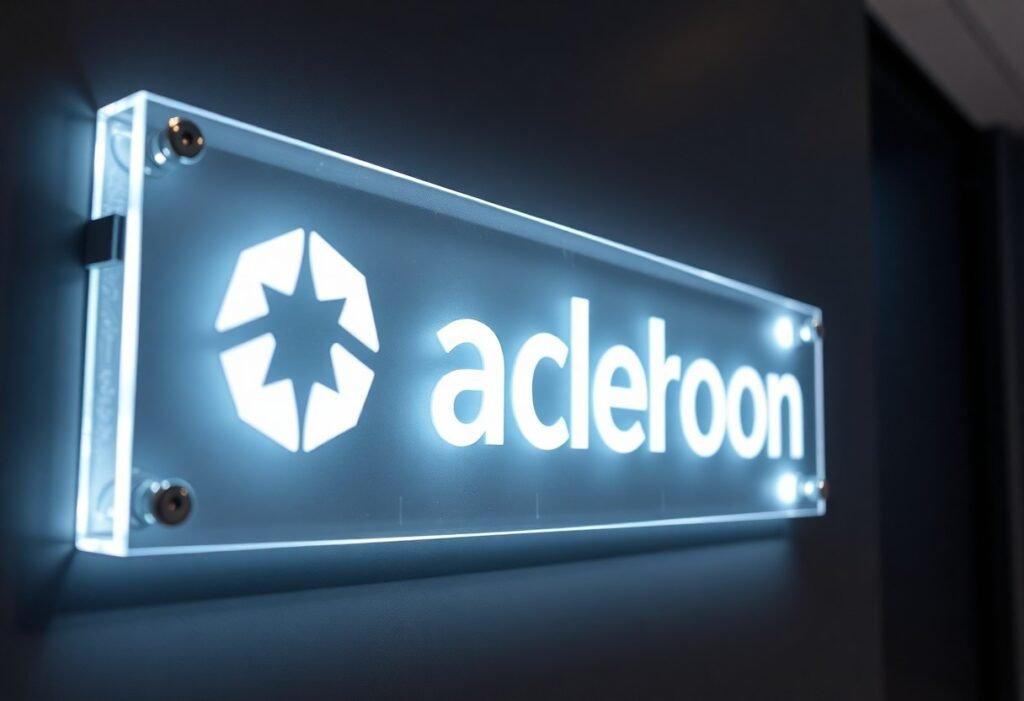
You can use edge-lit acrylic signs-thin acrylic panels illuminated from the edge by LEDs that transmit light to engraved or printed graphics-to produce uniform, eye-catching illumination with a slim profile. You’ll find them in retail branding, office wayfinding, hospitality, exhibitions, and awards, offering customizable shapes, color effects, and energy-efficient operation that enhance visibility and reinforce your visual identity in low- and high-ambient light environments.
Key Takeaways:
- Illuminated acrylic panels that use edge-mounted LEDs to produce a glowing outline and light up engraved or printed details.
- Typically made from clear or frosted acrylic, edge-polished and fitted into a slim LED base or channel; etching or UV printing adds visible graphics.
- Light is injected into the sheet edge and internally reflected until scattered by engraved or frosted areas, making text and logos appear illuminated.
- Used for reception and wayfinding signs, retail displays, trade-show graphics, awards, menu boards, and architectural accents where a sleek, modern look is desired.
- Advantages include low profile, energy efficiency, strong visibility day and night, and high customization; clean with mild soap and a soft cloth, avoid abrasive cleaners and solvents.
What are Edge Lit Acrylic Signs?
When evaluating signage options, you’ll find edge-lit acrylic panels use LEDs mounted along the sheet edge to channel light through engraved or polished acrylic, producing bright, uniform face illumination without bulky backboxes. Typical panels range from 3-12 mm thick and 300×150 mm up to 1200×2400 mm; manufacturers commonly use 2835, 3528 or 5050 SMD LEDs at 30-120 LEDs/m to achieve consistent glow for retail, hospitality, and wayfinding applications.
Definition and Characteristics
Technically, you’re dealing with light guided by total internal reflection until surface engraving or edge treatments scatter it, creating crisp, high-contrast graphics and halo effects. Engraving depths of 0.1-0.5 mm and dot densities tuned by CNC or laser etching determine brightness and diffusion; color temperatures typically run 2700-6500K, and you can expect clear logos readable from 1-5 m depending on panel size and LED density.
Materials Used
Acrylic (PMMA) is the standard you’ll see-cast for optical clarity and extruded for budget jobs-usually paired with SMD LEDs, aluminum mounting channels, and vinyl or painted backs for contrast. Diffuser films, silicone adhesives, and stainless standoffs are common hardware; power requirements typically fall in the 5-24 V range with average consumption around 2-10 W per panel depending on size and LED type.
If you choose cast PMMA, you gain better engraving resolution and improved UV stability, while extruded acrylic is cheaper but can show hazier edges or heat warping. Polycarbonate is selected where impact resistance matters but sacrifices some clarity. For edge finish, flame or mechanical polishing creates mirror-like edges that boost transmission; a common spec is 6 mm cast acrylic with 60 LEDs/m SMD2835 in an aluminum channel-effective for even illumination at viewing distances up to about 1.5 m.
How Edge Lit Acrylic Signs Work
When you run LEDs along an acrylic edge, light travels through the sheet by total internal reflection until it hits etched or sandblasted areas that scatter it toward the viewer. Typical acrylic thickness ranges from 3-10 mm, with LED densities of 60-120 LEDs/m and power draws around 5-14 W/m, so you can balance brightness and energy use. Edge polishing, back reflectors and diffusion films further shape uniformity, while laser-etched graphics convert injected light into crisp, evenly lit imagery.
Mechanism of Light Distribution
You control where light appears by varying etch patterns and LED placement: etched dots, lines or halftone patterns break internal reflection to emit light. Common practices use laser engraving depths of roughly 0.05-0.3 mm and dot spacing of 1-5 mm, with LED spacing typically 8-16 mm along the edge. Reflective backing, edge seals and micro-prismatic diffusers then smooth hot spots so graphics read consistently at distances of 1-10 m.
Color and Brightness Options
You pick color temperature and intensity to match environment and branding: white LEDs range from about 2700-6500 K (warm to cool), while RGB or RGBW arrays let you create over 16 million colors and programmable effects. Brightness scales with LED type and density, and you can use PWM dimming or constant-current drivers to adjust output and color stability; CRI values between 80-95 indicate how faithfully colors render on your sign.
For more control, choose LED strips that deliver roughly 300-1,600 lm/m depending on type (SMD3528 to SMD5050) and expect typical power between 5-15 W/m. You can integrate DMX, Wi‑Fi or simple PWM controllers to set scenes or schedule dimming to 1% for night modes. In practice, many retail installs use 60 LED/m at 4000 K with CRI ≥90 to keep logos accurate while maintaining energy efficiency and maintenance intervals of 3-5 years under normal operation.
Applications of Edge Lit Acrylic Signs
Across industries you’ll find edge-lit acrylic used for branding, wayfinding and ambient lighting; its slim profile suits tight retail fronts, office reception areas and display cabinets. LEDs typically last 25,000-50,000 hours, lowering maintenance while keeping consistent color temperature. Examples include boutique stores, hotel lobbies and transit hubs where clear, backlit graphics improve recognition at distances of 3-10 meters.
Commercial Uses
In retail and hospitality you can deploy edge-lit panels as illuminated logos, backlit menu boards and aisle markers; trade-show booths often use 1-3 m tall panels for high impact. Typical low power draw (often under 10 W/m) makes continuous operation feasible for 24/7 storefronts, and consistently lit, color-accurate signage helps reinforce brand recall and guide buying decisions.
Educational and Informational Uses
On campuses and in museums you’ll use edge-lit acrylic for wayfinding, exhibit labels and classroom identification because even illumination improves legibility for visitors and students. Hospitals and airports adopt it for schedules and directional signs to reduce glare and increase contrast; ADA-compliant legends shorten reading time in busy corridors and aid efficient navigation.
You can customize panels with engraved icons, raised characters and tamper-proof mounting to meet accessibility standards, and pair them with QR codes or NFC tags for layered content. Panel thickness commonly ranges from 6-12 mm, while RGB LED systems let you change color for events, schedules or emergency signaling without replacing hardware.
Advantages of Edge Lit Acrylic Signs
Edge lit acrylic signs give you high-impact visibility with low energy use: LED edge lighting typically uses 60-90% less power than incandescent solutions and LEDs often last 50,000+ hours. You get razor-sharp logo reproduction, consistent light distribution for night-time legibility, and a slim profile that suits storefronts, lobbies, and trade-show booths. Installation is lightweight and modular, so you can scale a campaign across multiple locations while keeping maintenance and electricity costs down.
Durability and Maintenance
You benefit from robust materials: cast acrylic is up to 10× more impact-resistant than glass and – when UV-stabilized – holds color outdoors for 5-8 years. LEDs are modular and often rated for 50,000 hours, which at 12 hours/day equates to roughly 11 years of operation before noticeable dimming. Cleaning is simple: dust monthly and wipe with a mild, non‑ammonia cleaner; damaged LED strips can usually be replaced without remaking the entire panel.
Customization and Design Flexibility
You can specify thicknesses from 1/8″ to 1″ and achieve engraving depths of 0.3-1.5 mm for precise edge diffusion. Options include edge-polish finishes, frosted diffusion films, RGB or tunable white LEDs with DMX or Wi‑Fi control, and Pantone color matching for brand accuracy. That flexibility lets you reproduce fine typography to within about 0.5 mm and create animated effects for dynamic storefronts or exhibition pieces.
Production techniques directly affect outcomes: laser etching yields crisp detail at 300-600 DPI, CNC routing handles complex shapes, and diffusion films eliminate hotspots for uniform glow. Typical lead times run 3-10 business days for standard runs, with prototypes adding 3-5 days; costs scale with size, electronics, and multi-color programming, so plan your specifications to control budget and turnaround.
Installation and Safety Considerations
You’ll need to plan mounting, power and access early: standoff spacing 200-400 mm for 3-10 mm acrylic, LED drivers typically 12-24 V DC delivering 4-30 W per sign, and local electrical codes (NEC/IEC) that dictate grounding and conduit. Factor in service clearance of 150-300 mm and schedule cleaning every 3-6 months to maintain light output and reduce heat buildup.
Installation Process
Measure and make a drilling template, attach stainless-steel standoffs or aluminum rails rated to the panel weight, run the driver in an accessible weatherproof box, route low-voltage cables through grommets and secure with cable ties, verify polarity and dimming control before final sealing, and test the sign for 24-48 hours to check thermal performance; a 600×300 mm sign typically installs in 1-3 hours with two installers.
Safety Tips
Before you start, isolate the circuit and lock out power, use insulated tools and eye protection, and select drivers with 20-30% power headroom for ambient heat. Ground metal frames, avoid relying solely on adhesives for support, and choose IP65 drivers and UV-stable acrylic for outdoor installations to minimize moisture and thermal damage.
- Use GFCI/RCD protection on circuits near wet or exterior locations.
- Maintain driver ventilation gaps of 10-20 mm and leave service access of 150-300 mm.
- Space standoffs every 200-400 mm depending on panel size and thickness to prevent sagging.
- Perceiving glare and sightline issues, add diffusers or adjust mounting height to reduce hotspots and driver-eye interference.
Label voltage, fuse and maintenance info on the sign, inspect seals and wiring every 6 months, and plan driver replacement after 5-7 years or if light output drops more than 10%. If you use dimming, choose compatible TRIAC, PWM or 0-10 V drivers and test for flicker across the dimming range to prevent premature LED failure.
- Check UL/CE and local approvals on drivers and LED modules for code compliance.
- Document the installation with photos, a wiring diagram and service dates for future technicians.
- Install surge protection for exterior runs and within 1-3 m of the driver if lightning risk is present.
- Perceiving scheduled inspections and logs reduces downtime, extends component life, and improves occupant safety.
Future Trends in Edge Lit Acrylic Signs
Expect IoT-enabled control, higher-efficiency LEDs and advanced diffusion to reshape installations; addressable strips like WS2812 (5V, ~60mA per LED, 60 LEDs/m ≈14.4W/m) bring pixel-level animation and remote scheduling, while COB and high-CRI (>90) modules improve color fidelity. You can explore community tips and examples on Edge Lit Acrylic Sign threads.
Technological Innovations
You’ll see micro-LED and COB modules cut power use and heat: COB strips often run at 24V for lower voltage drop and deliver 10-18W/m with tight CCT control (2700-6500K) and CRI>90. Expect Bluetooth Mesh, MQTT or DMX over IP for scheduled scenes, and power supplies sized to 20-30% overhead to avoid dimming over 2-5 m runs.
Design Trends
You’ll move toward multi-layer compositions, minimal frames and halftone engraving to produce depth without added bulk-typical sheets stay 3-10 mm thick while stacked or offset to create shadow effects; RGBW chips let you shift brand hues while keeping readable white at 3000-4000K for signage legibility.
For execution, you can combine laser-etched dot matrices (0.20-0.30 mm dot size, 0.25-0.50 mm spacing) with a micro-prismatic diffuser (e.g., 3M-style) to achieve even luminance; CNC-routing for reveal edges and using 2-4 mm spacer layers creates separations that read clearly from 2-10 m viewing distances.
To wrap up
From above, edge lit acrylic signs use LEDs along polished acrylic edges to refract light through engraved or routed faces, producing crisp, even illumination; you use them to showcase logos, direct traffic, or enhance retail and hospitality environments, relying on their low profile, energy efficiency, and customizable colors and effects to reinforce your brand and improve visibility both indoors and in sheltered outdoor settings.
FAQ
Q: What are edge lit acrylic signs and how do they work?
A: Edge lit acrylic signs are clear or frosted acrylic panels that carry light from LEDs installed along the panel edges. Light travels through the acrylic by total internal reflection and is scattered where the surface has been engraved, etched, sandblasted, or printed, making text and graphics glow while the surrounding material remains relatively dark. The effect is achieved with low-voltage LED strips or modules, an LED driver, and in many designs a thin diffuser or painted edges to improve uniformity. Edge lighting differs from backlighting by illuminating the panel from the edge rather than placing light behind the face.
Q: What materials and components are used to build an edge lit acrylic sign?
A: Typical components include optical-grade cast or extruded acrylic (commonly 3-25 mm thick), edge-mounted LED strips or SMD modules, an LED driver or transformer, and mounting hardware such as standoffs or frames. The acrylic face is processed by laser engraving, CNC routing, sandblasting, or UV printing to create the illuminated image; a frosted or opal diffuser and painted or polished edges help control light spill and contrast. For weather-exposed installations, use UV-stable, outdoor-rated acrylic and IP-rated LED modules and housings.
Q: What design and fabrication options are available for edge lit acrylic signs?
A: You can choose from clear, frosted, or colored acrylic, single- or double-sided engraving, full-color UV printing, and spot-applied paints or metallic inks for non-illuminated accents. LED color choices include warm/cool white, tunable white, and RGB or RGBW for dynamic color effects; diffusers and etch depth control help balance brightness and edge-to-face uniformity. Shape and size options range from small desk signs to large architectural panels; adding a backing panel or edge trim can improve contrast in bright environments.
Q: Where are edge lit acrylic signs commonly used and what mounting methods are typical?
A: Common applications include reception logos, wayfinding, retail displays, menu boards, point-of-sale signage, awards, and decorative interior lighting. Typical mounting methods are standoffs that float the panel off a wall, aluminum channels or rails that secure the edge and conceal LEDs, hanging kits for suspended installations, and framed housings for integrated wiring and drivers. For outdoors or wet locations, choose sealed housings, weatherproof drivers, and secure anchors to meet local codes.
Q: How do you install, power, and maintain an edge lit acrylic sign to ensure longevity?
A: Installations require a suitable low-voltage power supply sized for LED wattage (check driver compatibility and inrush specs), correct polarity, and, if needed, dimmers or controllers compatible with the LED type. Mount the panel securely, protect wiring in conduit or raceways, and allow ventilation around drivers to avoid overheating. Clean the face with a soft cloth and mild soapy water; avoid ammonia, alcohol, or acetone-based cleaners and abrasive pads that can scratch acrylic. Expect LED lifespans of 25,000-50,000 hours; replace drivers or LED modules when output drops, and use UV-stable materials for outdoor longevity.