
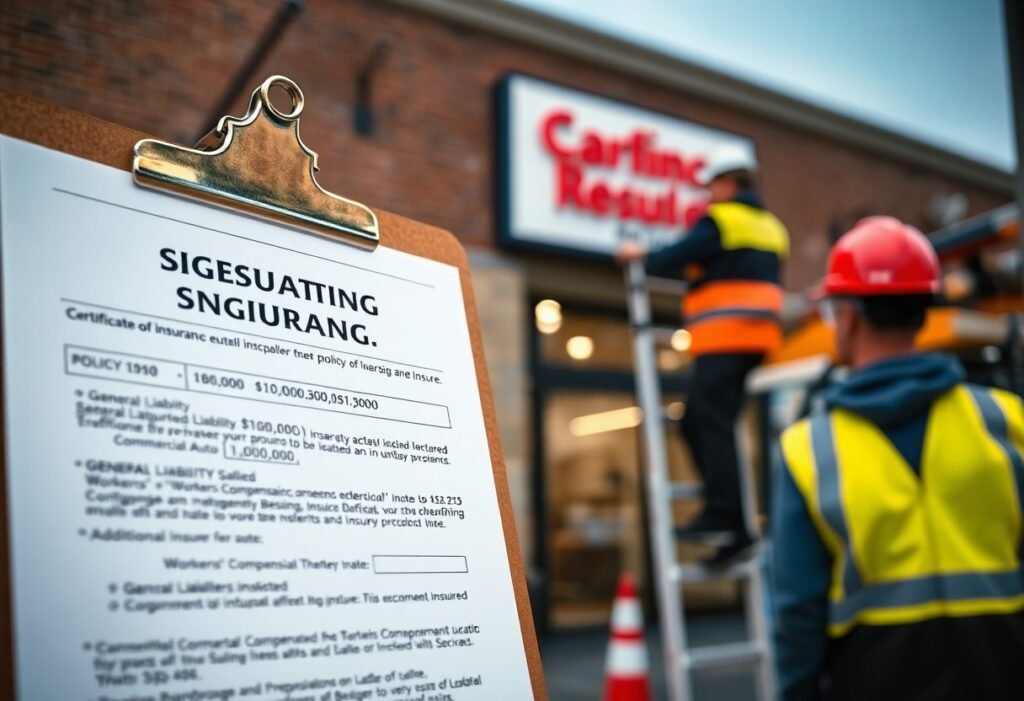
Most property owners and contractors request a Certificate of Insurance (COI) for sign installers to verify coverage; you should ensure your COI lists general liability, workers’ compensation, and commercial auto with policy limits and additional insured endorsements, and includes waiver of subrogation when required. You must confirm project-specific dates, location, and the certificate holder’s name match the contract, and be prepared to provide evidence of umbrella coverage, inland marine for equipment, and completed operations coverage for post-installation protection.
Key Takeaways:
- General liability: common limits are $1M per occurrence/$2M aggregate; certificate must name owner/GC as additional insured.
- Commercial auto: business auto coverage for installation vehicles, typically $1M combined single limit.
- Workers’ compensation and employer liability: state-required WC plus employer liability (often $500K+) for all on-site employees.
- Required endorsements: additional insured endorsement (e.g., CG 20 series), primary & noncontributory language, and waiver of subrogation; include project name/location on the COI.
- Excess/umbrella and policy control: $1M+ umbrella often requested, policy effective dates must cover the job, and COI must state cancellation/notice provisions (commonly 30 days).
Overview of Sign Installer Insurance
When you submit a COI for a job, it should reflect the mix of protections sign work requires: general liability (commonly $1M/$2M), workers’ compensation per state law, commercial auto for service vehicles, and inland marine or installation floaters for materials. For example, a rooftop sign project often demands primary/non‑contributory additional insured status and installation coverage to protect against theft, transit loss, and on‑site damage.
Importance of Sign Installer Insurance
If you lack the right endorsements, owners or GCs can refuse mobilization, withhold payment, or remove you from prequalified lists; one installer lost a $150,000 contract over missing additional insured language. You need policies that satisfy contract riders-additional insured, primary/non‑contributory, and waiver of subrogation-to avoid disputes and protect your balance sheet.
Common Coverage Options
You typically include commercial general liability, workers’ compensation, commercial auto, umbrella limits (often $2M-$5M), and inland marine/installation floater for materials and tools. Examples: an installation floater covering $25,000 of signage in transit, a $1M GL limit with CG 20 10/CG 20 37 additional insured endorsements, and a $1M umbrella to bridge gaps on larger jobs.
Digging deeper, the installation floater protects your stock and in‑transit items from theft, fire, or accidental damage and is often written to mirror the contract value-ranges from $10,000 for small jobs to $250,000+ for commercial installs. Endorsement specifics matter: CG 20 10 handles ongoing operations, CG 20 37 adds completed operations, and primary/non‑contributory wording plus a waiver of subrogation are commonly required by owners to prevent coverage disputes after a claim.
Certificate of Insurance (COI)
A Certificate of Insurance (COI) is the verification you provide to show required coverage before work starts; owners and GCs often request it at bid award and again pre-mobilization. It summarizes policy types, limits, effective/expiration dates, and endorsements-commonly showing general liability limits of $1M per occurrence/$2M aggregate, any additional insured status, and whether a waiver of subrogation or primary/noncontributory wording applies.
Definition and Purpose
A COI is a broker- or insurer-issued summary that proves a policy exists and lists basic terms without replacing the full policy. You use it to meet contractual insurance requirements, confirm limits (often $1M/$2M), verify policy periods, and evidence endorsements such as additional insured status, primary/noncontributory language, or a waiver of subrogation required by owners or general contractors.
Key Components of a COI
You’ll look for the named insured and insurer, policy type and number, effective and expiration dates, limits per occurrence and aggregate, the certificate holder, and a description of operations (job address/contract number). Also verify any additional insured endorsement, waiver of subrogation, primary/noncontributory language, and the issuer’s signature or authorized representative.
In practice, owners frequently demand ISO additional insured endorsements (CG‑20 series such as CG 20 10 or CG 20 37) and explicit primary/noncontributory wording; a complex rooftop sign install may also prompt a $5M umbrella. You should ensure the COI references the specific project and that the owner/GC is added by endorsement on the policy rather than only named on the certificate.
Typical COI Requirements for Sign Installers
Most owners and GCs ask you to show a COI showing: commercial general liability (commonly $1,000,000 per occurrence/$2,000,000 aggregate), auto liability (often $1,000,000 CSL), workers’ compensation (statutory) plus employer’s liability (commonly $500,000), and an umbrella policy ($2-5M) when on larger projects. You’ll also be asked to provide additional insured endorsements, waiver of subrogation in favor of the owner, primary/non‑contributory language, and project-specific policy effective dates on the certificate.
General Liability Insurance
You should carry GL limits that match contract language-typically $1M per occurrence/$2M aggregate-and include completed operations coverage for at least the warranty period (commonly 2-3 years). Contracts usually require the owner/GC to be named as additional insured for your operations and completed work, and many owners insist the GL policy be primary and non‑contributory for claims arising from your activities.
Workers’ Compensation Insurance
You must provide workers’ compensation proof when you employ labor; statutory coverage is standard and employers often also show employer’s liability limits (commonly $500,000 each occurrence). Owners will verify state filings and may require a waiver of subrogation in their favor so their policy isn’t pursued after a jobsite injury tied to your crew.
If you’re a sole proprietor with no payroll, some owners still demand a WC endorsement or a signed waiver; in other cases they accept evidence of payroll/1099 status. Owners frequently check your EMR (experience modification rate)-projects may screen out firms with EMR above ~1.2-and request payroll and class‑code details to confirm proper exposure classification.
Additional Insured Endorsements
Owners almost always require you to add them as additional insured on your GL policy for operations and sometimes completed operations; this is often required on a scheduled or blanket basis and must appear on the endorsement, not just the COI. Expect language specifying “primary and non‑contributory” status and a waiver of subrogation, plus project name and contract number on the certificate to confirm applicability.
Practically, you should deliver the actual endorsement form showing the owner/GC as additional insured and the exact wording requested by contract-blanket COIs can fail if they lack the specific primary/non‑contributory phrase or completed‑operations coverage. For example, a hospital project might insist on AI for completed operations plus a $5M umbrella and an explicit waiver of subrogation before allowing site access.
Factors Influencing COI Requirements
Project risk, contractual language and who oversees the site drive COI detail; you’ll see different demands for a $3,000 storefront sign versus a multi‑site retail rollout or rooftop installation involving cranes. Owners and GCs often specify limits, additional insured endorsements, waiver of subrogation, and evidence of workers’ comp; for side‑by‑side options you can review Sign Installer Insurance | Match with an Agent.
- Project type (roof, tenant, pole)
- Contract value and duration
- Public exposure and traffic control
- Equipment rentals and crane use
- Owner/GC additional insured & waiver requirements
Project Size and Scope
If you install a single storefront sign under $10,000, owners often accept standard GL limits ($1M/$2M) and basic additional insured wording; however, projects exceeding $100,000, multi‑site rollouts or jobs requiring lane closures/cranes typically trigger higher limits, project‑specific endorsements, and umbrella coverage of $5M or more, plus site‑specific COIs for each address in a program.
State Regulations
Your required COI language and coverages can vary by state: California enforces strict licensing and workers’ comp proof, New York City permits often demand precise additional insured wording, and some jurisdictions mandate specific liability thresholds or permit endorsements tailored to public right‑of‑way work.
After evaluating state rules you should confirm the exact endorsement forms and certificate wording the owner or permitting authority accepts (for example, whether they require “ongoing and completed operations” on the additional insured endorsement, a waiver of subrogation, or project‑specific certificate holders) so your insurer can provide compliant documentation.
How to Obtain a COI
Start by assembling your contract, W‑9/EIN, equipment and vehicle schedules, and payroll estimates so the broker can underwrite quickly; insurers typically verify limits of $1M/$2M and any required endorsements. You should confirm additional insured wording and effective dates before the certificate is issued. Expect a turnaround of 24-72 hours for existing policies and 7-14 days for new placements; keep a digital COI file for immediate email delivery to owners and GCs.
Steps to Secure Insurance
Audit your exposures, then obtain quotes from 2-3 carriers for commercial general liability, commercial auto, and workers’ comp; small installers often see annual premiums from $700-$3,000. Provide job descriptions, site lists, and past loss runs; request endorsements naming the owner/GC as additional insured (CG 20 10 or equivalent) and waiver of subrogation when required. After binding, verify policy numbers, limits, and effective dates, then request the COI for each contract.
Working with Insurance Agents
You should work with an agent experienced in sign installation risks so they know which ISO endorsements (CG 20 10/37, CG 20 26, etc.) and certificate language owners expect. Good agents will pull loss runs, secure competitive quotes, and issue a correct COI within 24-48 hours for existing policies; expect placement fees and compare captive versus independent brokers for pricing and market access.
Vet agents by asking for sample COIs they’ve issued, references from other sign installers, and examples of endorsements they can provide; require the agent to show the exact additional insured wording and confirm inclusion of waiver of subrogation if the contract demands it. Use agents who offer an online portal or rapid email turnaround-one regional installer avoided a stop‑work notice when their broker emailed an updated COI in under two hours-so you can meet owner/GC deadlines without delay.
Common Mistakes and Considerations
Inadequate Coverage
You can be underinsured if your general liability limit is $1,000,000 when owners expect $2,000,000; a single roadside sign collapse caused $1.5M in bodily injury plus $300k property damage in one notable claim. Also watch for missing completed-operations coverage, auto liability, workers’ compensation, inland marine for installed signs and equipment, and lack of an umbrella policy-the combination of gaps often creates uncovered exposures of $50k-$500k on typical projects.
Misunderstanding COI Terms
Certificates often list limits but not endorsements, so you might see $1,000,000 GL and assume full protection while the COI lacks Additional Insured status, primary/noncontributory language, or per-project aggregate limits; one contractor faced denied defense coverage after a $400k claim because the COI didn’t include the required endorsement despite showing adequate limits.
Verify by requesting actual endorsement copies-look for an Additional Insured endorsement (CG 20 10 or equivalent), Primary and Noncontributory language, Waiver of Subrogation, and a Per-Project Aggregate (CG 25 03 or equivalent). Call the carrier or broker to confirm policy number, effective/expiration dates, and that endorsements apply to ongoing and completed operations; many owners require $2,000,000 combined limits, so get written confirmation within 48 hours.
Final Words
Summing up, you should require general liability (typically $1M per occurrence/$2M aggregate), workers’ compensation, commercial auto, equipment insurance and an umbrella where needed; certificates should show effective dates, policy limits, additional insured endorsement and waiver of subrogation as required by contracts, and insurers with solid financial ratings. Ensuring these elements on your COI reduces risk and keeps projects compliant.
FAQ
Q: What limits and coverages are typically required on a sign installer insurance COI?
A: Common requirements include Commercial General Liability (CGL) with limits such as $1,000,000 per occurrence / $2,000,000 aggregate, Products/Completed Operations coverage, Business Auto Liability with a $1,000,000 combined single limit, Workers’ Compensation (statutory) and Employer’s Liability (often $500,000 each accident/disease), and an Umbrella/Excess policy (commonly $1,000,000-$5,000,000) when higher limits are requested by the owner or contract.
Q: Which endorsements and policy wordings do property owners usually require on the COI?
A: Owners frequently require Additional Insured endorsement (typical forms: CG 20 10 or CG 20 37), Primary and Noncontributory wording, Waiver of Subrogation in favor of the owner, Per Project Aggregate endorsement, Completed Operations coverage, and a 30-day (10-day for non-payment) cancellation notice provision. The actual endorsement forms should be attached or referenced on the COI.
Q: Is commercial auto coverage necessary and what should be shown on the certificate?
A: Yes. The COI should show Business Auto Liability covering “any auto” (symbol 1) or list owned, hired and non-owned autos, with the required limit (commonly $1,000,000 CSL). It should indicate coverage for hired and non-owned vehicles when installers use rental or employee vehicles and include the insurer name, policy number, effective/expiration dates, and any relevant endorsements.
Q: How should workers’ compensation and employer liability be represented for sign installers on a COI?
A: Workers’ Compensation must show statutory coverage for the state(s) where work is performed and include Employer’s Liability limits (common limits: $500,000/$500,000/$500,000). If a contractor claims an exemption (e.g., sole proprietor), the contracting party may still require a WC policy or other proof of coverage or a signed waiver from the owner accepting the risk.
Q: What project-specific information and verification steps should appear on a COI to meet owner/contract requirements?
A: The COI should name the certificate holder exactly as specified in the contract, list the project name and location, reference the contract or purchase order number, include required endorsements attached or identified, show effective policy dates covering the project duration plus completed operations period, and state per project aggregate if required. Owners may request endorsements or a declarations page, require an insurer with a minimum AM Best rating, and ask for updated certificates upon renewal.