
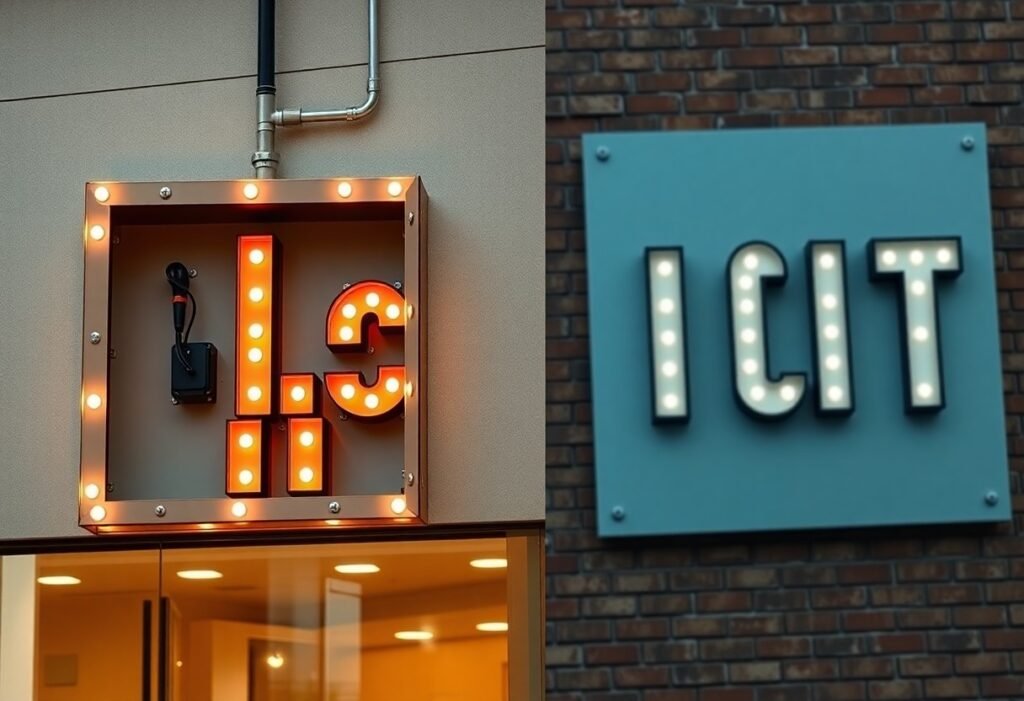
Just think of a raceway as a continuous aluminum strip that houses wiring and power supplies for quicker, uniform installation, while a backer panel is a full-surface substrate that supports individually mounted letters for a cleaner, flush appearance; you should weigh installation speed, maintenance access, appearance, and mounting surface when choosing which fits your project and budget.
Key Takeaways:
- Raceway: a metal trough that mounts multiple channel letters together, hides wiring and transformers, and simplifies installation and servicing.
- Backer panel: a single flat substrate (acrylic, aluminum composite, etc.) that all letters attach to, providing a continuous, uniform background for a polished look.
- Appearance: raceway emphasizes individual 3D letters and separation; backer panel creates a cohesive sign face that can match building finishes or brand colors.
- Installation & maintenance: raceway often allows easier wiring access and faster install on masonry or freestanding locations; backer panels can be quicker for mounting in one location but may require panel removal for service.
- Selection factors: choose raceway for simpler electrical management and quick servicing, choose backer panel for a unified aesthetic or to cover uneven surfaces-cost, wall condition, local code, and desired look determine the best option.
Overview of Channel Letters
Channel letters are the most common illuminated sign type you encounter on commercial façades, built from aluminum returns and acrylic faces in depths typically ranging 3-12 inches and heights from about 12-72 inches. You’ll find front-lit, back-lit (halo), reverse-lit and open-face variants, usually illuminated with energy-efficient LEDs that last 5-10 years. In practice you choose style based on visibility, mounting method (direct, raceway, backer) and brand guidelines.
Definition of Channel Letters
Channel letters are individually fabricated metal cabinets shaped into letters or logos, with acrylic or metal faces and LED illumination inside. When you specify them for a project you pick return depth, face color (Pantone matching is common), trim cap style, and illumination type; construction materials are almost always aluminum for returns and polycarbonate or acrylic for faces to balance durability and light diffusion.
Common Applications of Channel Letters
You’ll see channel letters on retail storefronts, shopping centers, office buildings, hospitals and hospitality properties where 24/7 brand visibility matters. Typical examples include a 24-36 inch front-lit letter package for a strip mall, halo-lit signage for upscale boutiques, and reverse-lit IDs on brick façades for higher contrast at night.
For specification and maintenance you should note national chains often standardize letter heights (18-48 inches) and lighting types to ensure consistency across sites, LEDs usually reduce maintenance visits compared with neon, and mounting choices-direct mount, raceway, or backer panel-affect installation speed, conduit routing and long-term service access.
Understanding Raceways
You’ll find raceways are continuous aluminum enclosures that mount to the façade and carry multiple channel letters, consolidating mounting, wiring, and power supplies into one neat assembly. They typically range from 4-12 inches deep, run the length of the sign bank, and provide hinged or removable access for maintenance, which simplifies service calls and keeps the exterior profile clean.
Definition and Purpose of Raceways
A raceway is a hollow, structural box that houses LEDs, drivers, and wiring while serving as the mounting substrate for channel letters. Its purpose is to conceal electrical components, reduce wall penetrations, and provide a single structural anchor for multiple letters-so one power feed and junction box can replace individual feeds for each letter on a storefront.
Advantages of Raceways for Channel Letters
You gain faster installs, consistent letter alignment, and easier maintenance with a raceway. Installers often report 25-50% time savings on multi-letter runs because you make one attachment and one electrical connection. Additionally, a raceway lets you mount larger power supplies and splice boxes inside the enclosure, lowering on-site wiring complexity and permit costs.
In practice, if you outfit a 20-30 ft storefront with a single 8-10 in raceway, you can mount 6-12 letters on one continuous box, cut wall penetrations from many to one, and access LEDs via the raceway cover for quick swaps-reducing both labor and downtime during service visits.
Exploring Backer Panels
Backer panels give your sign a unified, finished look by mounting channel letters to a single substrate, hiding wiring and simplifying alignment. You’ll see panels made from aluminum composite, acrylic, or steel in thicknesses commonly from 3-6 mm, sized to span multiple letters and reduce wall penetrations. For design variants and examples, see 3 Different Types of Channel Letters To Transform Your ….
Definition and Purpose of Backer Panels
You use a backer panel as a continuous board that supports and frames individual channel letters, providing a consistent background color or material. It serves as a mounting plane that conceals wiring, prevents direct wall penetrations, and lets you create full-bleed illuminated logos or block-style signage across storefronts and façades.
Benefits of Using Backer Panels
You gain faster installation and cleaner aesthetics by mounting letters to one panel instead of anchoring dozens of individual pieces. Panels improve weather resistance, simplify maintenance access, and make it easier to achieve exact spacing and alignment-advantages that matter most on multi-letter storefronts or when matching brand backgrounds is important.
Materials and finish choices extend those benefits: aluminum composite panels resist corrosion and weigh less than solid metal, acrylic offers seamless color and light diffusion, and powder-coated steel provides extra rigidity. In practice, retailers with 8-20 letters often consolidate onto 1-3 panels to cut installer time and reduce wall repairs, while designers use panels to create contiguous illuminated shapes that individual letters alone can’t produce.
Comparing Raceways and Backer Panels
Side-by-side, raceways centralize wiring and speed installation while backer panels present a finished field that hides hardware. Raceways are typically 3-6 inches deep and can house transformers and drivers; backer panels usually use 1/8″-1/4″ aluminum composite or HDU. For runs over 15-20 feet, raceways often reduce install time and simplify future servicing, whereas backers give you a seamless, branded backdrop for smaller, architecturally driven signs.
| Raceway | Backer Panel |
|---|---|
| Continuous aluminum trough; industrial, linear aesthetic. | Solid cut panel (ACM/HDU); clean, sign-like appearance. |
| Depth 3-6 in; designed to house drivers/transformers. | Thickness 3-6 mm ACM or 1/4″ HDU; color-matched finishes. |
| One-piece mount for multiple letters; faster alignment and fewer wall penetrations. | Panel mounts then letters attach to panel; allows complex shapes and graphics. |
| Service via access doors; multiple letters serviced from single point. | Service often per letter or from rear of panel; may require removal of components. |
| Best for long runs, multi-tenant façades, and retrofit jobs. | Best for branded fields, logos, and when you need a flush, architectural look. |
| Higher material for long spans but labor savings; tidy wiring reduces install hours. | Generally lower panel cost per sq ft, but higher labor for individual letter mounting. |
Visual Differences
Visually, raceways give you a continuous bar behind your letters that emphasizes horizontal lines and simplifies multi-letter layouts; backer panels let you create a shaped field or logo background so your sign reads as a single graphic. You can specify die-cut ACM backers for intricate silhouettes or full-color graphics, while raceways are better when you want a bold, utilitarian strip with exposed letter returns.
Installation and Maintenance Considerations
Installation-wise, raceways let you mount one substrate and wire inside, often cutting field labor by an estimated 30-50% on long runs, and they provide access panels for centralized servicing. With backer panels you mount the panel then fit each letter-this can increase install time but gives you a sealed face and fewer visible fasteners; maintenance typically requires per-letter access or rear-panel removal.
For more detail, place LED drivers inside raceways only if you plan ventilation and gasketed access-drivers and transformers need service access and should be mounted on removable plates every 6-10 feet for long runs. LEDs are commonly rated ~50,000 hours (roughly 5-7 years under typical duty), so you should plan driver/module replacement cycles and specify weatherproofing (silicone seals, neoprene gaskets) where the assembly faces moisture. Also verify local code and AHJ requirements for transformer accessibility and conduit routing, since some jurisdictions require external access to electrical components.
Cost Considerations
Budget-wise, you’ll weigh material, fabrication, installation, and long‑term service when choosing raceway or backer; raceways often front-load cost savings via simpler installation while backer panels raise upfront material and finishing expenses but can lower ongoing repair time. Expect regional variance: simple run-of-the-mill raceway jobs might total a few hundred to a few thousand dollars, whereas large custom backer panels frequently push projects into the mid-to-high thousands depending on size and finish.
Cost Implications of Raceways
For raceways you typically pay by the linear foot-rough estimates range $25-$50/ft installed-because fabrication and integrated wiring reduce per‑letter labor. You can save 20-30% on installation time for multi‑letter runs, and a single multi‑tap transformer ($150-$400) often services the whole run, lowering parts cost. Maintenance tends to be cheaper since technicians access wiring through a single channel rather than behind each letter.
Cost Implications of Backer Panels
Backer panels are often quoted by square foot-expect roughly $8-$35/ft² installed-because substrate, edge treatment, and painting add cost; complex shapes and routed faces raise prices. You’ll incur extra framing, sealants, and potentially structural engineering for large panels, plus longer fabrication cycles. Those factors increase initial spend but deliver a finished aesthetic that may justify higher signage budgets for brand impact.
For a concrete example you can compare a 10’×3′ aluminum backer: material and fabrication might be $300-$600, finishing/paint $150-$300, and installation 3-6 labor hours ($200-$600), totaling roughly $650-$1,500 before permits and freight; larger or specialty finishes push that higher. Breaking costs into line items like this helps you decide whether the visual benefit outweighs the premium versus a raceway solution.
Choosing the Right Option for Your Needs
Factors to Consider
You should weigh visibility, mounting surface, maintenance access, and budget: backer panels create a seamless face for high-end branding, while raceways centralize wiring for easier service. Consider substrate – uneven brick often needs a 1/8-1/4 in aluminum or ACM backer – and local code constraints for conduit runs. For multi-letter runs over 20 ft, raceways simplify wiring and reduce field labor. After weighing visibility, cost, maintenance access, and local-code impacts, select the solution that aligns with your priorities.
- Visibility & branding: backer = flush, raceway = modular spacing
- Mounting surface: brick/stucco favor backer panels
- Maintenance access: raceway offers one service point
- Installation speed: raceway faster for retrofits or multi-tenant sites
- Cost & materials: backer panels add material but hide imperfections
- Code/permits: conduit and service access rules vary by jurisdiction
Recommendations by Use Case
If you run a single-brand storefront (40 ft or less) and want a premium, uniform face, choose a backer panel for a clean look; for malls, plazas, or multi-tenant façades where tenants change frequently, pick a raceway to centralize wiring and speed swaps. For rooftop or high-elevation signs above 30 ft, raceways improve serviceability and compliance. When substrate is uneven or you need a custom shaped field, backer panels give you a flat assembly surface.
For example, a 60-ft plaza with ten tenants benefits from a continuous raceway to minimize per-tenant wiring costs and downtime during tenant turnover. Conversely, a boutique retail build-out with custom lettering and flush illumination often justifies the extra material and finish work of a backer panel to achieve the desired aesthetic and conceal wall imperfections.
Final Words
Presently you can decide between a channel letter raceway and a backer panel by weighing installation and appearance: a raceway mounts letters on a single metal box for easier wiring and maintenance while a backer panel provides a continuous aesthetic surface and simpler mounting on irregular walls. You choose raceway for speed and service access, and a backer panel when seamless look and mounting flexibility matter to your brand.
FAQ
Q: What is a channel letter raceway and what is a backer panel?
A: A channel letter raceway is an extruded metal box attached to a wall that houses the electrical wiring, transformers, and mounts the faces of individual channel letters in a straight, continuous row. A backer panel (backer) is a flat sheet-often acrylic, aluminum composite, or metal-mounted to the wall, with channel letters attached to the face of that panel; the backer serves as a visual background and can also conceal wiring when letters are individually mounted to the wall or standoffs.
Q: How do raceways and backer panels differ visually and in finished appearance?
A: A raceway produces a clean, linear look where letters sit on a raised continuous box, often used for single-line signage or where consistent letter depth is desired. A backer panel produces a unified sign area-useful for multi-line messages, logos, or contrasting backgrounds-making the letters appear as part of a single sign surface and allowing more design freedom with shapes, colors, and graphics behind the letters.
Q: What are the installation and maintenance differences between the two?
A: Raceways simplify installation because the electrical components are centralized in one accessible box; mounting and wiring are faster and service access is typically easier via removable raceway covers. Backer panels require routing or surface-mounting of wiring behind or through the panel and individual letter mounts may need more precise alignment; maintenance can be slightly more involved if access behind the panel or letters requires panel removal.
Q: When should I choose a raceway versus a backer panel from a cost and practicality standpoint?
A: Choose a raceway when you want lower installation labor, easier future service, consistent letter depth, or when budget and speed are priorities-raceways typically cost less to install on straightforward single-line signs. Choose a backer panel when you need a branded background, complex multi-line layouts, added weather protection for wall surfaces, or custom shapes and graphics that integrate the letters into a larger visual composition; this often increases materials and labor cost but yields more design flexibility.
Q: Are there structural, permitting, or site considerations that favor one option over the other?
A: Yes. Raceways reduce penetrations and concentrate weight in a narrower area, which can be preferable on weaker facades or where fewer wall penetrations are desired; they also simplify electrical inspections. Backer panels distribute weight across a larger surface and may require additional wall reinforcement or different mounting hardware; municipal sign codes or historic-district rules may favor one approach for consistency with building character, and permit reviewers sometimes require plans showing mounting and electrical access for either option.