
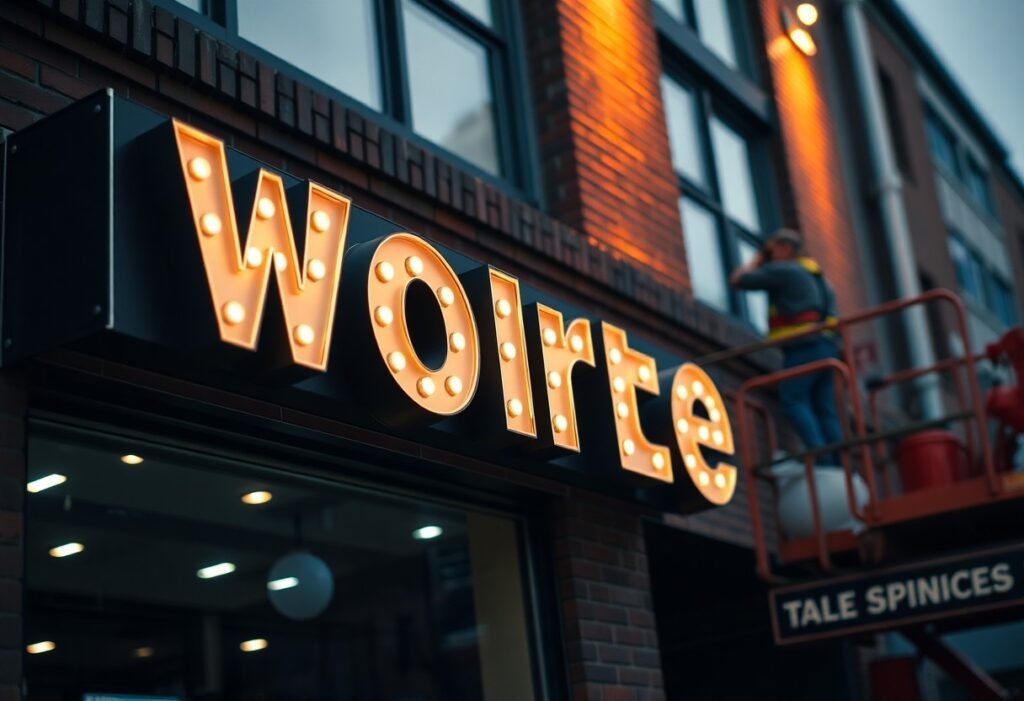
Just think of channel letter signs as three-dimensional, custom-shaped letters or logos-typically metal or acrylic-with built-in lighting that make your brand visible day and night. You use them on storefronts, building facades, and wayfinding displays to reinforce identity, guide customers, and increase visibility from a distance. You can choose front-lit, back-lit (halo), or open-face styles, select materials and colors, and tailor size and mounting to your site and budget.
Key Takeaways:
- Three-dimensional, individually fabricated letters or logos with hollow metal bodies and illuminated faces used for storefronts, building identification, and branded exterior signage.
- Built from aluminum returns, acrylic or polycarbonate faces, trim caps, internal LED modules and power supplies; can be mounted on raceways or directly to façades.
- Common styles include face‑lit (front illuminated), backlit/halo (reverse illumination), reverse‑mounted, and combination signs for mixed lighting effects.
- Enhances brand visibility day and night, supports custom fonts and colors, provides high legibility from distance, and is energy‑efficient when using LEDs.
- Requires planning for mounting method, wiring, weatherproofing, local permits and codes, routine LED/power maintenance, and professional installation for safe long‑term performance.
Definition of Channel Letter Signs
Overview of Channel Letters
Channel letters are three-dimensional characters you mount on building exteriors, typically 12-48 inches tall; they use metal or plastic housings with acrylic faces and are often LED-lit for 50,000+ hour lifespans. You select front-lit, back-lit, or open-face styles to match brand tone and visibility needs. They commonly increase storefront recognition by measurable percentages-studies show up to 35% in high-footfall locations-and are engineered for wind loads, tamper resistance, and local sign codes.
- You can choose front-lit for high daytime and nighttime visibility.
- You can choose halo (back-lit) letters for a premium appearance on glass or stone façades.
- The materials typically used include aluminum backs, acrylic faces, and energy-efficient LED modules.
| Construction | Aluminum shell, acrylic face |
| Height range | 12″-48″ typical; custom larger sizes possible |
| Illumination | LED modules or neon; 2-10 W per linear foot |
| Mounting | Flush, raceway, or wire-mount; permits often required |
| Common sectors | Retail, restaurants, offices, malls |
Types of Channel Letter Signs
You’ll encounter several standard types: front-lit letters with illuminated faces for maximum brightness, reverse-lit (halo) letters that cast light onto the wall for a refined look, open-face neon or LED letters for bold color, and combination letters mixing front and back lighting for contrast. Front-lit often suits fast-service brands while halo fits luxury retailers; costs typically range $200-$1,200 per letter depending on size and finish.
- Front-lit: best for long-range legibility along roadways.
- Back-lit (halo): ideal when you want soft wall illumination and elegance.
- The open-face style exposes neon or LED strips for vivid, saturated color.
| Front-lit | High visibility, daytime & nighttime |
| Back-lit (halo) | Premium, indirect glow on façade |
| Open-face | Exposed lighting for vibrant neon-like effects |
| Combination | Front + halo for depth and contrast |
| Raceway-mounted | Easier service access; good for long runs |
You should factor LED efficiency (50,000+ hours, 3000-5000 K typical), maintenance access via removable faces, and local permitting when choosing types; for example, a 24″ front-lit letter with high-output LEDs may draw 10-30 W and cost $400-$800 installed, while a halo-mounted stainless steel letter of the same size can run 15-35% higher. You’ll also want UL listing and a grounding plan for rooftop or cantilevered installs.
- You should schedule maintenance every 3-5 years for LED modules and seals.
- You should budget for permit fees and possible structural reinforcement.
- The finish options-painted, brushed metal, or plated-affect longevity and cost.
| LED life | 50,000+ hours typical |
| Power draw | 2-10 W per linear foot depending on density |
| Installation cost | $200-$1,200 per letter (size/finish dependent) |
| Maintenance interval | 3-5 years for cleaning and seal checks |
| Regulatory | UL listing and local sign permits often required |
Design and Customization
When designing your channel letters, you can specify dimensions (common heights run 12-48 inches with depths of 4-12 inches), fonts, and finishes to match brand standards; for example, a bank might choose 24″ high, 6″ deep letters with brushed stainless returns for a premium look, while a quick‑service restaurant often picks 18″ acrylic‑faced, front‑lit letters for nighttime visibility. You should also decide mounting-flush, raceway, or wire‑way-and consider local sign code setbacks and illumination limits during the design phase.
Materials Used
You’ll typically see aluminum returns (14-20 gauge) for lightweight, rust‑resistant frames, acrylic faces in 1/8″-3/8″ thickness for crisp front‑lighting, and stainless steel or polycarbonate for high‑impact locations; trims can be powder‑coated or brushed, and vinyl overlays or translucent faces let you reproduce complex brand colors. Selecting materials depends on budget, durability needs, and whether you need serviceability from the front or back.
Lighting Options
You can choose front‑lit (LED behind an acrylic face), back‑lit halo, or combination letters; LEDs often cut energy use by up to 80% versus neon and let you pick color temperatures from ~2,700K to 6,500K or full RGB control for dynamic effects. Consider ambient light levels, viewing distance, and local regulations when choosing brightness levels and illumination style.
In practice, SMD LED modules (commonly 2835 or 5050 packages) are spaced roughly 2-4 inches apart to avoid hot spots in 4-8″ deep returns, powered by 12V/24V drivers sized to total wattage plus a 20% buffer; LEDs are typically rated around 50,000 hours, while neon tubes usually last 10,000-20,000 hours and require higher maintenance, so your choice affects lifetime costs, dimming ability, and dynamic color options.
Applications of Channel Letter Signs
In urban façades, shopping centers and campuses you use channel letters for brand identity, wayfinding and 24/7 visibility; common sizes run 12-48 inches high with 4-12 inch depths and LEDs often rated ~50,000 hours for low maintenance. You can select front-lit, reverse-halo or combination styles to match aesthetic and legibility needs; for technical context see Channel letter.
Retail and Business Signage
For storefronts and malls you choose letters sized 12-36 inches to suit pedestrian and vehicular sightlines, often mounted 6-12 feet above sidewalks; retailers use push-through acrylic faces, built-in logos and dimmable LEDs to maintain brand color and contrast at night. You may prefer raceway mounting for simplified wiring and faster service access in high-traffic locations.
Architectural Signage
On larger buildings you deploy architectural channel letters for campus identity, mixed-use towers and landmark façades, fabricating returns in brushed aluminum, stainless steel or painted metal to complement the elevation. You should evaluate wind load, mounting method (stud, raceway or backer) and local sign codes when deciding scale and placement.
Delving deeper, you’ll pick front-lit, reverse-halo or combination illumination to control light spill and visual depth; typical returns measure 4-12 inches, acrylic faces 1/8-1/4 inch thick, and LEDs are commonly specified at ~50,000 hours. You’ll often require an electrical permit and structural sign review for rooftop or high-elevation installs, and most installers use stud bolts into masonry or welded raceways for secure, serviceable mounting.
Benefits of Using Channel Letter Signs
Visibility and Impact
Channel letters boost your storefront presence both day and night: common heights of 12-48 inches and depths of 4-12 inches create strong legibility from 100-300 feet depending on mounting and lighting. LED front-lit letters give uniform brightness and low power draw, while halo-lit returns add contrast on textured façades. You can select color, size and placement to dominate sightlines on busy corridors and parking lots, turning passersby into potential customers with a single, well-lit statement.
Brand Recognition
Consistent channel lettering reinforces your brand identity by combining custom fonts, Pantone-matched colors and material choices-acrylic faces for crisp color, brushed aluminum for premium appeal. National retailers often use this approach to maintain uniformity across dozens or hundreds of locations, so when you replicate those elements on your sign, customers recognize your brand faster and associate it with professionalism and reliability.
Digging deeper, your choice between front-lit, halo-lit or exposed neon changes perception: front-lit reads boldly from a distance, halo-lit imparts sophistication through a soft backglow, and exposed neon conveys nostalgia or high visibility. You should also consider maintenance cycles-LED modules typically last 50,000+ hours-so design decisions that support consistent appearance over time directly protect the brand equity you’re building.
Installation and Maintenance
For storefronts you’ll coordinate permits, engineered mounting, and electrical hookups; professionals typically mount letters to a raceway or use stainless studs and wall anchors, then run low-voltage wiring to a weatherproof J-box. You should factor in a site survey, wind-load calculations, and a licensed electrician for final connections. Typical installs for a 10-letter façade take 4-8 hours, longer for multi-level or rooftop applications.
Installation Process
Start with a full-scale layout to mark plumb lines and anchor points; installers either drill and epoxied studs into substrate or secure a raceway that houses all wiring. You’ll route LED leads through conduit into driver enclosures, seal seams with UV-stable silicone, and torque stainless fasteners to spec. After powering up, perform photometric checks for uniform luminance and verify that mounting meets local wind and seismic requirements.
Maintenance Tips
Schedule inspections every 3-6 months to clean acrylic faces with mild detergent, check gaskets for compression or cracking, and verify LED color temperature (commonly 3000-4000K) and uniformity. You should also inspect driver enclosures for moisture, confirm connectors are secure, and track lumen depreciation; proactive parts replacement reduces downtime and extends system life.
- Clean faces and trim to remove dirt and pollen that reduce output.
- Inspect wiring and drivers for heat damage; test voltage under load.
- Knowing you should log maintenance dates and keep spare LED modules and a driver on hand to enable same-day repairs.
When troubleshooting, note that quality LEDs often last 50,000+ hours while drivers tend to fail earlier; you should monitor for flicker, gradual dimming, or color shifts as indicators. HVAC vents or heat traps behind letters accelerate aging, so improve ventilation or add thermal breaks when possible; documenting serial numbers and part specs speeds future replacements and warranty claims.
- Replace drivers every 7-10 years in high-use installations to prevent sudden outages.
- Address water intrusion immediately-corrosion often starts within months if seals fail.
- Knowing proactive record-keeping of parts, installation dates, and vendor warranties cuts diagnostic time and lowers long-term costs.
Regulations and Permits
You’ll encounter overlapping rules from zoning, building and historic-preservation codes that control size, mounting height, illumination and placement of channel letters; typical limits include façade coverage caps of 20-30% or absolute sign faces in the 32-50 sq ft range, setback requirements, and special rules for canopy-mounted or rooftop signs – factor these into design choices early to avoid costly redesigns or denials.
Local Signage Laws
You must check municipal ordinances, business improvement district (BID) rules and any HOA or historic-district guidelines: downtown commercial zones often allow full-illumination, whereas residential buffers or historic cores may require non-illuminated, halo-lit or size-restricted letters; cities commonly tie maximum mounting height to storefront cornice or set a 12-15 ft minimum clearance for pedestrian paths.
Permitting Process
You’ll typically submit a sign permit package including scaled site plans, building elevations showing exact letter placement, electrical diagrams, landlord consent and contractor license; review times range from about 2-8 weeks, fees commonly run $50-$500, and final sign inspections plus electrical sign-offs are required before the sign may be energized.
You should prepare for engineering requirements on larger channel letters: local jurisdictions may ask for wind-load calculations per the IBC, anchor details from a structural engineer, UL listings for LEDs, and photometric reports showing nighttime spill light; if your project needs a variance expect hearings and a 4-12 week extension, while small reface jobs can sometimes be fast-tracked in 48-72 hours in smaller jurisdictions.
Final Words
Upon reflecting, you should understand that channel letter signs are three-dimensional, illuminated or non-illuminated letters and logos fabricated from metal and acrylic to form durable branded displays; you use them to increase visibility, reinforce identity, guide customers, and enhance storefront aesthetics by placing them on facades, canopies, or interior walls for day-and-night impact, with customization options to suit your location and budget.
FAQ
Q: What are channel letter signs?
A: Channel letter signs are three-dimensional, individually fabricated letters or logos made from metal and plastic that are used on building exteriors and interiors. Each letter consists of a metal return (sides), an acrylic or polycarbonate face, and a back panel; lighting is installed inside the hollow form so the letters can be illuminated. They are fully custom in size, font, color and finish, and can include logos or complex shapes as channel-built graphics.
Q: How are channel letter signs illuminated and what lighting options exist?
A: Illumination is typically provided by LED modules placed inside the letter cabinet, offering long life and energy efficiency. Common lighting styles include front-lit (light shines through the face), reverse-lit or halo-lit (light projects from the back to create a glow on the wall), open-face (exposed LEDs visible behind a protective diffusing lens), and neon or LED neon alternatives for a continuous glow effect. Color temperature, brightness, and RGB or programmable LEDs can be specified for different visual effects.
Q: In what applications are channel letter signs commonly used?
A: Channel letter signs are used for storefront identification, corporate signage, shopping centers, hospital and campus wayfinding, malls and interior signage, rooftop or pylon signs, and any application where high-visibility, branded exterior signage is needed. Their three-dimensional form and lighting make them effective for nighttime visibility and for creating a professional, on-brand presence at entrances and along roadways.
Q: What are the typical mounting and installation methods for channel letter signs?
A: Common mounting methods include mounting letters to a raceway box that houses electrical wiring, stud-mounting letters directly to the building facade using threaded studs and anchors, and flush mounting to a backing panel or sign cabinet. Installers must provide electrical connections, conform to local electrical and building codes, and may need permits or façade approvals. Structural backing, weather sealing, and proper anchoring are important to withstand wind and weather.
Q: What design, permitting and maintenance factors should be considered when planning channel letter signs?
A: Design factors include scale and viewing distance, font choice and stroke width for legibility, color contrast, illumination style, and material/finish for durability. Permitting considerations involve local sign codes, zoning restrictions, electrical permits, and tenant or landlord approvals. Maintenance items include periodic cleaning, checking and replacing LED modules or drivers, resealing seams to prevent moisture ingress, and inspecting mounts and wiring. Cost and lead time depend on complexity, size, lighting type, and finish, with fabrication typically taking several days to a few weeks plus installation time.