
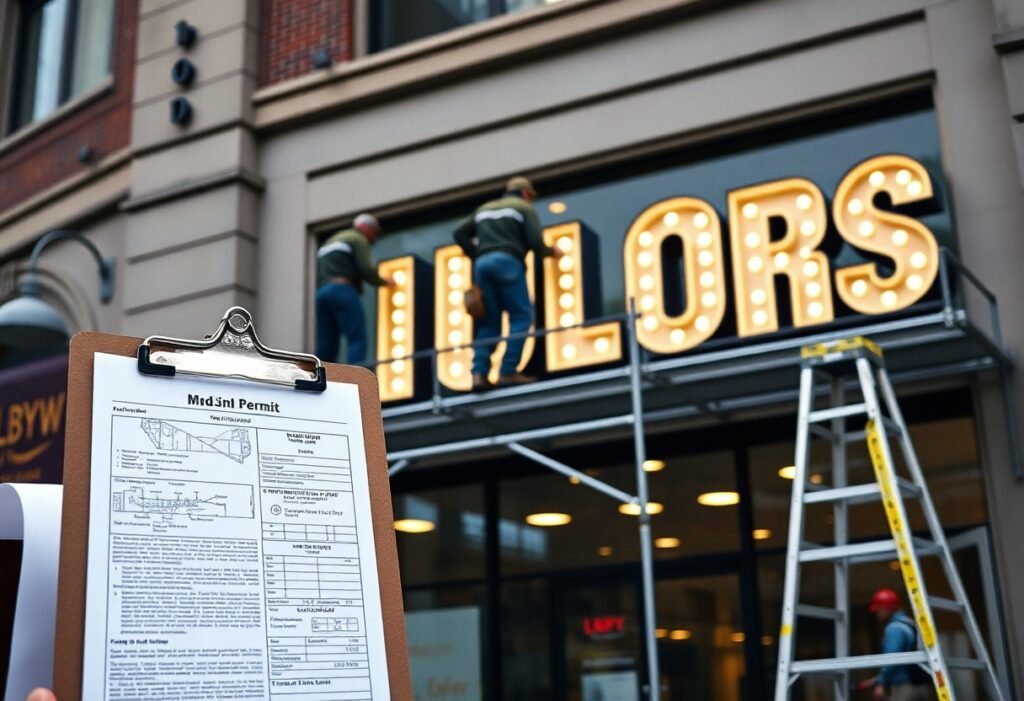
Over the course of planning your storefront, you must verify whether channel letter sign permits are required by your municipality, since rules vary by zoning district, sign size, illumination, mounting method and historic-district controls. Check your local building department and sign code, prepare drawings and electrical plans if requested, and secure approvals before installation to avoid fines or removal.
Key Takeaways:
- New installations or relocations of channel letter signs generally require a permit.
- Permits are needed when the sign’s size, height, area, or structural design exceeds local code limits or is altered.
- Illuminated channel letter signs require electrical permits and inspections for wiring and power connections.
- Signs that attach to or penetrate a building façade typically trigger building permits and review for structural impact.
- Zoning restrictions, historic-district rules, or signs placed in the public right-of-way often require special permits or variances.
Understanding Channel Letter Signs
You’ll encounter channel letters as modular, three-dimensional storefront characters-typically 3-6 inches deep-illuminated by LEDs or neon; many U.S. cities require permits when sign area exceeds about 32 sq ft or mounting height passes 6 ft, and you should factor in a 120-277V supply and a raceway or stud-mounted backing when planning installations and permit applications.
Definition of Channel Letter Signs
Channel letters are individual metal-formed characters with acrylic faces or open fronts that house illumination; you either mount each letter directly to the building or to a continuous raceway, and the fabrication method-returns depth, face type, and internal wiring-affects structural, electrical, and permitting details.
Types of Channel Letter Signs
There are four common types you’ll see: front-lit (face-lit) for direct illumination, halo- or reverse-lit for a backglow, open-face for exposed neon or visible LEDs, and combination letters that mix effects; each style can change permit review because illumination intensity, mounting, and depth influence zoning and electrical requirements.
For example, front-lit letters use diffused acrylic faces with low-wattage LED modules suited to 24/7 visibility, halo-lit installations typically need a 2-3 inch reveal or setback to ensure even glow and may be preferred in historic districts, open-face configurations raise glare and brightness scrutiny, and combination letters can trigger multiple permit categories simultaneously.
- You must verify total sign area, letter heights, and projection limits against local zoning codes.
- You should provide electrical plans showing transformer location and circuiting for inspection.
- Permitting often requires facade-penetration details when letters are stud-mounted through cladding.
- The preferred illumination and finish will influence light-spill controls and permitted operating hours.
| Front-lit | Bold daytime/night visibility; acrylic face with LED modules; common retail choice |
| Halo-lit (reverse) | Creates a 1-3 in glow around letters; needs setback or opaque reveal; favored in sensitive districts |
| Open-face | Exposed neon or visible LEDs; high aesthetic impact but greater glare and brightness scrutiny |
| Combination | Mixes front and halo or open-face elements; may trigger both structural and electrical permit reviews |
| Dimensional/specs | Typical depths 3-6 in, heights 8-48 in; many jurisdictions flag permits when area >32 sq ft |
Permitting Requirements
You’ll need to verify local thresholds for size, illumination, and placement: minor storefront decals often skip permits, while externally illuminated channel letters usually require submissions. Expect to provide scaled elevations, mounting details, electrical schematics, and sometimes a licensed engineer’s stamp confirming anchor and wind/seismic calculations to meet building-code standards.
When Permits Are Required
You must secure permits when letters exceed area limits (commonly 16-32 sq ft), are illuminated, or alter the façade; many cities also treat changes to electrical service as a separate permit. Typical fees run $50-$1,000 and municipal review times vary from 7-30 days, with additional historic-district reviews adding weeks.
Common Regulations Governing Permits
You’ll face rules on total sign area, maximum height above grade, required setbacks, and illumination limits (often specified in lux or candela at a set distance). Municipal codes frequently restrict animated content, mandate approved materials/finishes, and require contractor licensing plus liability insurance before issuing permits.
You can shorten reviews by submitting a complete compliance packet-scaled elevations, electrical schematics, photometric reports showing lumen output at a specified distance, and engineer-stamped anchor details. In practice, providing lighting specs, bolt sizes, and wind/seismic calculations upfront often reduces municipal turnaround from ~30 days to under 10 business days.
Application Process
When you submit a channel letter permit application, plan for municipal review times of roughly 2-8 weeks and fees typically ranging from $50 to $500; electrical permits are often filed separately. Many jurisdictions require contractor licensing, proof of property owner consent, and an inspection after installation. Some cities (e.g., larger metros) will also demand engineered attachment details for signs over ~50 sq ft or for canopy-mounted letters, which can add 1-2 weeks and $200-$800 for engineering review.
Steps for Applying
Start by confirming local code and zoning setbacks, then prepare scaled site and elevation drawings. Next, gather electrical schematics, UL listings, and contractor credentials before submitting online or in person. Pay application and plan-check fees, allow 2-8 weeks for review, respond to plan-check comments, and schedule final inspections once installed. If structural calculations are required, factor in an extra engineering review and revised submittals.
Required Documentation for Permits
Typical required documents include a site plan, scaled elevation drawings (commonly 1/4″=1′-0″), mounting and attachment details, electrical wiring diagram, UL/ETL listings, proof of contractor license and insurance, property owner consent, and stamped structural calculations when the sign exceeds about 50 sq ft or alters building attachments.
Scaled drawings should show exact sign dimensions, setback from property lines, distance to windows/doors, and mounting method with anchor sizes. Electrical schematics must list circuit breakers, conductor sizes, LED wattage, and transformer locations. Engineering stamps are usually required for wind and seismic loads; obtaining them can take 3-14 days and cost $200-$800 depending on complexity. Keep copies of all submittals for inspections and future renewals.
Local Ordinances and Zoning
Municipal zoning and sign codes dictate whether your channel letters require a permit, where they can be located, and how they must be illuminated. You’ll encounter zoning map designations-commercial, mixed‑use, historic, or residential overlays-that set maximum sign area, setback, and height limits; for example, many downtown districts limit sign coverage to roughly 10-30% of a storefront façade and restrict internal illumination near residences.
Importance of Local Zoning Laws
Your compliance with local zoning prevents stop‑work orders, civil fines, or costly removals. Local rules also determine required documentation-scaled elevations, electrical permits, and engineer-stamped attachments for façades over 6 inches of penetration-and whether you need a certificate of appropriateness in historic districts, where internally lit faces are often prohibited.
Variations in Regulations by Location
Regulations vary by jurisdiction and context: highway corridors often allow taller letters (up to 48-60 inches) and larger areas, while neighborhood commercial zones cap heights at 12-24 inches and impose illumination curfews. You’ll also find different enforcement levels-some cities process permits in 2-4 weeks, others require public hearings that extend review to 8-12 weeks.
For more detail, note that historic districts commonly mandate a public review and approvals that can take 6-12 weeks and may require non‑illuminated or externally lit channel letters; variance requests generally involve a 4-8 week hearing cycle and require proof of hardship or unique site conditions. Homeowners associations and business improvement districts add another layer of design review and may levy separate fees or deny illuminated signage outright.
Impact of Non-Compliance
Failure to get permits can cost you fines, removal, and delayed openings; many municipalities levy daily penalties-often $100-$500 per day, sometimes exceeding $1,000-and enforcement can include stop-work orders and mandated sign removal. If you want to avoid delays and learn the proper steps for permit applications, see How to Pull A Business Sign Permit for practical guidance.
Penalties for Operating Without a Permit
Municipal fines commonly range from $250 to $5,000 per offense, with daily penalties of $100-$1,000 for ongoing violations; you can also face business-license suspensions, stop-work orders, and orders to remove signage at your expense. Repeat violations often escalate to misdemeanor charges and higher fines.
Possible Legal Issues
Beyond fines, you risk civil litigation, code-enforcement liens, and being held liable if an unpermitted sign causes injury; your insurer may deny coverage for claims tied to noncompliant installations, and courts can issue injunctions forcing removal.
In severe cases municipalities pursue criminal charges for willful code violations-penalties include fines up to $10,000 or jail time in some jurisdictions-and civil plaintiffs can seek statutory damages plus repair and removal costs; you should budget for legal fees, potential settlements, and expedited removal costs that commonly run $1,000-$20,000.
Tips for Ensuring Compliance
Start by assembling your documents-site plan, elevation drawings, electrical schematics, and photos of the mount-and confirm which approvals apply to your storefront; incomplete packets cause 2-8 week re-submittals and extra fees. Check size caps, illumination rules, setbacks and any historic-district overlays that often add constraints or require variance hearings. Maintain digital and printed copies of permits and inspection reports. The checklist below highlights immediate steps.
- Confirm local size and illumination thresholds before fabrication
- Obtain electrical and building permits and schedule inspections
- Keep stamped drawings, insurance certificates, and final inspection sign-offs on file
Researching Local Requirements
Use your city’s permitting portal and call planning and building departments to verify thresholds-many jurisdictions trigger permits for signs roughly between 32 and 100 sq ft or for illuminated displays-and to obtain zoning maps and sign-code sections; expect municipal review times of 2-8 weeks and fees commonly ranging $50-$500, with separate electrical or tenant-improvement charges in some areas.
Consulting with Professionals
Engage a licensed sign contractor and a licensed electrician early: contractors prepare scaled drawings, coordinate electrical permits, and handle municipal submittals, while electricians ensure code-compliant wiring and inspections; typical permit-package fees run about $300-$1,200 or $75-$150/hr for consultations, and many contractors will pull permits and attend final inspections for you.
Verify licenses, insurance and past permit numbers and ask to see stamped plans and example permit files; you should require engineered mounting details when attaching to masonry or parapets, insist the contractor obtain the electrical permit and final sign-off, and retain all stamped drawings and inspection records in your lease or asset folder for future tenants and audits.
Conclusion
From above you should obtain a channel letter sign permit whenever you add, replace, relocate, enlarge, or illuminate individual letter signage, or when local zoning, historic-district rules, electrical hookups, building facade changes, or placement in the public right-of-way are implicated; standards vary by jurisdiction, so you must consult municipal sign codes and the permitting office before ordering or installing to avoid fines, required removal, or delays.
FAQ
Q: When are channel letter sign permits required?
A: Permits are usually required whenever a channel letter sign is installed, altered, relocated, electrically connected, changes size or illumination, or affects the building envelope. Most jurisdictions treat channel letters as regulated signage that require a sign permit and often an electrical permit if the sign is illuminated. Requirements vary by municipality and by whether the property is commercial, within a shopping center, or in a special district (historic, downtown, highway corridor).
Q: What local factors determine whether a permit is needed?
A: Key factors include zoning designation, sign size and height, type (wall-mounted, projecting, roof-mounted), illumination or animation, placement relative to property lines and rights-of-way, and district restrictions (historic or overlay zones). Homeowner association rules and lease covenants can impose additional permit-like approvals. Municipal sign codes and zoning ordinances specify thresholds-e.g., free-standing signs over a certain square footage or illuminated signs typically require permits and plan review.
Q: What documentation is typically required to obtain a channel letter sign permit?
A: Common submittals are scaled elevation and plan views showing sign dimensions and location on the building; mounting and attachment details; structural calculations or engineer stamp if required (wind and seismic loads); electrical wiring diagram and permit; cut sheets for letters and illumination components; proposed lighting controls and color/brightness information; site plan indicating setbacks and obstructions; proof of property ownership or tenant authorization; contractor’s license and insurance; and photos of the existing facade. Historic districts or special overlays may require additional design compliance documentation.
Q: How long does the permitting process take and what inspections are typical?
A: Review times vary from a few business days for simple permits to several weeks or months for complex or district-reviewed projects. Expedited services may be available for a fee. Typical inspections include structural/anchorage inspection and electrical rough and final inspections. If installation affects the public right-of-way, an encroachment permit or separate review may add time. Permit issuance may be contingent on approvals from planning, building, and sometimes public works or design review boards.
Q: What are the consequences of installing channel letters without a permit?
A: Consequences can include stop-work orders, civil fines, required removal or retroactive permit and correction work, denial of final inspection, liens or withheld certificates of occupancy, and complications when selling or refinancing the property. Insurance claims for non-permitted work may be denied. Requiring corrective work can be costly and may include structural or electrical upgrades to meet code.