
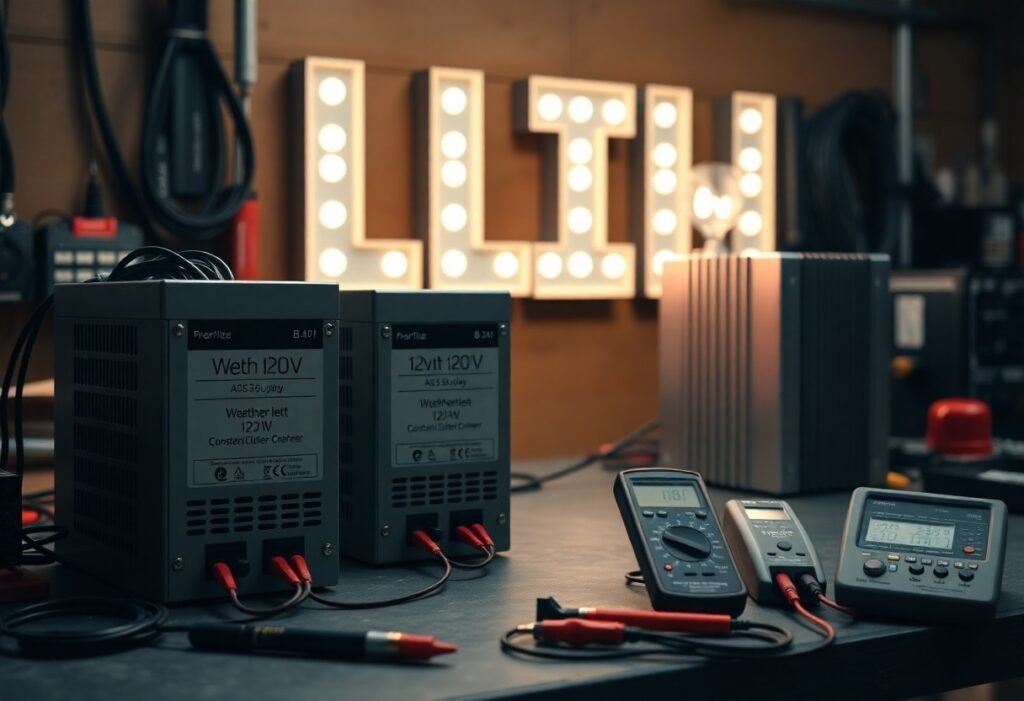
letter sign power supplies come in constant-voltage (12V/24V) and constant-current versions, and you should select based on your LED modules, run length, and brightness. Consider wattage sizing, IP rating for outdoor mounting, UL listing, surge protection, mounting location, dimming capability, and redundancy for reliability. Proper load calculation and ventilation ensure long life and stable performance for your signage.
Key Takeaways:
- Match driver type and output: choose constant-voltage (12V/24V) for parallel LED runs or constant-current (e.g., 350mA/700mA) for series modules, and ensure output amperage/wattage exceeds the total load.
- Decide remote vs in-can mounting: remote drivers simplify heat management and serviceability; in-can (potted) drivers save space but require good ventilation and appropriate sealing for outdoor use.
- Select environmental and safety ratings: use IP/NEMA-rated, weatherproof drivers for exterior signs and prefer UL-listed/Class 2 units with built-in short‑circuit, overcurrent and surge protection.
- Account for temperature and load derating: size the supply ~20-30% above continuous load and follow ambient temperature specs to prevent thermal shutdown and shorten lifespan.
- Consider control features and wiring: pick supplies with required dimming or multiple outputs, plan for voltage drop and correct wire gauge, and provide proper fusing and surge protection for each run.
Understanding Channel Letter Power Supplies
When specifying power for channel letters, you should match driver topology to LED layout: constant-voltage (12V or 24V) for parallel strips and modules, constant-current drivers (350mA, 700mA) for series high‑power LEDs. You must size wattage by totaling all runs and adding 20-25% headroom; for example, a 12V run drawing 5A is 60W, so a 75-100W supply is appropriate. Prefer UL/ETL-listed, high-efficiency units with IP65+ enclosures for exterior installs.
Types of Power Supplies
You’ll commonly choose among constant-voltage (12V/24V), constant-current (350mA/700mA), dimmable drivers (0-10V, PWM, triac), Class 2/UL-listed units for limited-power runs, and IP-rated enclosed supplies for outdoors. Each option affects wiring, dimming compatibility, and mounting constraints. Recognizing the trade-offs in voltage tolerance, dimming method, and enclosure form factor will guide your selection.
- Constant-voltage: 12V/24V strips and parallel LED modules
- Constant-current: series LEDs, specify mA (e.g., 350mA, 700mA)
- Dimmable (PWM/0-10V/triac): compatibility with controllers
- Class 2/UL-listed: safer for long or multi-run wiring
- IP-rated/enclosed: weatherproof for exterior channel letters
| Constant‑Voltage (12V/24V) | Best for parallel LED strips; easy to splice and feed multiple points |
| Constant‑Current (350/700mA) | Use with series high‑power LEDs to control current per string |
| Dimmable Drivers | 0-10V, PWM, triac options; match driver protocol to controller |
| Class 2 / UL‑Listed | Limited output for safer wiring and code compliance |
| IP‑Rated / Enclosed | Weatherproof housings for outdoor, wet locations |
Voltage and Wattage Considerations
You should compute total watts by summing each letter’s module wattage and converting amps to watts: watts = volts × amps. For instance, a 24V run drawing 3A is 72W; add 20-25% headroom and select a 90-95W supply. For constant‑current systems, total current equals mA × parallel strings (e.g., four 350mA strings = 1.4A), then multiply by system voltage to get watts.
Account for voltage‑drop over long runs: 12V systems often suffer noticeable drop beyond 5-10 ft, while 24V tolerates longer runs-still plan multiple feed points every 10-20 ft on long façades. Use proper wire gauge (for example, 18 AWG for short 5A runs, 14-12 AWG for longer or 10-15A runs) and place drivers near letter groups to minimize losses. Size supplies with 1.25-1.4× continuous‑load margin, add short‑circuit/fuse protection, and derate for high ambient temperatures (add ~10-20% margin if mounted in hot enclosures).
Choosing the Right Power Supply
When sizing power, you should total your LED wattage, add a 20-30% safety margin, and factor mounting location and ventilation; consult Channel Letter Installation: Remote Power Supplies for guidance on remote placement, conduit runs, and service access.
Matching Power Supply to Channel Letters
Match voltage (12V vs 24V) to your LED modules, then size wattage: if your letters draw 120W total, choose a 150W-160W supply (25-33% margin). For long runs, prefer 24V to cut voltage drop; and if you plan to dim, pick a driver with <5% ripple and compatible dimming protocol (0-10V, PWM, or DMX).
Factors to Consider in Selection
You should check environmental rating (IP65/IP67 for outdoors), UL/ETL listings, efficiency (>85% preferred), thermal derating (many drivers lose 10-20% capacity above 40°C), and inrush current for large parallel arrays to avoid nuisance tripping.
- Total measured wattage plus 20-30% for continuous load and aging.
- Wire gauge and run length-12V more sensitive to voltage drop than 24V.
- Mounting location: internal drivers increase heat in letters; remote reduces interior temperature.
- The recommended safety margin is 20-30% above your calculated load.
For cabling and protection, you should use correct AWG: 12V runs under 5A OK on 18 AWG, 5-15A use 14 AWG, over 15A use 12 AWG; fuse each supply at ~125% of running current, add surge protection (MOV/TVS) in lightning-prone areas, and allow a 10-20% derating for ambient temps above 35-40°C.
- Specify UL/ETL-listed drivers for code compliance and insurance acceptance.
- Choose IP67 remote enclosures if the supply will be exposed to moisture.
- Include accessible disconnects and ventilation to extend driver life.
- The service loop and accessible disconnect make maintenance safer and faster.
Installation Best Practices
When installing channel letter power supplies you should mount them in ventilated, weatherproof enclosures (IP65+ for outdoor), keep runs short to limit voltage drop (ideally within 5-15 ft / 1.5-4.5 m), derate by 10-20% above 40°C ambient, and secure units on vibration-free surfaces; for example, a 120W LED load is best paired with a 150W supply and routed in conduit to protect wiring from rodents and moisture.
Safety Precautions
You must ground the supply and use GFCI-protected circuits for outdoor installs, follow local NEC rules for continuous loads (size breakers at load/0.8), and employ proper PPE and lockout/tagout during service; test polarity and insulation with a multimeter before energizing and fit overcurrent protection at the panel and at the supply output.
Wiring and Connections
You should wire LEDs in the correct topology: parallel for constant-voltage (12/24V) systems and series for constant-current runs, using appropriate wire gauges (18 AWG up to ~5 A, 16 AWG up to ~10 A, 14 AWG above ~10 A) and aiming for under 3% voltage drop (0.36 V on 12V systems); use soldered joints or IP68-rated connectors and seal all outdoor connections.
For more reliability, use tinned-stranded copper conductors in conduit (THHN for fixed, silicone-insulated flex for tight bends), add inline fuses or polyfuse each branch (e.g., a 2 A branch → 3 A fuse), crimp with ferrules, and test voltage at the furthest LED under load before final sealing; when using multiple supplies, balance loads and employ distribution blocks with individual fusing to isolate faults quickly.
Troubleshooting Common Issues
When signs flicker, dim, or go dark, isolate whether the fault is the driver, wiring, or LED modules by checking fuses, breakers, and connectors first; measure input and output voltages-an output sag over 5-10% under load often indicates driver failure. You should also watch operating temperature (supplies above ~60°C age faster) and keep a labeled spare for quick swap-testing to confirm root cause.
Identifying Power Supply Failures
Use a multimeter and, if available, an oscilloscope to confirm output voltage and ripple-ripple above ~5% RMS frequently causes visible LED flicker. You should measure voltage under full load and inspect crimps and solder joints for corrosion or looseness; thermal imaging can reveal hotspots 10-30°C above ambient that point to failing drivers or poor connections.
Solutions for Common Problems
Tighten or re-crimp loose connections, replace undersized drivers with units rated 20-30% above measured load, and add soft-start/inrush limiters on large runs to stop nuisance tripping. You should upgrade to IP65+ enclosures outdoors, fit correct output fusing, and consider splitting a 200W run into two 100W supplies to lower stress and add redundancy.
When faults persist, perform a swap test by powering the LED run from a bench supply at nominal voltage-if brightness returns, replace the driver. You should log inrush current (a 24V 200W supply can show 20-30A peak), verify per-channel current for constant-current drivers (e.g., 350mA or 700mA) with a clamp meter, and deploy N+1 redundancy for mission-critical signs.
Maintenance and Longevity of Power Supplies
Scheduled inspections, proper ventilation and conservative loading define real lifespan more than advertised specs; you should expect typical LED drivers to last 50,000-100,000 hours (about 5.7-11.4 years continuous) if kept below 40°C ambient and de‑rated to 70-80% load. Perform preventive maintenance every 6-12 months, track runtime hours, and choose units with high MTBF and quality electrolytic capacitors to reduce premature failures.
Routine Checks
Perform visual inspections for bulging capacitors, corrosion, or condensation and use a multimeter to verify output voltage within ±5% under load; measure ripple if flicker is reported. Check fans and vents for dust, confirm connectors are tight, and use thermal imaging to spot hot spots. In harsh or coastal sites inspect quarterly, otherwise every six months is a practical cadence.
Extending Power Supply Life
De‑rate supplies to 70-80% of maximum, maintain ambient temperatures under 40°C, and install surge protection and dust filters to reduce electrical and particulate stress. Select IP‑rated enclosures (IP65+) for outdoor letters, choose drivers with higher MTBF and low‑ESR capacitors, and plan component replacement intervals-electrolytics often need attention after 3-5 years in hot environments.
For installation details, mount power supplies vertically with 2-3 cm clearance for convection, route cables to avoid heat sources, and add forced ventilation or thermostatically controlled fans where ambient exceeds 35°C. Keep a maintenance log of runtime and repairs, replace failing electrolytic capacitors promptly, and specify UL/CE certified surge devices; these practical steps drastically reduce thermal cycling and electrolyte degradation that commonly shorten service life.
Summing up
From above, you should evaluate constant-voltage vs constant-current drivers, remote vs internal supplies, and UL-listed, efficient, IP-rated units to match your channel letter type, run length, and dimming needs. Consider voltage drop, gauge and run, thermal management, surge protection and redundancy for reliability. Proper sizing and placement reduce failures and simplify maintenance, ensuring your signage performs consistently and safely.
FAQ
Q: What types of power supplies are used for channel letters and how do I choose?
A: The most common are constant-voltage supplies (12V or 24V) for LED strips and many module systems, and constant-current drivers (specified in mA) for high-power LEDs or when LEDs are driven in series. Choose constant-voltage for modular, parallel LED configurations; choose constant-current for series LED strings or fixed-current LED engines. Use switching (SMPS) designs for efficiency and compact size; linear supplies are heavier and less efficient but simpler. Verify dimming compatibility (PWM vs 0-10V or analog), confirm UL/cETL listings for sign use, and match output type to your LED load and control method.
Q: How do I size a power supply for one or multiple channel letters?
A: Add the wattage of every LED, transformer, and accessory in the sign to get total load. Multiply that total by a safety margin-commonly 20-30%-to avoid continuous operation near maximum rating and to allow for inrush and aging. Account for ambient temperature derating (supplies lose capacity at higher temps) and any startup current spikes. If total load or run layout is large, split into multiple supplies placed near groups of letters to reduce wiring losses and balance loads.
Q: What IP/NEMA ratings and mounting arrangements should I consider for outdoor channel letter power supplies?
A: For exposed outdoor installations choose weatherproof enclosures (IP65 or higher, or NEMA 3R/4 when applicable) to protect against rain and dust. If you place the supply inside the building or behind the sign face in a sealed cabinet, ensure adequate ventilation or use a supply rated for enclosed spaces and higher ambient temperatures. Use sealed connectors and grommets at cable entry points, provide drainage or desiccant for condensation-prone locations, and locate the supply where it is accessible for service but protected from direct water and physical damage.
Q: How do I manage voltage drop and wiring for long runs or multiple channel letters?
A: Minimize voltage drop by choosing thicker wire (lower AWG number), keeping run lengths short, or distributing power from multiple feed points. Using 24V systems cuts voltage drop compared with 12V for the same run and load. Calculate expected drop (Vdrop = I × R) and keep it below LED manufacturer limits (often 3-5%). If runs are long, feed the far end from a second supply or use higher-voltage distribution with local regulators or DC-DC converters near each letter.
Q: What safety, code, and control features should I require when selecting a channel letter power supply?
A: Specify UL/cETL listing for sign use, built-in overcurrent and short-circuit protection, and thermal overload behavior. Include surge protection and proper grounding. Ensure service access and strain relief for field wiring, and verify compatibility with your dimmer or control system (PWM frequency, 0-10V, DMX, etc.). Follow local electrical and sign codes for mounting, conduit, and disconnects, and provide clear labeling for voltage and circuit identification to aid maintenance and inspection.