
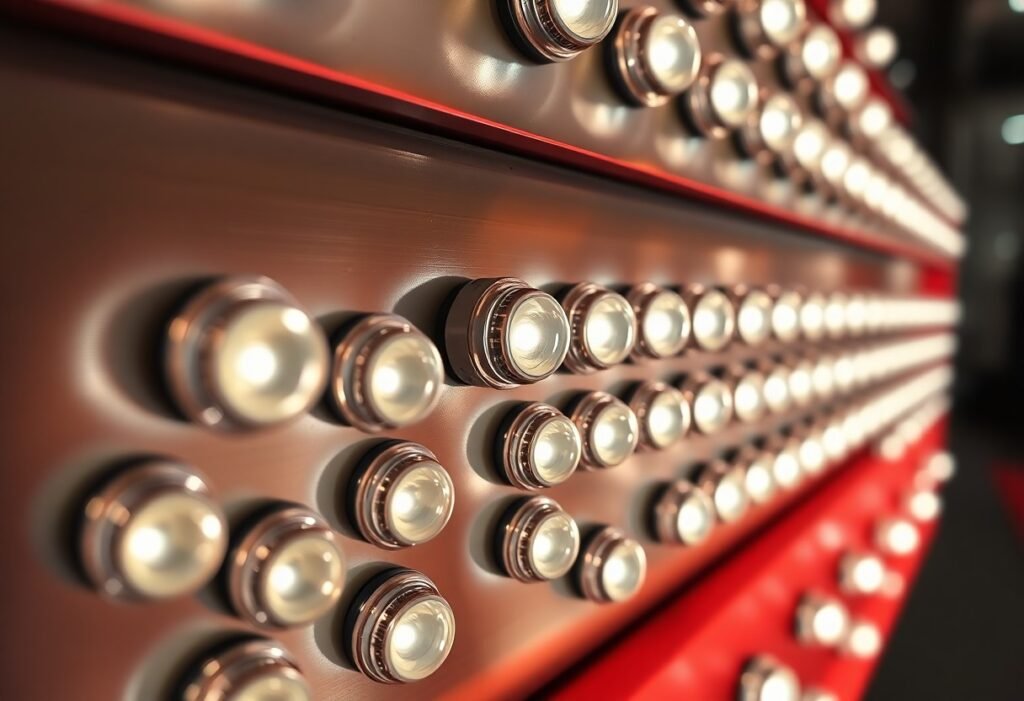
Just so you know, channel letter LED modules are compact lighting units you install inside or on the face of channel letters; they house LEDs, lenses, and mounting clips so your signage is illuminated evenly and efficiently. You wire them to a constant-voltage power supply, connect modules in runs with quick-connects or soldered joints, and optionally control them with dimmers or color controllers; their modular design simplifies replacement and lowers energy use while maintaining consistent brightness and color.
Key Takeaways:
- Purpose and design: small, weatherproof LED modules built to fit inside channel letters, typically comprising LEDs on a PCB, a lens or diffuser, a housing and electrical connectors.
- How they work: modules are wired to a low‑voltage DC driver; LEDs emit light that is diffused by the letter face or back to create even illumination, with spacing and beam angle determining uniformity.
- Types: available as single‑color (white), RGB/RGBW color‑changing, and addressable pixel modules, in rigid or flexible housings and various beam angles.
- Installation and maintenance: mounted with screws, clips or adhesive and connected with plug‑and‑play leads; many are IP‑rated for outdoor use and can be replaced individually.
- Advantages and tradeoffs: provide energy efficiency, long life and high brightness; proper thermal management, driver compatibility and module spacing are important for optimal performance.
What are Channel Letter LED Modules?
Definition and Overview
In channel letters, LED modules are compact, pre-wired light units you mount inside each letter to produce consistent, even illumination. They run on 12V or 24V DC, commonly use SMD or COB chips, and typically last 40,000-60,000 hours. Output ranges from about 20-200 lumens per module depending on type and spacing, and many modules carry IP65 or better ratings so you can choose weatherproof options for exterior signage.
Types of Channel Letter LED Modules
You’ll encounter several common types: SMD3528 for low-power, soft face lighting; SMD5050 for higher brightness in back-lit letters; COB modules for seamless, shadow-free surfaces; high-output modules for tall facades requiring long throw; and RGB modules when you need color-changing effects. SMD5050 typically draws ~0.24W per LED while 3528 is about ~0.08W, and most modules pair with 12V/24V constant-voltage drivers.
- SMD3528 – low power and soft glow for close-range letters.
- SMD5050 – higher lumen output for larger or deeper channels.
- COB – uniform surface illumination with minimal hotspotting.
- High-output – 1-3W modules for long-throw or very large letters.
- Any RGB modules enable dynamic color sequencing for promotions and events.
| SMD3528 | ~0.08W/LED, 20-50 lm/module, best for short-throw, soft face fills |
| SMD5050 | ~0.24W/LED, 60-150 lm/module, suited to back-lit and larger letters |
| COB | Seamless light, high CRI, reduces hotspots on acrylic faces |
| High-output | 1-3W/module, used on tall signage where distance to viewer is large |
| RGB | Color-change capable, requires controller and compatible driver |
When you choose modules, factor in spacing (commonly 25-75 mm or 1-3 in between modules), target lumen per letter (many designs aim for 500-2,000 lm per letter depending on size), and driver sizing – allow ~20% power headroom. You should also consider thermal management: dense arrays or high-output modules need aluminium channels or heat paths to maintain lifespan above the typical 40k-60k hour range.
- Plan module spacing based on letter depth and face material to avoid banding.
- Size power supplies with at least 20% extra capacity over calculated load.
- Choose IP65+ modules for exposed exterior installations to prevent moisture ingress.
- Use COB or closely spaced SMD for acrylic faces to achieve uniform brightness.
- Any faulty modules should be replaced promptly to prevent localized overheating and uneven illumination.
How Do Channel Letter LED Modules Work?
You feed pre-wired LED modules with a constant-voltage DC driver (commonly 12V or 24V), then mount them inside each letter so they illuminate evenly; modules use SMD chips (e.g., 2835/3528), silicone potting for IP65 protection, and lenses or diffusers to control beam spread, delivering roughly 15-100 lumens per module depending on type and spacing.
Basic Functionality
Each module contains 1-3 LED chips with a current-limiting circuit or resistor, so you rely on the driver to regulate voltage while the module shapes light with lenses and diffusers; typical color temps run 3000-6500K and viewing angles are around 120°, letting you balance brightness, uniformity, and energy use per letter.
Wiring and Installation Process
You daisy-chain modules inside the channel and run a positive/negative feed to the power supply, calculating load: for example, 50 modules at 60 mA each on a 12V system draw 3.0 A, so you’d pick a 12V, 4 A driver (20% headroom); mount modules with rivets or high-bond tape and seal entry points to maintain IP rating.
Voltage drop and safety matter: keep 12V runs short (under ~5 m/16 ft) or use 24V for longer runs, select wire gauge accordingly (18 AWG for >3 A runs), add inline fuses or distribution blocks, test voltages with a multimeter after installation, and choose UL/ETL-listed drivers to meet code and ensure long-term reliability.
Advantages of Using Channel Letter LED Modules
Beyond appearance, channel letter LED modules give you tangible operational and branding benefits: energy reductions up to 70-80% versus neon, more uniform face illumination for easier night-time reading, faster installs that cut labor hours, and a wide palette of color temperatures and beam angles for consistent brand presentation. Many retailers report 50-70% lower electricity bills and noticeably fewer maintenance visits after converting storefront signage to LED modules.
Energy Efficiency
Typical channel letter modules run about 60-120 lm/W and draw roughly 0.5-5 W per module depending on size and output. You can expect 50-80% lower consumption compared with neon or fluorescent options; for example, a 100-module sign at 2 W per module uses ~1,752 kWh/year, so switching to 1 W modules roughly halves that load. Dimmable drivers and scheduled timers further reduce runtime and costs during off-hours.
Longevity and Durability
LEDs are usually rated 50,000-100,000 hours (L70 commonly ~50,000 h), meaning you rarely change modules; at 8 hours/day that equals about 17-34 years of operation. Outdoor-rated modules often carry IP65 or higher protection and warranties of 3-5 years, so you get extended service intervals and less exposure to moisture and dust-related failures.
Delving deeper, most failures stem from driver stress or poor thermal design rather than the LED chips themselves. You should specify modules with aluminum PCBs, silicone potting and good heat-sinking, plus drivers with over-voltage protection. Aim for L70 ≥50,000 h, color consistency within a 3-step MacAdam ellipse, and IP65-IP67 for exposed installations to minimize lumen depreciation and service calls over the sign’s life.
Design Considerations for Channel Letters
When planning your layout, factor in driver voltage (commonly 12V or 24V), module IP rating (IP65-IP67 for exterior), and expected lifetime (many modules list 50,000+ hours). You should balance spacing and wattage to avoid hot spots; for example, using 12V modules at 3″ spacing typically works for letters up to 6″ deep. For a deeper primer, consult Channel Letter: A Comprehensive Guide.
Color Options and Brightness
You can choose fixed white CCTs from 2700K to 6500K, tunable white, or RGB/RGBW for dynamic effects; aim for CRI ≥80 when color fidelity matters. Typical modules deliver 20-100 lumens each, so calculate total lumen output to achieve your target face luminance-public-facing signs often target 300-800 nits for daytime legibility. Also consider diffusion: opal faces require fewer modules than clear acrylic to avoid spotting.
Size and Shape Layout
Module spacing and mounting depend on letter depth and stroke width: shallow letters (≤3″) often use face-mounted modules every 2-3″ while 4-8″ depths need modules on both back and side walls, spaced 3-4″. For long runs, you should group modules in circuits of 10-20 to match driver capacities and simplify service. Complex shapes may require custom brackets or segmented modules to maintain even illumination.
For planning quantity, use a simple rule: total modules ≈ (inside perimeter in inches) ÷ spacing in inches; for example, a 72″ perimeter with 3″ spacing needs ~24 modules. Factor thermal management-aluminum backs and ventilation extend LED life-and allow 10-20% extra modules for overlap in corners and tight curves. Finally, verify driver amp draw (amps = watts ÷ voltage) and provide 20% driver headroom to avoid overloads.
Maintenance of Channel Letter LED Modules
You should inspect modules every 3-6 months, checking seals, lenses, and drivers; typical LEDs last ~50,000 hours but UV, salt spray, and heat shorten life. Measure driver output (12V/24V) and look for voltage drop over long runs, replace yellowed diffusers, and reseal any gaps with silicone rated for outdoor use to prevent water ingress and corrosion that lead to failures.
Routine Checks and Cleaning
You should clean lenses with 70% isopropyl or mild soapy water and a microfiber cloth, avoiding ammonia-based or abrasive cleaners that cloud acrylic. Inspect gaskets and mounting hardware for looseness, tighten fasteners, and verify vents are clear. If you detect condensation, dry the cavity and replace breached seals immediately to stop corrosion and short circuits.
Troubleshooting Common Issues
When you see flicker, dimming, or color shift, first measure driver voltage-expect ±5% of nominal-and inspect connectors for corrosion or loose crimps. Swap a suspect module with a known-good one to isolate the fault, check for overheating (surface temps >70°C), and confirm polarity. Replace the driver if voltage sags under load or protection modes activate.
A practical example: you log nighttime flicker and find the driver voltage dropping from 24.0V to 21.5V under peak load; you solve it by upgrading to a driver with ~30% headroom, shortening runs to keep voltage drop <0.5V, and replacing corroded connectors. Using a thermal camera can quickly reveal hotspots and failing solder joints before full module loss.
Cost Considerations for Channel Letter LED Modules
You’ll face a mix of upfront and ongoing costs when specifying channel letter LED modules: module and driver purchases, mounting hardware, electrical work, permits, and periodic maintenance. Modules often range from $4-$20 each depending on density and IP rating, while drivers typically cost $30-$200. Expect a trade-off between higher-quality parts and longer lifetimes; choosing premium modules can lower replacement frequency and energy bills, improving total cost of ownership over the sign’s lifespan.
Initial Investment vs. Long-Term Savings
Modules and installation are your biggest initial expenses, but LEDs cut energy use by about 60-80% compared with neon. With typical lifespans of 50,000-100,000 hours, you can see ROI in 1-3 years for high‑use signs. For example, a 200 W LED sign running 12 hours/day uses ~876 kWh/year (~$105 at $0.12/kWh) versus a 600 W neon using ~2,628 kWh (~$315), giving annual savings of roughly $210.
Budgeting for Installation and Maintenance
Plan for installation costs of $500-$3,000 for standard storefront channel letters, which covers labor, wiring, and basic permits; complex installs with lifts or façade work can exceed $5,000. Maintenance should include cleaning, occasional module replacements, and driver swaps: budget $100-$500/year for small signs and consider setting aside 2-5% of the initial install annually for upkeep and unexpected repairs.
When you budget, obtain itemized quotes showing module counts, driver types, mounting accessories, and permit fees. Add a 10-20% contingency for scaffolding, emergency wiring, or ordering lead-time premium parts. A mid‑size storefront sign often totals $2,000-$6,000 installed, so earmark $200-$600/year for maintenance or a one-time spare-module kit and spare driver to minimize downtime.
Conclusion
With these considerations you can confidently select and deploy channel letter LED modules that match your signage needs; understanding module types, IP ratings, color temperature, power requirements, and mounting methods helps you ensure brightness, longevity, and energy efficiency while simplifying maintenance and troubleshooting, so your signage communicates clearly and reliably in varied environments.
FAQ
Q: What are channel letter LED modules?
A: Channel letter LED modules are compact, pre-wired LED assemblies designed specifically to fit inside channel letter signs. Each module typically contains one or more LED chips mounted on a small PCB, a lens or diffuser to shape the beam, a current-limiting resistor or driver electronics (for some types), and mounting features such as adhesive backing or studs. They provide low-voltage, energy-efficient illumination tailored for the depth and contour of letter bodies, producing even face or halo lighting without bulky fixtures.
Q: How do channel letter LED modules work?
A: Modules operate on low-voltage DC supplied by a remote LED driver. The driver converts mains AC to a regulated DC voltage and limits current to protect the LEDs. Within the module, the LED chips emit light when current flows; lenses and diffusers mix and spread that light to minimize hotspots. Modules are wired in series or parallel strings depending on type and driver voltage; addressable pixels have data lines for color control. Proper spacing and optical selection create uniform illumination across the letter face or trim.
Q: What types of channel letter LED modules are available and how do they affect appearance?
A: Common types include SMD modules (e.g., 3528, 5050) for single or multi-LED packages, COB modules for very uniform linear light, and pixel/addressable modules for animated or multicolor effects. Modules also differ by lens/beam angle, color temperature (warm to cool white), CRI, and IP rating. SMDs offer flexibility and cost-efficiency, COB gives the smoothest, most even illumination, and pixels enable motion or color sequencing. Choice impacts brightness, uniformity, viewing distance, and whether dynamic effects are possible.
Q: How are channel letter LED modules installed and wired?
A: Installation begins with a layout plan that specifies module spacing based on module output and viewing distance. Modules are placed inside the letter channel and fastened with adhesive, mounting studs, or screws. Wiring runs from each module to the LED driver using low-voltage cable; modules rated for the same voltage are grouped to match the driver output, balancing series/parallel arrangements to avoid voltage drop. Connections may be soldered or made with insulated quick-connects. Seams and cable entries are sealed for weather protection, and polarity is observed to prevent reverse connection. Final steps: power up, check for uniformity, and secure faces and trim.
Q: What maintenance, lifespan, and troubleshooting should I expect for these modules?
A: Typical LED module lifespans range from ~50,000 to 100,000 hours depending on quality and thermal management. Common issues include dimming or flicker caused by a failing driver, loose connections, or voltage drop; color shifts from heat or aging; and moisture ingress in low-IP installations. Troubleshooting steps: verify supply voltage at the module with a multimeter, inspect and re-seat connectors, test the driver output, and swap suspected faulty modules to isolate failures. Regular inspections, proper sealing, and using drivers sized for load and run length extend service life. Replace modules with equivalent type and color temperature to maintain consistent appearance.