
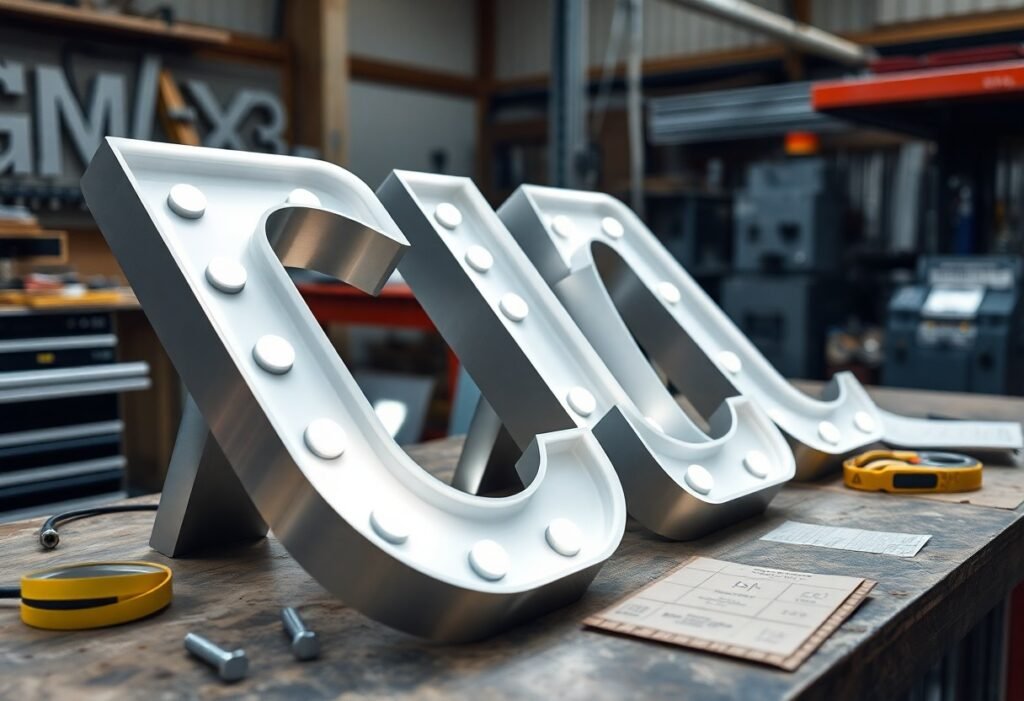
Letter signage defines your brand visibility; this guide explains how channel letters work, material and lighting options, installation and permitting basics, maintenance, and cost considerations so you can choose, plan, and oversee signage that meets your design and regulatory needs.
Key Takeaways:
- Understand types: front-lit, backlit/halo, open-face and reverse channel affect appearance, brightness and cost.
- Choose materials and LEDs: aluminum channels with acrylic faces and efficient LED modules provide durability and uniform lighting.
- Design for readability: scale, stroke width, spacing, contrast and viewing distance determine legibility day and night.
- Plan installation and power: verify mounting method, wiring access, transformer placement, local electrical codes and permit requirements.
- Factor maintenance and budget: design for service access, use weatherproof components, and estimate long-term energy and replacement costs.
Types of Channel Letters
You’ll encounter five common styles that change how signs read at night and from a distance: front-lit, back-lit (halo), reverse channel (reverse-lit), open-face neon, and combination letters. Each varies by depth, mounting method, and cost; for example, front-lit letters often use 3-6″ depths and surface-mounted LEDs, while halo-lit letters need 2-4″ standoffs to create the glow. Choose based on viewing distance, wall material, and brand positioning.
| Type | Best use / notes |
|---|---|
| Front-Lit | High daytime/nighttime visibility; acrylic face with LED modules; common for storefronts and highways |
| Back-Lit (Halo) | LEDs behind letters produce a halo; ideal on textured or painted walls for upscale look |
| Reverse Channel | Metal-faced letters that illuminate the wall, offering a premium, dimensional metal finish |
| Combination / Open-Face | Front + back illumination or exposed neon for retro/eye-catching designs; higher cost and maintenance |
- You should factor in letter depth (typically 3-6″), mounting gap (0-4″), and LED spacing (commonly 1-3″ between modules).
- Your budget often drives choice: front-lit is usually most cost-effective, halo and reverse are 10-40% pricier depending on materials.
- Installation complexity varies: stud-mounted or raceway-mounted options change labor and permitting requirements.
Front-Lit Channel Letters
You get the brightest, most legible option with front-lit letters: acrylic faces diffuse LEDs mounted inside aluminum returns, giving uniform illumination ideal for retail storefronts and highways; typical depths are 3-6″ and LED modules are spaced 1-3″ depending on letter size, producing consistent face brightness even at viewing distances up to a few hundred feet.
Back-Lit Channel Letters
You create a halo effect by recessing LEDs behind opaque faces so light bounces off the wall; halo letters usually need 2-4″ of standoff to form a pronounced glow, work best on contrasting or textured surfaces, and are favored by restaurants and boutique retailers seeking a refined night presence.
After you evaluate mounting surfaces, note that halo illumination depends on wall reflectivity-masonry and light-colored paints amplify the halo while dark or glossy finishes reduce it; installers often recommend a minimum 2″ setback and specifying LED color temperature (usually 3000K-5000K) to control halo tone and brand consistency.
Reverse Channel Letters
You choose reverse channel letters when you want a metal-faced, halo-illuminated look: letters have solid metal fronts with illumination directed onto the wall from behind, creating a subtle halo while preserving a premium metal finish up close; stainless or aluminum faces and deeper returns are common for durability and crisp edges.
After selecting reverse channel, consider material grades (e.g., 5052 aluminum or 304 stainless for coastal durability), finish options like powder coat or brushed metal, and ventilation for LED drivers; these letters often cost more due to metal fabrication but deliver a long-lasting, upscale aesthetic suitable for flagship stores and corporate campuses.
After you weigh visibility, maintenance, and budget, pick the style that aligns with your brand goals and site conditions.
Step-by-Step Guide to Designing Channel Letters
You’ll move through a compact workflow: plan for viewing distance and branding, pick materials, finalize layout, fabricate, wire and install. Use the 1 inch = 10 feet legibility rule to size letters, keep stroke widths ≥2 inches for durability, and target letter depths of 3-6 inches depending on halo or front-lit effects. Factor in local sign codes and electrical access early to avoid costly rework.
Design Steps at a Glance
| Step | Action & Details |
|---|---|
| 1. Planning | Define viewing distance, size (1″ = 10′), font legibility, permit check. |
| 2. Layout | Mock up spacing, alignment, use vector files (AI/EPS) at 1:1 scale. |
| 3. Material Selection | Aluminum returns (20-22 ga), acrylic faces (1/8″-1/4″), LED type (SMD, 50,000 h). |
| 4. Fabrication | Router or CNC cutting, weld returns, seam finishing, face bonding. |
| 5. Wiring | Choose drivers, plan voltage drop, use weatherproof connections and junction boxes. |
| 6. Installation & Testing | Select mount method (stud or raceway), anchor type, test for uniformity and safety. |
Planning Your Design
You should size letters using the 1″ per 10′ viewing rule and test fonts at full scale; for a busy street with 100 ft sightlines choose ~10″ tall letters. Prioritize high-contrast color pairs (dark returns, light faces for front-lit; opposite for halo). Check local sign codes for illumination limits and required setbacks, and mock up a 1:1 template on the facade to validate spacing and sightlines before committing to fabrication.
Selecting Materials
You’ll typically choose 20-22 gauge aluminum returns for cost and corrosion resistance, opal or clear acrylic faces 1/8″-1/4″ thick for diffusion, and LED modules (SMD) rated ~50,000 hours. For coastal sites pick 316 stainless or PVDF-coated aluminum; specify IP65-rated drivers and marine-grade fasteners where salt spray is a factor.
For lighting, prefer 2835 or 5050 SMD LEDs for higher lumen-per-watt output and uniform color temperature (3000K-6500K options). Use an opal diffuser or frosted acrylic to hide individual diodes; space LEDs 1-2 inches apart for even illumination in standard channel depths (3″-6″). Select PVDF powder-coat or 70% PVDF liquid finishes for long-term color retention; include gasketed seams and silicone seals to meet IP65 standards in wet climates.
Installation Process
You can mount letters directly on studs or on a raceway; stud-mounting with 3/8″-1/2″ stainless studs is common for masonry, while a raceway simplifies wiring and service access. Ensure drivers are in ventilated, accessible enclosures inside the building or in a lockable outdoor cabinet, and hire a licensed electrician for mains connections and conduit runs to meet code.
During install, use a level template and confirm anchor pull-out ratings for wind loads (consult local codes for required factors of safety). For runs over ~50 ft account for voltage drop by increasing wire gauge or using multiple power supplies; test each letter for polarity, uniform brightness, and leakage current, and document driver locations and wiring diagrams for future maintenance.
Tips for Choosing the Right Channel Letters
When you narrow options, align sign size, mounting style, and budget with storefront height and local code limits; plan for power access and serviceability. If you need typography guidance, review the Beginner’s Guide To Channel Letter Design: Fonts And … for spacing and casing examples. Knowing the trade-offs between upfront cost, maintenance, and visibility will help you finalize the best solution.
- Assess location: measure sightlines, typical viewing distance, and traffic speed.
- Pick materials: aluminum returns with acrylic faces for durable, even illumination.
- Confirm compliance: verify permits, mounting structure, and electrical routing.
Size and Visibility Considerations
For legibility use the 1 inch per 10 feet rule-e.g., 10″ letters read from ~100 ft-and increase height 20-30% against busy façades or at high speeds; mount letters so the baseline sits within typical driver and pedestrian sightlines, and keep stroke width at least 10-15% of letter height for thin fonts to avoid losing definition at distance.
Color and Lighting Options
Choose front-lit for high contrast and night visibility, halo (back-lit) for upscale depth, or RGB modules for programmable effects; LEDs typically run 50,000+ hours and come in 2700-6500K color temps-3000-4000K feels warm and inviting, 5000-6500K reads brighter from distance.
Pay attention to CRI (aim for 80+ for accurate color), diffuser thickness for uniform face illumination, and a 1-2″ halo gap to maximize the reverse-lit glow; select IP65-rated LED modules for outdoor exposure, consider dimming or timers to reduce energy use, and specify RGB/DMX control only if you need dynamic color shifts, as that increases installation and maintenance complexity.
Factors Influencing Channel Letter Costs
Several variables change what you’ll pay for channel letters: material, size, illumination, mounting, and permitting; a 12″ front‑lit aluminum letter with standard LEDs often runs $200-400, while a deep, halo‑lit stainless letter can be $800-1,500+ depending on shop labor and engineered attachments. Fabrication time, custom tooling, and difficult installations add hours and fees, and local sign permits or electrical permits can tack on $100-$1,000. Any single choice can swing price from $200 to $1,500 per letter.
- Material (aluminum, stainless, acrylic, polycarbonate)
- Size and return depth
- Illumination type (standard LEDs, high‑output, neon)
- Design complexity (scripts, logos, multi‑color zones)
- Installation difficulty and permitting
Material Selection
You’ll notice material sets the baseline: aluminum returns with acrylic faces are the most cost‑effective and common, stainless or brass returns can raise material costs by 50-200%, and polycarbonate faces add impact resistance but cost more than acrylic. Finishes like powder coat or brushed metal add $20-$150 per letter, while thicker gauge metal or custom veneers increase fabrication time and mounting hardware requirements, pushing overall price higher.
Complexity of Design
When you choose script fonts, tight kerning, or custom logo shapes, labor and CAD time increase: simple block letters may take 1-2 shop hours, whereas intricate forms require CNC routing, hand finishing, and multiple shop passes, moving per‑letter costs from a few hundred dollars into the $800-1,500+ range. Multiple internal color zones or segmented LEDs further multiply cost and wiring complexity.
You should track specific cost drivers: return depth (2″ vs 12″) can add $50-$300 per letter, each additional LED zone often costs $30-$150, and custom trim caps, prism faces, or internal mullions require extra routing and assembly time; inaccessible installations add rigging or lift rental fees of $200-$1,000, so factoring these line items early helps you avoid surprises.
Pros and Cons of Channel Letters
You’ll benefit from high-impact, 24/7 branding with channel letters: LED-lit options can reduce energy use by roughly 70% versus older neon and commonly offer 50,000-100,000 hour lifespans, while custom depths and fonts keep your sign legible from hundreds of feet; however, higher upfront costs, permitting, and periodic maintenance still influence total ownership costs and timelines.
Pros and Cons
| Pros | Cons |
|---|---|
| High nighttime visibility for passing traffic | Higher initial fabrication and installation costs |
| Energy-efficient LEDs (~70% lower use than neon) | Electrical permits and inspections required |
| Long LED life (50,000-100,000 hours) | Drivers or LEDs may need replacement after years |
| Highly customizable shapes, colors, and depths | Custom work increases lead time and complexity |
| Strong curb appeal that supports brand recognition | Zoning or historic-district restrictions can limit designs |
| Retrofit-friendly for many existing storefronts | Installation complexity on masonry or glass facades |
| Good ROI when placed on high-traffic routes | Vandalism or theft of components can incur costs |
| Visible day and night with proper face materials | Faces can yellow or fade over long sun exposure |
| Scalable from small stores to large multi-tenant signs | Large systems require additional structural engineering |
| Works with dimmers and smart controls for efficiency | Light pollution complaints may require modification |
Advantages of Channel Letters
You get continuous brand exposure with channel letters that outperform flat panels at night; LEDs provide low operating costs and 50,000-100,000 hour lifespans, and custom depths and fonts improve legibility from several hundred feet, so your storefront reads clearly to both pedestrians and drivers while offering strong visual ROI for high-traffic frontages.
Disadvantages to Consider
You should factor in upfront fabrication and installation costs, which often exceed non-illuminated signs, plus permitting and inspection fees that can range from tens to several hundred dollars depending on jurisdiction, and potential ongoing expenses for driver replacement, face cleaning, or re-lamping over the sign’s life.
Additionally, expect occasional service needs: LED drivers commonly fail before LEDs and may require replacement every 5-10 years, faces can discolor in harsh UV climates, and structural mounts on older façades may need reinforcement-budgeting 5-15% of initial cost annually for maintenance and possible permit-driven redesigns helps avoid surprises.
Maintenance and Care for Channel Letters
Schedule inspections at least every 3-6 months-monthly if you’re near the coast or heavy traffic-to check mounting hardware, seals, and illumination; LEDs typically last ~50,000 hours, but moisture, corrosion, and loose wiring shorten that life. You should log each service, note replaced parts and lumen levels, and prioritize roof- or pole-mounted access safety; small, regular interventions prevent larger failures and keep visibility consistent with brand standards.
Routine Cleaning
Clean your letters with a soft microfiber, mild pH-neutral detergent, and low-pressure rinse; inland sites can follow a 3-6 month cycle while coastal or industrial locations may need monthly attention. Avoid ammonia, acetone, abrasive pads, and high-pressure washers that strip paint or damage seals. When stains persist, test a small area first and flush thoroughly to prevent residue that reduces LED output and causes uneven illumination.
Repairs and Upkeep
Diagnose outages by first isolating the power and testing the driver output-most systems use 12V or 24V DC-then inspect fuses, connectors, and LED modules with a multimeter. You should reseal gaps with UV-stable silicone, replace cracked faces promptly, and match replacement LEDs by color temperature (e.g., 3000K, 4000K, 5000K) to maintain uniform appearance. Keep wiring diagrams from the fabricator for faster troubleshooting.
Smaller fixes often cost $50-$400 (LED module $20-$120, driver $80-$300, face panel $100-$600 depending on size), so budget for periodic parts and labor; always de-energize circuits and use a licensed electrician for rooftop work or when mains wiring is involved. Track part serials and supplier contacts to speed repeat repairs, and consider scheduled driver replacement every 7-10 years to avoid sudden dark signs during peak business hours.
Conclusion
To wrap up, you should focus on your design choices, material and lighting options, proper sizing and placement, installation safety, permitting, realistic budgeting, and ongoing maintenance; consult experienced fabricators and local codes to ensure compliance and longevity.
FAQ
Q: What are channel letters and what common types should beginners know?
A: Channel letters are three-dimensional sign characters made from metal and acrylic, used for storefronts and building identification. Common types include front-lit (internal LED lights shine through an acrylic face), reverse-lit/halo (illumination exits the back to create a glow on the wall), open-face (no acrylic face, exposed neon or LED inside), and push-through (acrylic or polycarbonate pushed through a metal pan for a backlit effect). Each type affects visibility, installation complexity, and cost.
Q: What materials and fabrication methods are used to make channel letters?
A: Typical materials are aluminum for the returns (sides) and backs, and acrylic or polycarbonate for faces. Returns are formed on a brake or roll former, welded or riveted at seams, then attached to a routed metal or plastic pan. Faces are trimmed and glued or siliconed to the returns. LEDs are mounted inside on strips or modules and wired through the back. Finishes include powder-coating for durability and vinyl overlays for color or diffusion control.
Q: What design and visibility factors should beginners prioritize when planning channel letters?
A: Key factors are letter size relative to viewing distance, stroke width and character spacing for legibility, font choice (avoid overly thin or ornate fonts), contrast between letter color and background, illumination type (front or halo) for the desired nighttime effect, and mounting height and setback from the façade. Also consider depth (return height) to influence shadowing and perceived dimension, and local sign codes that limit sign area and placement.
Q: What should I know about illumination, electrical components, and energy use?
A: LEDs are the standard due to efficiency and long life; choose LED modules or strips with appropriate lumen output and color temperature for brand consistency. Use UL-listed drivers sized with a safety margin and plan for voltage drop on long runs. Consider dimming options and surge protection for reliability. Ensure wiring meets local electrical code, that back vents or thermal design allow heat dissipation, and select LEDs with suitable IP ratings for exterior exposure.
Q: What are the steps for permitting, installation, and ongoing maintenance?
A: Start by checking local sign regulations and obtaining permits; submit elevations and engineering if required. Installation involves secure mounting to the building structure, proper anchoring, weatherproofing cable entry, and an electrical hookup inspected by authorities. For maintenance, schedule periodic cleaning of faces and vents, inspect seals and flashing, replace failed LED modules or drivers, and check mounting hardware for corrosion; planned servicing extends life and maintains brightness.