
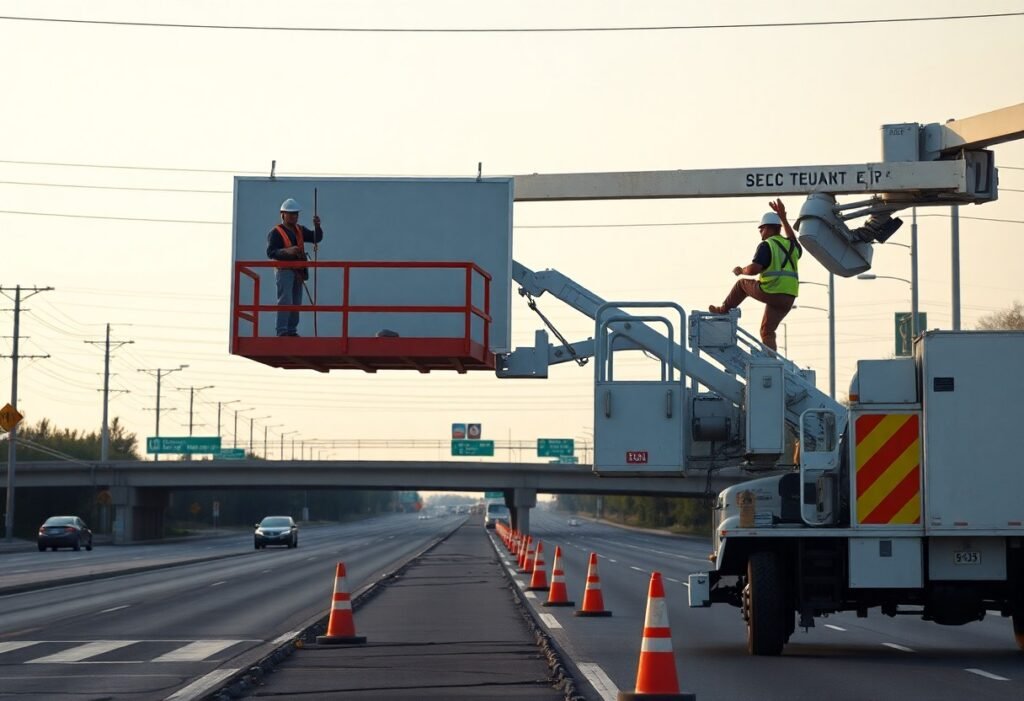
It’s advisable to use a bucket truck sign install instead of a ladder when your job puts you above safe ladder heights, when you need stable, adjustable positioning for heavy or complex signs, when traffic control or uneven ground prevents safe ladder placement, when you work near live electrical lines, or when the task requires prolonged time and tool support-these conditions protect you, comply with regulations, and increase efficiency.
Key Takeaways:
- When work exceeds safe ladder height or requires extended reach, use a bucket truck for stable, elevated access during sign installs.
- For prolonged installs or frequent repositioning, a bucket truck reduces worker fatigue and fall exposure compared with ladders.
- In high-traffic zones, near power lines, or where a secure work envelope is required, a bucket truck offers better safety controls and traffic management.
- When tools, heavy materials, or multiple personnel must be aloft, a bucket truck provides a secure platform and material-handling capability.
- If truck access, permits, or parking are unavailable, or the job is very low and brief, a ladder may be preferable; otherwise choose a bucket truck for greater safety and efficiency.
Understanding Bucket Trucks
When site constraints push work above 25-30 feet or involve live lines, you should favor a bucket truck: it gives stabilized, powered access, faster positioning than ladders, and integrated safety controls to reduce time aloft and fall risk during sign installs.
Definition and Features
A bucket truck is an aerial lift with a personnel platform mounted on a boom; you get hydraulic or electric controls, insulated boom options for electrical work, rated platform loads (commonly 300-600 lb), outriggers for stability, and dual controls in the bucket and at chassis level.
Types of Bucket Trucks
You’ll typically see telescopic (straight) booms for long, unobstructed reach, articulating (knuckle) booms for complex access around structures, service trucks that carry tools and generators, towable units for occasional use, and 4×4 chassis for rough terrain.
| Telescopic (Straight) Boom | Reach 40-65 ft; best for high, direct approaches; platform 300-1,000 lb. |
| Articulating (Knuckle) Boom | Reach 30-45 ft; excels at tight, obstructed access and multi-plane positioning. |
| Service/Utility Truck | Integrated tool storage, power sources; ideal for full sign replacement or electrical work. |
| Towable Aerial Lift | Cost-effective for infrequent jobs; limited reach (20-40 ft) and smaller platforms. |
| Rough-Terrain / 4×4 | High ground clearance and outriggers; suited for uneven or remote job sites. |
To match a truck to your task, you should compare working height (telescopic up to ~65 ft, articulating 30-45 ft), platform capacity (300-1,000+ lb), mobilization needs, and site access; you must also verify operator training and inspection records per ANSI A92.2 and local regulations before use.
- Verify ground conditions and outrigger placement for stable setup.
- Confirm load calculations for personnel, tools, and sign components.
- Coordinate traffic control and permitting when working over streets or sidewalks.
- After you select the appropriate truck, document operator certification, machine inspection, and a written lift plan.
Benefits of Using a Bucket Truck for Sign Installation
With a bucket truck, you gain a stable, elevated workspace that lets you handle larger signs, work near traffic more safely, and access heights beyond typical ladder limits; aerial lifts commonly reach 30-60 ft and let you carry tools and materials aloft, reducing manual lifting and often eliminating the need for scaffolding on routine installs.
Safety Advantages
You get a rigid platform with integrated anchor points and fall-restraint options that align with OSHA fall-protection rules for work above 6 ft (29 CFR 1926.501); insulated booms lower electrocution risk near power lines, outriggers stabilize the vehicle, and a bucket plus a ground spotter reduces the chance of ladder slips or vehicle strikes when working roadside.
Efficiency and Time Savings
Setup often takes under 10 minutes, and you can position, secure, and adjust from the bucket while carrying fasteners and tools, so many crews report 25-40% faster installs versus ladders or scaffolding because you avoid repeated climbs and extensive rigging on typical retail or road-facing sign jobs.
In practice you’ll find the bucket’s 300-600 lb payload and hydraulic rotation let one or two technicians lift and orient a 4×8 sign at 20-30 ft without constant ground-to-elevated transfers; that reduces crew size, shortens traffic control time, and frequently removes the need for scaffold permits, cutting project duration and permitting costs on busy commercial corridors.
When to Choose a Bucket Truck Over a Ladder
You should favor a bucket truck when the job combines height, weight, traffic exposure, or multiple tasks that make ladder setup inefficient or unsafe; for example, installing a 6×3 ft aluminum sign weighing 80-120 lb over a busy sidewalk or 25+ ft above grade usually calls for a truck. You’ll save time when you need repeated repositioning, two-person work, or powered tools, and you’ll mitigate fall and strain risks that increase rapidly above typical ladder working heights.
Job Complexity
If your installation requires hoisting heavy panels, using impact wrenches, aligning multiple mounting points, or working around utilities, you’ll want a bucket truck. You can position a technician and tools together, handle signs that exceed one person’s lifting capacity (over ~75-100 lb), and complete multi-step installs faster. For example, a double-sided illuminated cabinet with electrical hookup and four anchor bolts is far more practical from a stabilized bucket than from an extension ladder.
Height and Reach Requirements
You should consider a bucket truck when the vertical or horizontal reach exceeds what’s practical from a ladder-typically above 20-25 ft of working height for most crews. Common boom trucks offer 30-60 ft of vertical reach and better horizontal outreach than extension ladders, so installations on pole-mounted blades, rooftops, or over streets are safer and more efficient from a bucket.
Also assess horizontal reach and boom type: articulating booms give offset access to fascia or overhangs where a straight ladder can’t reach, and telescopic booms provide precise positioning for high-profile highway signs. You’ll also benefit from bucket stability in windy conditions and the ability to reposition quickly between closely spaced signs, reducing traffic control time and overall labor hours.
Limitations of Bucket Trucks
You should assess operational constraints before choosing a bucket truck: typical booms reach 20-60 ft and platforms carry 300-600 lb, but trucks need level ground, outrigger space of 6-10 ft, and certified operators. In dense urban settings you may face lane closures, overhead utilities, and permit requirements that add time. For smaller signs, confined sites, or jobs under 20 ft, a ladder or lift-assist may be faster and less expensive.
Accessibility Issues
In narrow alleys, underground garages, or streets with low clearance, you’ll often find bucket trucks can’t position safely-most chassis are 8-9 ft wide and outriggers extend several feet. You’ll also contend with overhead power lines and uneven terrain that prevent safe setup; in a downtown job in Manhattan or Atlanta, you might need traffic control and a spotter, turning a simple install into a multi-resource operation.
Cost Considerations
Rentals for small bucket trucks commonly run $150-$500 per day while larger 40-60 ft units can be $300-$1,000+ per day; operator rates typically range $50-$100 per hour. You’ll also pay for insurance, permits, mobilization, and potential traffic control, so short, simple installs under two hours can become cost-prohibitive compared with ladder work or scissor lifts.
For example, a 40‑ft boom rental at $300/day plus an operator at $75/hr for a 3‑hour job (including mobilization) yields about $525 in labor and rental; add $150-$300 for permits/insurance and you’re near $700-$1,000. Ongoing maintenance, vehicle depreciation, and operator certification push contractor billing rates higher, so you’ll want to compare total job cost, not just rental fees, when choosing equipment.
Comparing Bucket Truck and Ladder Installations
When evaluating method options you should consider height, traffic control, and crew skill; bucket trucks give safer access for elevated or heavy signs and reduce installation time on multi-unit jobs, while ladders remain cost-effective for single low-height installs in tight urban spots. The table below helps you compare these trade-offs quickly.
Side-by-side comparison
| Bucket Truck | Ladder |
|---|---|
| Safe access above 20 ft with stable platform | Best for work under ~12-15 ft |
| Faster multi-sign installs (often 20-40% time savings) | Slower for repeated climbs; fatigue increases time |
| Requires vehicle access and parking/permit planning | Minimal site access; works in cramped sidewalks |
| Higher hourly equipment cost but fewer labor hours | Low equipment cost but can need extra crew for safety |
| Works in adverse ground when stabilizers can be used | Unstable on uneven surfaces without special base |
| Operator certification often required | Basic ladder safety training required |
| Better for heavy or awkward sign handling | Limited load handling and balance |
| Can require lane closures or traffic control | Often avoids full lane closures if set off curb |
| Higher upfront mobilization time for short jobs | Quick to deploy for single, small installs |
| Preferred for rooftop or over-street placements | Unsuitable above certain heights or over traffic |
Pros and Cons of Each Option
You should match the method to the job: bucket trucks reduce exposure and speed up complex installs, while ladders lower mobilization cost for simple, low-height work; the table below lists practical pros and cons so you can choose based on schedule, budget, and site constraints.
Pros vs Cons
| Pros | Cons |
|---|---|
| Greater operator protection and fall prevention (bucket) | Higher equipment and mobilization cost |
| Faster installation time on multiple or high signs | Requires vehicle access and potential permits |
| Handles heavier signs and tools safely | Needs certified operator and maintenance |
| Low initial cost and easy to deploy (ladder) | Limited reach and poorer stability at height |
| Works in tight spots without vehicle access | Increased fatigue and longer labor hours |
| Minimal traffic control in many sidewalk installs | Higher risk on uneven or soft ground |
Case Studies and Examples
You can use concrete examples to justify equipment choice: a regional roll-out, municipal arterial work, and single-store replacements each show different cost and time outcomes that inform your selection for similar sites.
- Regional retail chain: 120 signs across 40 sites – bucket crew averaged 25 min/sign; ladder crews averaged 42 min/sign; total labor hours reduced by 38%.
- City corridor retrofit: 18 overhead signs at 24-30 ft – bucket truck required; project completed in 3 days with 2 trucks versus estimated 7 days with specialized scaffolding.
- Small storefronts: 36 low-height signs – ladder installs averaged $95 labor per sign; bucket mobilization would have added $1,200 in travel and setup for no time benefit.
Applying these examples, you should quantify your site: measure average install height, number of signs per route, and traffic-control costs; that lets you model whether the bucket’s hourly hire and mobilization offset ladder labor and safety exposures.
- Municipal project A: 72 signs at 18-28 ft – bucket option cut total days from 14 to 9 and saved ~210 crew-hours, equating to $6,300 in labor savings at $30/hr.
- Sign shop pilot: 6 rooftop signs – ladder-based mixed approach took 9 hours total; single bucket crew could have reduced to 6.5 hours, improving productivity by ~28%.
- Highway contract: one 3-day closure for bucket work cost $1,200/day in lane control; alternative night-ladder method avoided closure but added 45% more labor time and minor safety incidents.
Best Practices for Bucket Truck Sign Installation
Always perform a pre-op inspection of the boom, outriggers, harnesses, and load charts before lift-off; verify hydraulics, fluid levels, and emergency descent. If you’re choosing equipment, consult How to Pick the Best Boom Truck for Sign Installations. Use rated rigging, level pads, and plan lifts for signs over 100 lb with a spotter and tag lines; maintain at least 10 ft clearance from energized lines under 50 kV.
Safety Protocols
Before each shift you must complete a documented pre-op: check boom wear points, harness D‑rings, outriggers, and ground pads; log defects. Use a dedicated spotter to monitor clearances and traffic, set up barriers for roadside work, and wear ANSI/OSHA‑recommended PPE. Maintain 100% fall‑arrest tie‑off to approved anchors and suspend operations when winds exceed 25 mph or visibility prevents safe placement.
Operational Guidelines
You should be trained and certified to operate the aerial device and always reference the truck’s load chart for boom angle and extension limits; most personnel buckets support roughly 350-1,000 lb including tools. Stow loose gear, use tag lines for sheet signs to prevent swing, and avoid side‑loading-consult the manufacturer’s derating chart before any offset lift.
Plan lifts for signs heavier than 100-200 lb by bringing a material lift or crane and apply a 2:1 safety factor to slings and rigging. Perform a trial lift to verify balance, assign a single lift coordinator with radio control, and secure required permits for lane closures when you work within 10 ft of traffic or pedestrian paths.
Summing up
Hence you should opt for a bucket truck instead of a ladder when signs are high, over traffic, or require long reaches, heavy hardware, or precise positioning; a bucket truck gives you and your crew stable, elevated access, reduces fall and overhead-hazard risk, speeds installation, and helps you meet safety and compliance requirements while minimizing disruption.
FAQ
Q: When should you choose a bucket truck over a ladder for sign installation?
A: Use a bucket truck when the sign height exceeds safe ladder reach, when extended work times are expected, when multiple adjustments are needed at height, or when the job requires tools and materials that make ladder balance unsafe. Bucket trucks provide a stable, adjustable platform and reduce the physical strain and fall risk associated with long-duration or high-elevation installs.
Q: How do site conditions influence the decision to use a bucket truck instead of a ladder?
A: Site conditions such as uneven or soft ground, steep slopes, limited flat setup area, overhead obstructions, or proximity to traffic favor a bucket truck. A truck can be positioned and stabilized with outriggers where a ladder cannot, and its boom can reach around obstacles or from a safer access point without placing workers in hazardous footing or traffic lanes.
Q: What role do sign size and weight play in selecting a bucket truck versus a ladder?
A: Large or heavy signs, or signs that require multiple people to maneuver, generally necessitate a bucket truck. Ladders limit the ability to carry bulky materials and can become unstable when lifting or securing heavy hardware; a bucket truck allows safe hoisting, positioning, and attachment while keeping workers inside a secure platform.
Q: How do weather and wind conditions affect the choice between a bucket truck and a ladder?
A: Windy or wet conditions increase the risk of ladder slips and sway, making a bucket truck the safer option when gusts, rain, or icy surfaces are present. The truck’s platform and stabilizers offer better resistance to lateral forces than a ladder, and work can be paused safely if conditions deteriorate while the platform is secured.
Q: Are there regulatory or safety-policy reasons to prefer a bucket truck over a ladder for sign installs?
A: Yes. OSHA, municipal codes, and company safety policies may require aerial lifts for certain heights, work over traffic, or when fall protection can’t be effectively used with ladders. Using a bucket truck can ensure compliance with training, fall-arrest, and equipment standards, and can reduce liability by following prescribed safe-access methods for elevated work.