
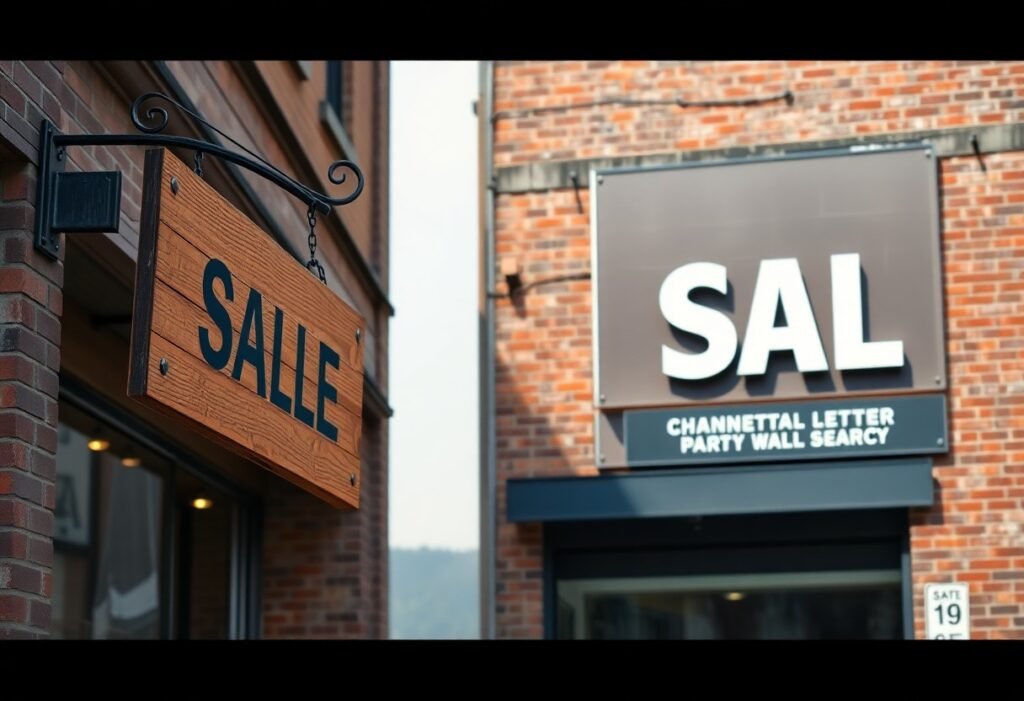
Most business owners find that blade signs boost your storefront visibility to pedestrians by projecting perpendicular to the building, while wall signs maximize brand presence along façades for drivers and long-range sightlines. You should weigh factors like viewing angle, installation complexity, local zoning, lighting, and maintenance to choose the option that best fits your location and budget.
Key Takeaways:
- Orientation & visibility: Blade signs project perpendicular to the building for easy sidewalk sightlines; wall signs are flush and read better from a distance or along a street axis.
- Audience & placement: Blade signs excel for pedestrian-heavy, narrow streets; wall signs serve vehicular traffic and broader-area recognition.
- Design & scale: Wall signs can span large façades and carry bold graphics; blade signs are narrower, often double-sided, and suited to logos or business names.
- Installation & cost: Blade signs need brackets and building anchors and can cost more per square foot; wall signs may require larger mounts and permits but scale more economically.
- Branding & impact: Blade signs offer intimate, wayfinding character for storefronts; wall signs deliver stronger high-visibility branding and skyline presence, especially when illuminated.
Overview of Blade Signs
Definition and Characteristics
Built to project perpendicular from a building face, blade signs typically measure 18-48 inches wide and 24-60 inches tall and are mounted at a sidewalk clearance commonly around 8-12 feet. You’ll find them made from aluminum, wood, acrylic or composite panels, sometimes with LED edge lighting for night visibility. Their perpendicular orientation makes them legible to pedestrians approaching from either direction and ideal for dense retail corridors.
Advantages of Blade Signs
When you use a blade sign, you increase lateral visibility along sidewalks where passersby scan storefronts in seconds; LED-lit blades extend effective hours and improve contrast at night. Costs generally range from $300-$2,000 depending on size, materials and illumination, while durable aluminum options can last 10-20 years with minimal maintenance. Installation is straightforward on many façades, making them a cost-effective branding tool for small businesses.
For practical use you should follow legibility rules: a common guideline is 1 inch of letter height per 10 feet of viewing distance, so a 30-foot sightline needs ~3-inch letters. Permits are often required for blades over about 2-4 sq ft and mounting must account for wind load and bracket strength; consult local code and consider a professional install to ensure compliance and longevity.
Overview of Wall Signs
In dense storefront rows you rely on wall signs for broad brand presence; they mount flush to the façade and commonly span 2-12 feet depending on storefront width. You can combine aluminum, acrylic, or channel letters and add LED illumination for night visibility. For a direct comparison with perpendicular options see The Advantages of Blade Signs. Typical install heights range 6-15 feet to optimize pedestrian and driver sightlines.
Definition and Characteristics
Wall signs sit flat against your building and appear as flat panels, dimensional letters, or lighted cabinets; you choose materials and finishes to match branding. Standard sizes often run 2-8 feet high with custom widths to fit storefront bays. Mounting methods include through-bolts into masonry or direct-to-stucco anchors, so you should verify wall structure and local code clearances before ordering.
Advantages of Wall Signs
You gain a large, information-rich surface that communicates your name, logo, and hours at a glance; wall signs cover wide façades more cost-effectively than many projecting options. They also perform well at curbside speeds-when mounted appropriately they remain legible to drivers at 30-60 mph-and in many jurisdictions require simpler permitting, speeding installation.
For example, national retailers commonly use 8-foot channel letters to remain legible from 100-200 feet on arterial roads. You benefit from lower maintenance when using LEDs rated around 50,000 hours and durable substrates like powder-coated aluminum. If you manage multiple locations, standardized wall signage streamlines production and can reduce lead times to under two weeks.
Aesthetic Considerations
When choosing between blade and wall signs, focus on scale, material and streetscape rhythm: blades punctuate pedestrian corridors while wall signs stitch a building face together. You should match materials-brushed aluminum, painted wood, acrylic-to neighborhood character; selecting a contrast ratio near 70% improves legibility at 20-30 feet. Historic districts often restrict color palettes and projection depths, so factor local guidelines into your aesthetic plan.
Visual Impact of Blade Signs
Blade signs typically project 18-48 inches and sit 7-10 feet above the sidewalk, giving you perpendicular visibility for pedestrians approaching from either direction. Double-sided illumination and high-contrast logos boost nighttime legibility; a 30‑inch blade with backlit acrylic letters is readable within 20-40 feet and can increase lateral storefront recall on busy retail blocks.
Visual Impact of Wall Signs
Wall signs commonly span 2-12 feet across a façade and favor horizontal composition, providing you broad brand presence for sightlines at roughly 50-200 feet depending on letter size and traffic speed. Channel letters, flat-cut graphics, or painted murals each alter perceived scale; for instance, halo-lit channel letters at 10-12 inches work well for driver-facing recognition on arterial roads.
Apply the 1 inch = 10 feet rule to plan letter height so you can estimate readability-100 feet of viewing distance suggests 10‑inch letters. Also prioritize contrast, concise wordmarks, and consistent illumination: 5000K white LEDs preserve color fidelity at night and help your wall sign maintain brand clarity across daylight and dark conditions.
Practical Applications
Ideal Uses for Blade Signs
You’ll find blade signs most effective where pedestrians pass close to storefronts: downtown shopping strips, mall corridors, and cafe-lined sidewalks. Typical sizes run 24-36 inches wide and 6-12 inches deep, mounted perpendicular to the façade to catch sightlines from both directions. In practice, independent retailers and boutique shops use them for immediate wayfinding and impulse visits, while landlords place them above entrances to mark suites in multi-tenant buildings.
Ideal Uses for Wall Signs
Wall signs work best when you need long-range visibility or large-format branding across a building face, such as strip malls, office parks, or roadside storefronts. You can specify letter heights of 8-24 inches-readable roughly 80-240 feet using the 1 inch = 10 feet rule-so channel letters or cabinet signs with illumination are common for highway-facing sites. These also help build brand presence across multiple tenants or locations.
For deeper planning, consider materials and mounting: aluminum or steel frames for wind load, acrylic push-through or routed metal faces for logos, and LED modules at 3000-4000K for consistent illumination. Check local sign codes and permitting limits on sign area and height, factor electrical access and serviceability, and size the structure to withstand local wind loads and maintenance cycles so your wall sign performs reliably for years.
Cost Analysis
Across projects you weigh upfront purchase, installation and permitting against long-term upkeep. Blade signs often cost $400-$2,500 for a typical 18-36″ illuminated unit, while wall signs range from $300 for flat vinyl up to $10,000+ for large channel-letter installations. Permits and electrical hookups add $50-$1,000 depending on jurisdiction. Factor in visibility ROI: higher pedestrian conversion for blades can justify higher per-unit expense.
Initial Costs of Blade and Wall Signs
When budgeting you should compare material, fabrication and installation: an aluminum 24″ blade with LED backlighting typically runs $1,000-$1,800 installed; a 10’×2′ routed wall sign or non-illuminated pan panel sits about $1,200-$4,000, while channel letters often exceed $5,000. Labor and scaffold costs can add 10-30% to the quote, and historic-district or downtown permits may increase fees further.
Maintenance and Longevity
Durability hinges on material and exposure: LEDs commonly last ~50,000 hours, powder-coated steel resists corrosion 7-15 years, and acrylic faces may yellow in sun within 5-10 years. Blades endure more wind and vandal stress, prompting more frequent fastener and finish checks, whereas wall signs typically need fewer structural inspections but higher-cost electrical or access repairs when components fail.
You should budget annual upkeep at roughly 1-5% of the initial cost: expect $100-$600/year for small blade signs (cleaning, fastener checks, bulb swaps) and $500-$2,500/year for illuminated wall systems due to lift rental and electrical servicing. Warranties commonly cover LEDs for 3-5 years; plan full refurb or replacement every 7-15 years based on finish, coastal exposure, and city maintenance requirements.
Consumer Preferences
You tend to favor signs that match the street context and time of day: blade signs catch your eye on narrow sidewalks and evening shopping districts, while wall signs read better from vehicles or wider promenades. Multiple retail tests report blade signage boosting pedestrian engagement noticeably, and your choice will often hinge on visibility, brand tone, and local footfall patterns rather than pure cost alone.
Surveys and Studies on Signage Choices
Industry surveys and retailer A/B tests frequently highlight visibility, legibility, and illumination as top drivers of consumer preference; many merchants report 10-25% increases in walk-ins after switching to illuminated blade signs in evening hours. You’ll see demographics matter too: younger shoppers prefer bold, LED-accented designs, while older customers prioritize high-contrast, easy-to-read wall signage for faster recognition.
Trends in Signage Design
Design trends are pushing you toward cleaner typography, energy-efficient LED illumination, and modular systems that support quick branding updates; LEDs can use roughly 70-80% less energy than incandescent solutions, lowering operating costs. Brands increasingly combine tactile materials like brushed metal with programmable RGB backlighting and QR-enabled wayfinding to keep signage functional and on-brand across dayparts.
Further, you’ll notice urban regulations and experiential retail drives shaping choices: cities limit projection depth and light spill so designers favor thin-profile blade signs and dimmable fixtures. For example, several municipal codes cap sign projection or lumen output, prompting retailers to prioritize high-contrast faces and spot-lit logos-strategies that maintain visibility while complying with local limits.
Final Words
Summing up, blade signs project perpendicular to the street and command attention at pedestrian eye level, making them ideal when you want your shop to catch passing foot traffic; wall signs sit flat on the facade, offering larger, bolder branding visible from distance or at vehicle speeds. You should weigh placement, sightlines, local regulations and brand scale to decide which format best supports your visibility and messaging goals.
FAQ
Q: What are the main visibility differences between blade signs and wall signs?
A: Blade signs project perpendicular to the building face, making them more visible to pedestrians and cross-traffic approaching from either direction; they catch sightlines at street level. Wall signs run flush with the façade and read best from a distance or at oblique angles along the street, so they work well for long-view branding or highway visibility when mounted high. Blade signs provide a stronger presence at sidewalk level and for window-lined shopping streets, while wall signs offer broader horizontal coverage and can be scaled larger for distant visibility.
Q: How do blade signs and wall signs differ in installation and mounting requirements?
A: Blade signs require secure bracketry, appropriate anchoring into structural elements, and consideration of wind load and clearance for pedestrians; they often need custom mounting hardware and periodic bolt checks. Wall signs typically attach directly to the façade or to an independent backing system, which can be simpler structurally but may require reinforcement for heavy channel letters or boxed cabinets. Both can trigger building permits, electrical inspections for illumination, and may need engineering for attachment points, but blade signs generally demand more precise support and safety checks due to their projecting nature.
Q: Which option offers greater design flexibility and branding impact?
A: Blade signs excel at storefront-level impact with double-sided graphics, three-dimensional elements, and backlit illumination that draws attention at night; they create a strong pedestrian-facing identity. Wall signs give more freedom for large-scale graphics, murals, dimensional letters, and integrated architectural signage that becomes part of the building’s identity. Choice depends on branding goals: choose blade signs for directional, neighborhood, or boutique visibility; choose wall signs for comprehensive brand statements or when you want large, readable text from far away.
Q: How do costs and maintenance compare between blade signs and wall signs?
A: Initial costs vary by size, materials, and lighting: blade signs can be costlier per square foot because of custom brackets, weatherproofing on multiple faces, and more complex installation. Wall signs often have lower installation complexity but can become expensive at large scales or when structural reinforcement and high-elevation work are required. Maintenance for blade signs includes routine checks of fasteners and lighting on both faces; wall signs may need periodic façade-compatible repairs, repainting, or service access for high-mounted illumination. Lifespan depends on materials and exposure-metal and acrylic with proper finishes will last longer in either format.
Q: What regulatory and site-specific factors should influence the choice between blade and wall signs?
A: Local sign codes determine allowable projections, maximum size, illumination rules, and historical-district restrictions; many jurisdictions restrict projecting signs’ height or require minimum clearances over sidewalks. Site factors include sidewalk width, pedestrian vs. vehicle traffic patterns, neighboring signage density, and building façade condition-narrow sidewalks and heavy foot traffic favor narrow, elevated blade signs with safe clearance, while open plazas or highway-adjacent buildings may benefit from large wall signage. Consult local permitting authorities and, if needed, a sign engineer to confirm setbacks, wind-load requirements, and electrical code compliance before deciding.