
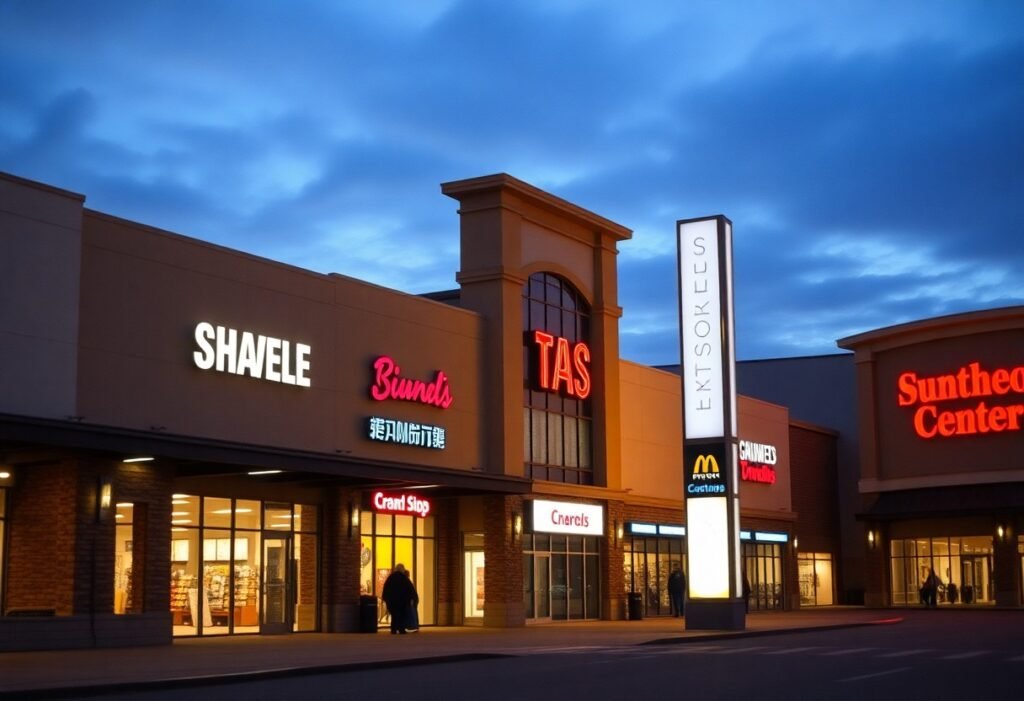
Shopping centers demand visible, consistent branding, so you should choose illuminated signs that balance visibility and energy efficiency: channel letters for storefront identity, halo-lit signs for elegance, LED lightboxes for flexible graphics, and blade signs for wayfinding. Consider brightness controls, durable materials, and local code compliance to ensure your signage attracts customers, reinforces your brand, and minimizes maintenance.
Key Takeaways:
- Channel letters (front-lit for bold visibility, halo/backlit for premium glow) offer the best brand impact and legibility for storefronts.
- Lightboxes/cabinet signs are cost-effective for multi-tenant façades and pylon signs-use translucent faces and LED backlighting for even illumination.
- LED digital displays are ideal for promotional flexibility; include brightness controls, content schedules, and compliance checks to avoid distractions or code violations.
- Prioritize high contrast, simple typefaces, appropriate letter height/stroke, and correct color temperature to maximize readability day and night.
- Confirm shopping center design guidelines and local codes, choose energy-efficient LEDs with dimmers/timers, and design for easy maintenance and module replacement.
Importance of Illuminated Signs
You rely on illuminated signs to extend your storefront into evening hours and compete for attention along busy corridors; LED signage typically consumes 60-80% less energy than neon while delivering consistent color and brightness for 50,000+ hours, and properly sized signs can be readable from 100-300 feet depending on letter height and mounting, directly affecting after-dark foot traffic and impulse visits.
Visibility and Attraction
You should size and light signs for expected viewing distances: the common rule of thumb is 1 inch of letter height per 10 feet of readable distance, so 12″ letters reach ~120 feet. Select 3000-4000K LEDs for balanced color rendering, aim for even face luminance (measured in lux) to avoid hotspots, and use contrasting backgrounds-these choices increase storefront noticeability and improve night conversion rates.
Branding and Identity
You must treat signs as 24/7 brand touchpoints: halo/backlit channel letters convey premium positioning through silhouette and depth, front-lit channel letters maximize legibility for quick reads, and consistent use of brand colors, typography, and materials across façades and pylon signs reinforces recall among shoppers navigating the center.
You can tighten brand consistency by specifying color tolerances (Delta E ≤2 for close matches), approved materials like acrylic faces with brushed aluminum returns for upscale tenants, and standardized mounting heights across the center; combining those specs with tenant signage guidelines and LED modules rated ≥50,000 hours minimizes visual drift and maintenance while preserving the unified identity you want shoppers to associate with your location.
Types of Illuminated Signs
You can choose from front-lit channel letters, halo/backlit letters, neon, lightbox cabinets and full-motion LED displays; see What are the Different Types of Lighted Signs? Here … for a deeper list. Perceiving how each performs at night, you decide based on legibility, energy use and brand fit.
- Channel Letters
- Neon
- Lightbox / Cabinet
- Backlit Flat Panels (push-through)
- LED Displays
| Channel Letters | Bold storefront branding, high legibility |
| Neon | Vibrant color accents, retro aesthetic |
| Lightbox / Cabinet | Cost-effective large-area graphics |
| Backlit Flat Panels | Even face illumination for logos and murals |
| LED Displays | Dynamic messaging, video and promotions |
Channel Letters
You get the strongest brand presence with channel letters: front-lit styles remain readable from roughly 100-300 ft when letters are 18-36″ tall, while halo/backlit builds add a premium silhouette for evening shoppers; typical aluminum/acrylic construction with integrated LEDs lowers energy use by about 60-80% versus legacy neon and lasts for decades with routine maintenance.
LED Displays
You can deploy LED displays for rotating promotions and wayfinding; outdoor units often use 4-10 mm pixel pitch for clear viewing at 10-50 meters and 5,000-8,000 nits brightness for daytime visibility, with remote content management allowing instant updates across multiple tenant faces.
Further, modular LED panels usually offer 50,000-100,000 operational hours, IP65-rated protection for outdoor exposure, and redundant modules to avoid full-face outages; you should budget for professional installation and 5-10 years of maintenance, with many operators seeing payback in 2-3 years depending on usage and ad revenue.
Strategic Placement of Signs
Place signs where sightlines intersect high-traffic approaches: main arterial roads, parking rows, and interior promenades. You should prioritize storefront fascias and pylon entries that capture drivers at 25-40 mph and pedestrians at 3-4 mph. For example, a 24″ channel letter set mounted on a 15 ft fascia remains readable from roughly 100-150 feet at night, so align mounting and letter size with those distances.
Location Considerations
You need to map primary and secondary sightlines: locate primary identity signs facing the main road and secondary wayfinding every 30-50 feet along pedestrian corridors. Also audit obstructions like trees, light poles, and HVAC units; place illuminated boxes on corners or end units to gain 180° visibility. Coordinate with center management on monument and pylon allocations to avoid sign stacking that reduces impact.
Height and Angle
You should set primary fascia signs roughly 12-18 feet above grade for vehicle visibility and 6-10 feet for pedestrian-facing blades. Aim for a 10-15° downward tilt on blade or projecting signs to reduce skywash and improve driver readability. When letters are 18-24 inches, expect effective legibility out to 120-180 feet under good lighting.
Apply the 1:10 rule for letter sizing-one inch of letter height per 10 feet of typical viewing distance-so a 36″ letter suits a 300-360 foot sightline from a service road. Verify local codes: many municipalities require 8 ft minimum clearance over sidewalks and have maximum sign heights for façades and pylons; factor those limits into bracket design and electrical routing to avoid costly rework.
Compliance with Regulations
You must meet zoning, building and electrical codes while maximizing visibility; municipalities commonly limit sign luminance to about 300-600 cd/m² and restrict illuminated hours (often 11:00 PM-6:00 AM). ADA mandates tactile interior signs and accessible route identification. Expect landlord design guidelines, tenant sign packages, and the occasional variance process if your channel letters or monument sign exceed local caps.
Local Signage Laws
Local ordinances control sign area (commonly 20-200 sq ft), height (typically 10-50 ft), setbacks and placement by zone; downtown or historic districts frequently impose stricter materials and color palettes. You should check overlay districts, temporary banner rules, and any storefront glazing limits-violations can force removal or redesign, so align your design with the jurisdiction’s sign code before ordering fixtures.
Permitting Process
You’ll generally need scaled site plans, elevations, electrical schematics, a photometric plan and landlord approval to apply; permit fees often range $75-$1,500 and review times run 2-8 weeks. Expect an electrical permit and final inspections; failure to secure permits can delay openings or trigger fines and rework orders.
More detailed submissions commonly require engineer-stamped structural calculations for freestanding signs or any sign over ~50 sq ft, a certified installer affidavit, proof of insurance and anchorage details. If your design is nonconforming, prepare for a variance or administrative appeal that can add 4-12 weeks and public notice; national chains sometimes secure expedited reviews in 5-10 business days with complete packages.
Cost Considerations
Budgeting for signage requires balancing upfront cost, permitting and lifecycle expense: permits typically run $100-$2,000 depending on municipality, installation labor $75-$150/hour, while sign types vary-channel letters commonly cost $150-$400 per letter, lightbox cabinets $1,200-$6,000, and full-motion LED façades often exceed $10,000; factor LED energy savings of 50-70% into ROI calculations.
Initial Investment
Expect about $200-$350 per channel letter installed for standard acrylic and aluminum, $1,200-$5,000 for a typical storefront lightbox, and $8,000+ for a modest digital display; add structural engineering, electrical hookup and permits-plan an extra $500-$3,000-so your quoted price should include fabrication, mounting, electrical and permitting line items.
Maintenance and Long-Term Costs
Plan ongoing expenses: LED modules and drivers commonly last 5-10 years, but budget annual maintenance of roughly $100-$600 for small signs and $1,000-$4,000 for large digital displays; expect regular cleaning, gasket and transformer checks, and occasional module or pixel replacements-skip a service contract and emergency repairs can easily double your yearly spend.
You should adopt a preventive program-secure a 3-5 year service contract covering driver/module replacement, biannual cleaning and remote diagnostics; contracts typically cost 5-10% of original sign value per year. For example, a regional shopping center that moved to scheduled inspections and preemptive driver swaps cut emergency outages by about 60% and extended average sign life from eight to twelve years, lowering total cost of ownership and tenant downtime.
Case Studies of Successful Signage
In practice, you’ll find several documented wins where the right illuminated sign drove measurable gains: mall tenants reporting double-digit evening footfall increases, quicker payback on installation costs, and improved brand recall when signage matched visibility needs and operating hours.
- 1) Regional coffee chain, Riverdale Mall – Front-lit channel letters: +22% evening footfall, +12% night sales over 12 weeks; installation $14,500; payback ~14 months (POS & mall sensor data).
- 2) Mid-size fashion retailer, Lakeside Center – Full-motion LED facade: +15% night sales, +30% ad recall; 6-month A/B test; capex $28,000; payback ~10 months.
- 3) Grocery anchor, Northview Plaza – Backlit lightbox at entrance: +8% average basket size in evening, +4% weekly revenue; retrofit cost $18,000; measured across 20 weeks.
- 4) Multiplex cinema, Central Square – Large programmable LED screen: +18% evening attendance, promo conversion rose from 9% to 16%; project cost $120,000; 24-month ROI projection.
- 5) Fast-casual restaurant, Oakwood Strip – Halo/backlit letters: +28% walk-ins after sunset, installation $8,200; two-month payback from incremental dinner shift sales.
High-Performing Retailers
If you operate food & beverage or convenience outlets, expect the strongest immediate impact-these tenants often see 20-30% bumps in evening visits with bold front-lit channel letters; fashion stores get 10-15% night sales lifts from dynamic LED displays; service providers benefit from legible halo letters that increase appointment bookings by 5-8%.
Lessons Learned from Tenants
You should budget for maintenance and tune brightness: tenants that scheduled annual inspections and implemented dimming schedules avoided community complaints and extended ROI windows; case studies show typical payback ranges from 6 to 24 months depending on foot traffic and sign complexity.
More specifically, aim LED storefronts at roughly 600-800 nits for urban evenings, select 3000-4000K color temps that match brand tone, enforce minimum stroke widths (about 2 inches) for readability at distance, and keep mounting heights within 25-30 feet for optimal legibility-these details consistently improved visibility and conversion in the cited projects.
FAQ
Q: What are the best types of illuminated signs for shopping center tenants?
A: The best options depend on storefront geometry and brand goals. Common, high-impact types are: front-lit channel letters for clear distance visibility and brand fidelity; halo-lit (backlit) channel letters for a premium, architectural look; illuminated cabinets/lightboxes for uniform, cost-effective branding on shallow storefronts; LED neon (flex) for warm, vintage or decorative effects; and digital LED displays for dynamic promotions. Choose based on viewing distance, sightlines from parking and main drive aisles, day/night readability, and the tenant’s visual identity.
Q: How should different tenant categories select illuminated signs?
A: Retail stores benefit from large front-lit channel letters or edge-lit lightboxes for strong daytime and nighttime legibility. Restaurants and bars often use LED neon or warm-color halo letters to create atmosphere and attract evening traffic. Service tenants (banks, clinics, salons) should prioritize high-contrast backlit panels or clean channel letters that emphasize legibility and trust. Kiosks and pop-ups do well with portable lightboxes, hanging illuminated blades, or small digital screens for promos. Match color temperature, finish, and scale to both your brand and the center’s master signage program.
Q: What permitting and landlord rules affect illuminated sign choices?
A: Sign selection is constrained by local zoning codes and the shopping center’s master signage standards. Typical restrictions cover maximum sign area, mounting location, height, setback, illumination type (steady vs. flashing), color limitations, and hours of illumination. Landlord approval typically requires design submittals, engineering drawings, and proof of electrical permits and inspections. Lease clauses may assign maintenance responsibilities, require removal on lease termination, or limit modifications to building façades. Coordinate early with the landlord, the municipality, and your sign fabricator to avoid redesign delays.
Q: What are the energy, maintenance, and lifespan trade-offs among illuminated sign types?
A: LEDs offer the best energy efficiency and longest service life (often 50,000+ hours) with low heat and straightforward dimming/timer controls; their drivers and LEDs are the common maintenance points. Neon provides a distinctive glow but consumes more power and needs periodic tube repairs and gas refills; glass neon is also more fragile. Acrylic faces and vinyl may yellow or delaminate over time and need replacement. Metal channel letters resist weathering but require internal access for driver replacement. Include access panels, IP-rated components, scheduled cleaning, and a service contract in the plan to minimize downtime and extend useful life.
Q: What are typical costs, installation timelines, and ROI factors for illuminated signage?
A: Costs vary by type, size, complexity, and permitting: expect ballpark ranges such as $2,000-$10,000+ for channel-letter signs (per storefront, not per letter), $1,000-$6,000 for lightboxes, $1,500-$8,000 for neon or flexible neon, and $5,000-$25,000 for larger digital displays. Design and approvals often take 2-8 weeks depending on landlord and municipal review; fabrication 2-4 weeks; installation 1-3 days for typical signs, longer for large or structural projects. ROI comes from improved visibility, extended operating-hours exposure, higher foot traffic, and promotional flexibility-track sales lift after installation and factor in energy savings and reduced maintenance if switching to LEDs. Obtain multiple quotes, confirm warranty and maintenance terms, and verify permit costs when budgeting.