
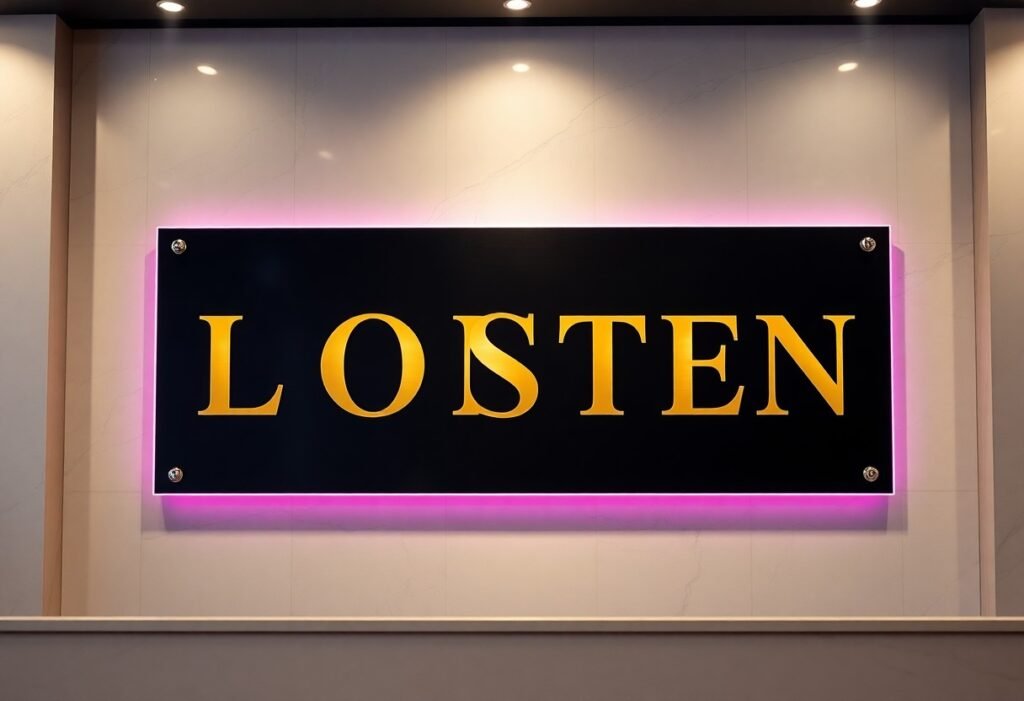
Signs that combine halo-lit or front-lit channel letters, backlit acrylic panels and crisp LED logo illumination give you the strongest first impression by balancing visibility, material quality and brand-accurate color temperature. You should prioritize clean typography, appropriate scale, durable finishes and even illumination to convey professionalism and guide visitors. With thoughtful placement, contrast and maintenance your lobby sign becomes a confident expression of your brand from the moment someone enters.
Key Takeaways:
- Prioritize visibility and legibility: high contrast, clear typography, proper letter spacing and brightness for easy reading from typical entry sightlines.
- Align with brand identity: materials, finishes, and color palette should reflect your brand – premium metals/glass convey sophistication, matte/acrylic finishes feel modern.
- Choose the right lighting style and color temperature: backlit halo for elegance, front-lit/channel letters for impact; warmer (~3000K) feels inviting, neutral (~3500-4000K) reads professional.
- Scale and placement matter: size and mounting height must suit lobby dimensions and focal points so the sign feels proportionate and immediately noticeable.
- Design for longevity and upkeep: energy-efficient LEDs, durable materials, easy service access, and compliance with accessibility standards preserve appearance and impression over time.
Importance of First Impressions
You have roughly seven seconds to register a lobby and form an opinion, so lighting, scale and material choices matter: a backlit brushed-aluminum sign reads professional, while a colorful LED panel reads innovative. Studies show signage drives behavior-76% of consumers say a sign influenced their decision to enter a store-so your illuminated lobby sign directly affects perceived legitimacy, wayfinding, and the tone you set before anyone meets your team.
Psychological Impact of Lobby Signs
You shape immediate emotional responses through color, contrast and brightness: cool white (4,000-5,000K) often reads modern and efficient, warm white (2,700-3,500K) feels welcoming, and higher CRI LEDs (80+) maintain true color of logos and finishes. Typography and halo vs. face-lit treatments cue formality or friendliness, and consistent, glare-free illumination reduces anxiety and increases dwell time in reception areas.
Role in Brand Perception
You project brand values with materials and lighting coherence-metal channel letters suggest longevity, acrylic push-through letters suggest accessibility, and programmable LEDs suggest innovation. A Sign Research Foundation study found 76% of shoppers entered a business because of its sign; translate that to your lobby and a high-quality illuminated sign becomes a direct touchpoint for trust and professionalism.
You can refine perception further by matching lighting specs to brand attributes: choose 2,700-3,500K and satin metal finishes for hospitality or legal firms, 3,500-4,500K with matte blacks or brushed steel for corporate/tech, and dynamic RGBW modules for creative brands. Specify CRI ≥80 to preserve logo colors, use diffused LEDs to avoid hotspots, design scale for sightlines at the main approach, and plan accessible maintenance and IP ratings for longevity-these technical choices deliver measurable improvements in recall and foot-traffic in busy locations.
Types of Illuminated Lobby Signs
Materials and illumination determine how quickly your brand reads in those first seconds; you should align sign type with sightlines, branding and maintenance budgets. Channel letters excel at long-distance legibility (50-200+ ft), halo-lit letters convey premium depth for executive lobbies, acrylic backlit panels deliver crisp logos for reception walls, and lightboxes offer large-area uniformity for wayfinding or history panels.
| LED Channel Letters | High-brightness letters for street-side visibility and long viewing distances. |
| Halo-lit Channel Letters | Backlit effect that creates a soft glow on the wall for upscale environments. |
| Acrylic Backlit Signs | Uniform, flush-lit panels ideal for reception walls and logo displays. |
| Edge-lit Acrylic / Push-through | Thin profiles with illuminated edges or push-through acrylic for modern aesthetics. |
| Lightbox / Illuminated Panels | Large-format diffuse illumination for graphics, directories, or branded murals. |
- Match brightness and color temperature to adjacent lighting-2700-3000K for warm interiors, 3500-4000K for neutral tones.
- Factor mounting depth and maintenance access: recessed halo requires more wall clearance than surface-mounted panels.
- Any installation over 10 feet benefits from high-lumen LEDs (≥100 lm/ft) and secure anchoring to maintain legibility and safety.
LED Signs
You’ll find LEDs dominate modern lobbies because they last 50,000+ hours, cut energy use versus neon by roughly 70-80%, and offer precise color control; choose high-CRI (≥90) modules to keep brand colors accurate, specify 2700-4000K to match interior mood, and plan for integrated dimming to adapt brightness across dayparts and conserve lifetime.
Acrylic Backlit Signs
You should prefer acrylic backlit signs when you want a seamless, uniform glow; typically fabricated from 1/8″-1/2″ acrylic with opal diffusion and rear-mounted LED strips, these panels produce clean logo fills, require 1.5″-3″ cavity depth, and perform well in reception zones where close-range scrutiny highlights finish quality.
For installation, use high-density LED tape with baffles or micro-prisms to avoid hotspots; polish edges and consider 3-6mm frosted laminate to balance brightness. You can route power discreetly through a shallow aluminum chassis, specify serviceable access panels for LED replacement, and maintain with mild soap-avoid solvents. Case studies show well-engineered acrylic backlit signs retain uniformity for years in 24/7 lobbies when using quality LEDs and correct diffusion.
Design Considerations
Balance lighting, material and scale to maximize legibility and brand presence: use halo-lit letters for depth or front-lit acrylic for bold color, aim for internal LED brightness in the 300-600 nits range for interior illumination, and provide at least 2″ return depth for a clean halo effect. Apply the 1″ letter height per 10 ft viewing-distance rule, test finishes under natural and artificial light, and choose mounting systems that allow wiring access and future servicing without removing the entire sign.
Color and Font Choices
Prioritize high contrast and tested brand colors so your logo reads from typical approach angles; aim for a contrast ratio consistent with accessibility guidelines (around 4.5:1) and avoid low-contrast pastels under bright backlighting. Use bold, geometric sans-serifs like Gotham, Helvetica or Proxima Nova for distances under 30 ft, and ensure stroke widths are no less than 1/10 of letter height to prevent washout when lit.
Size and Placement
Scale letters to reading distance using the 1″ per 10 ft rule and place the visual center near eye level – roughly 60-66 inches (152-168 cm) from finished floor – when signage will be read up close; for double-height lobbies increase letter height to 12-36 inches depending on viewing distance and ceiling height. Also position signs to avoid direct glare from windows and to align visually with reception or primary sightlines.
For example, a professional-services lobby with an 18 ft ceiling used 36″ channel letters mounted with centers at about 8 ft above the floor and set back 6-10 ft from the main doors; the result was clear legibility from 40+ ft and balanced proportion with surrounding architecture. You should also allow 4-6″ clearance behind letters for halo diffusion and avoid mounting opposite glass where sunlight creates specular highlights that reduce contrast.
Materials and Durability
What you choose-acrylic, polycarbonate, aluminum, or stainless steel-directly affects appearance and lifespan; acrylic offers superior clarity for face-lit letters while polycarbonate resists impact and UV better in high-traffic lobbies. You should note LEDs typically reach L70 at ~50,000 hours, so pair them with non-corroding substrates like 316 stainless or powder-coated aluminum in humid environments. Also verify UL listings and fire-code compliance for installation surfaces and backboxes to avoid costly rework.
Weather-Resistant Options
If your lobby has exterior exposure, specify IP65-IP66 rated fixtures and sealed LED drivers to block dust and water. You can rely on 316 stainless in coastal locations for superior corrosion resistance and on UV-stabilized polycarbonate lenses to prevent yellowing; both withstand ASTM B117 salt-spray conditions better than 304 stainless or untreated aluminum. Manufacturers often offer marine-grade hardware and silicone gaskets tested for 1,000+ hours of salt-spray exposure for extended reliability.
Long-Term Maintenance
You should plan routine care: clean faces biannually with mild detergent, inspect seals and fasteners annually, and test lumen output yearly to track degradation. Replace LED drivers proactively every 5-10 years depending on duty cycle, and keep spare modules and a documented parts list to minimize downtime. Simple log entries of cleaning dates and voltage checks reduce troubleshooting time and protect warranties.
For deeper upkeep, implement a maintenance checklist: monthly visual inspections for condensation or insect ingress, quarterly cleaning of acrylic/polycarbonate with non-abrasive solutions, and annual electrical verification (ground continuity, driver temperature, and surge protection). Photometric re-checks every 3-5 years help you decide when to relamp or upgrade; always use OEM or equivalent components and reseal penetrations with UV-rated silicone to maintain IP ratings and prevent premature failure.
Technical Aspects
You’ll need to balance brightness, depth, heat management and service access when specifying an illuminated lobby sign. Choose LED modules rated 80-120 lm/W for efficiency, allow 50-100 mm of internal cavity for driver and wiring, and plan for a removable face or rear access panel to simplify maintenance. Measure intended contrast at typical viewing distance-aim for clear legibility at 3-6 m-and verify finish options won’t reduce luminous output by more than 10-20%.
Power Source and Energy Efficiency
You can run most lobby signs on low-voltage systems (12-24 V DC) fed by a UL-listed LED driver or directly from 120/240 V with an integrated power supply. LEDs typically cut energy use by 60-80% versus neon; a medium backlit acrylic sign often draws 15-40 W while providing 1,000-3,000 lumens. Consider dimming drivers and occupancy sensors to shave runtime and specify drivers with >0.9 power factor and 5-10 year lifespan.
Installation and Safety Regulations
You must comply with local building codes, NEC Article 600 for electrical signage in the U.S., and UL 48 or equivalent for electric sign safety; many jurisdictions require a permit and inspection. Mount to studs or structural backing using stainless steel anchors at up to 406 mm (16 in) centers, route power in conduit to a junction box, and have a licensed electrician perform the final connection and certificate of compliance.
Additional practical details: signs over 22.7 kg (50 lb) commonly trigger structural review or engineer sign-off, and inspectors often request proof of UL/CE listings and driver specifications. For indoor installations expect IP20-rated fixtures, while any moisture exposure needs IP65. Typical permit turnaround runs 7-14 days; plan for 1-2 hours on-site for a straightforward 1-2 m cabinet sign install and 3-6 hours for larger, bonded installations requiring scaffolding or lifts.
Case Studies of Successful Implementations
Across industries, illuminated lobby signs produce measurable outcomes you can quantify: pilots and rollouts often report higher brand recall and faster wayfinding. In one study you can compare results and best practices in Lobby Signs: Guide to Enhancing Your Business …, while individual implementations below show specific metrics you can use when specifying your next project.
- 1) Global law firm (headquarters): 16 ft acrylic backlit logo, 4,000 K LEDs, measured 320 lux at reception; visitor survey showed a 30% increase in perceived professionalism; installation: 3 days; total cost: $28,500; maintenance interval: 24 months.
- 2) Tech HQ (series B to enterprise): 10 ft brushed aluminum halo-lit sign with RGB accent, power draw 95 W total, achieved 22% rise in employee retention-related referrals over 12 months; payback via recruitment savings estimated ~18 months.
- 3) Retail flagship pilot (12 stores): channel-letter illuminated signs, 3000 K, average evening foot-traffic +18%, conversion rate up 9%, average sales per store +5% in first quarter post-install; per-store install cost: $4,800; ROI reached in 9-12 months for high-traffic locations.
- 4) Boutique hotel lobby: 6 ft halo-lit sign, warm 3000 K, guest satisfaction scores rose 12% for lobby aesthetic; installation time: 1 day; energy use: ~30 W; incremental ADR (average daily rate) impact estimated at +1.8% during promotional months.
- 5) Medical clinic (multi-site rollout, 8 locations): ADA-compliant illuminated signage with tactile elements, 3,500 K backlight, patient check-in time reduced 8% due to clearer wayfinding; installation per site: 6 hours; average cost: $1,950; measured drop in front-desk queries by 15%.
Corporate Offices
You can leverage illuminated signs to reinforce brand values for employees and visitors alike; one enterprise rollout replaced static plaques with 10 custom backlit logos and reported a 25% improvement in reception NPS and a 14% reduction in directional inquiries, while design choices (metal vs. acrylic, 3500-4000 K, 200-500 lux) influenced perceived prestige and maintenance schedules.
Retail Spaces
You should prioritize visibility and messaging cadence: a 12-store pilot used front-lit channel letters and dynamic backlit window promos, producing an 18% increase in evening foot traffic and a 5% uplift in same-store sales, with most locations recouping install costs within 9-12 months.
More granularly, you can optimize placement, color temperature (3000-4000 K for warmth vs. 4000-5000 K for high contrast), and controller-driven dimming to match store hours; measuring conversion before and after (week-over-week for 8-12 weeks) lets you attribute revenue lift to sign changes and fine-tune brightness, messaging rotation, and maintenance cycles for maximum impact.
Final Words
Considering all points, you create the best first impression with an illuminated lobby sign that clearly communicates your brand through legible typography, balanced brightness, appropriate scale and color temperature, quality materials, and thoughtful placement; prioritize harmony with your interior design, minimize glare, and ensure easy maintenance so your sign looks professional and welcoming every time visitors arrive.
FAQ
Q: What types of illuminated lobby signs create the strongest first impression?
A: High-impact options include halo-lit channel letters for a premium, dimensional look; front-lit channel letters for bold visibility; backlit logo panels and acrylic panels for even, modern glow; edge-lit acrylic for a sleek, minimalist effect; and illuminated lightboxes for large-format graphics. Choose based on brand tone: halo-lit and metal finishes signal luxury, front-lit and bold colors read well from distance, while backlit panels give a contemporary, clean appearance.
Q: How do I choose the right size, scale, and placement for a lobby sign?
A: Base size on viewing distance and wall proportion – letters should be legible from the main entry point and balanced with surrounding architecture. Mount at eye level or slightly above for reception areas; center the sign on the primary sightline and allow breathing space around it. Use scaled mockups or projection to verify legibility and avoid cluttering the wall with competing elements like lights or artwork that reduce impact.
Q: Which materials, finishes, and lighting colors create the most favorable perception?
A: Metal faces (brass, stainless) with halo illumination convey sophistication; matte painted metals or acrylic in brand colors deliver a bold, modern presence. Diffused acrylic faces produce uniform lighting and soften hot spots. Warm white LEDs (2700-3500K) feel welcoming and upscale; neutral white (3500-4000K) reads as professional; cool whites can feel clinical unless balanced with warm finishes. High contrast between letters/logo and background ensures instant readability.
Q: How can typography and logo treatment affect first impressions on illuminated signs?
A: Legibility is paramount: choose typefaces with sufficient stroke width and open counters for backlit or halo-lit execution. Avoid overly intricate details that disappear when lit or viewed from distance. Maintain consistent brand proportions, color matches, and clear space rules. Provide sign manufacturers with vector artwork and a signage spec to preserve kerning and logo fidelity during fabrication and lighting application.
Q: What practical considerations influence the long-term effectiveness of an illuminated lobby sign?
A: Opt for LED lighting with reliable drivers and a warranty, and specify service access for driver replacement. Confirm IP ratings for moisture exposure in certain lobbies and choose finishes that resist fingerprints and scuffs. Factor in dimming controls to match ambient light, energy efficiency, and maintenance access. Verify local building codes and ADA requirements for signage height, contrast, and tactile elements if needed. Budget for professional installation and a commissioning check to ensure even illumination and secure mounting.