
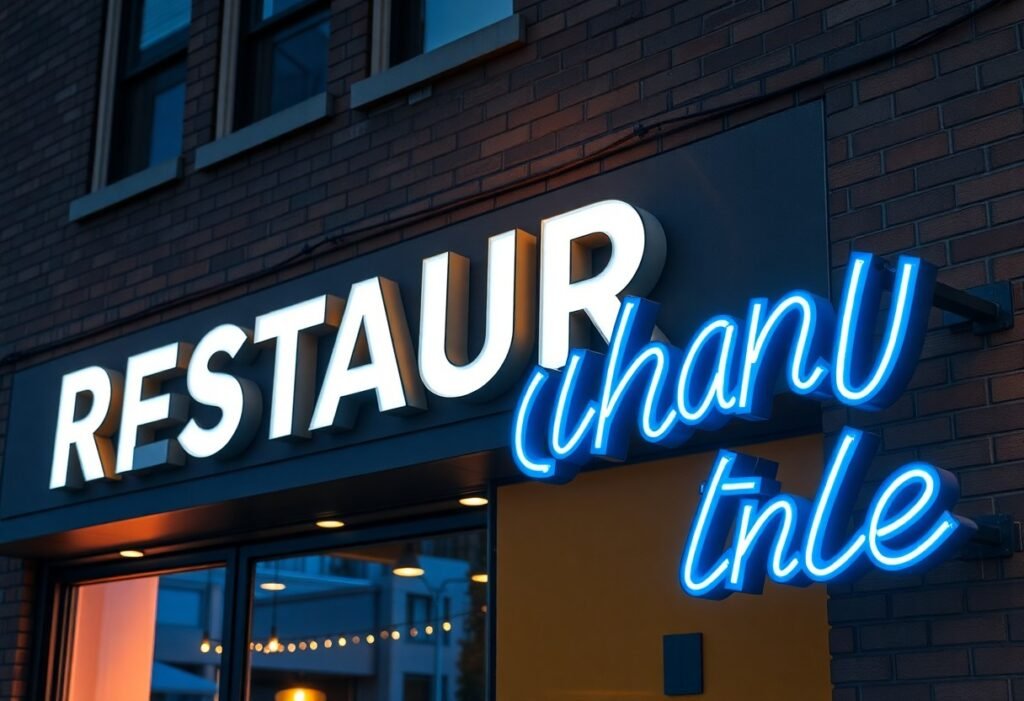
Just prioritize visibility and brand fidelity when selecting channel letters for your restaurant: face-lit and halo-lit LED channel letters deliver the best balance of nighttime legibility and energy efficiency. You should choose durable materials like aluminum returns and cast acrylic faces, match LED color to your palette, and favor deep dimensional returns or push-through elements for distance readability. Consult a reputable fabricator who evaluates sightlines, mounting, maintenance, and local codes to maximize impact.
Key Takeaways:
- Prioritize visibility and legibility: high-contrast colors, simple fonts, adequate stroke width and letter height matched to viewing distance increase read rate.
- Choose the right lighting: front‑lit LEDs for bold readability, halo/backlit for an upscale halo effect, or a combination for depth and 24/7 presence; specify color temperature and dimming options.
- Pick durable materials and finishes: aluminum cabinets with translucent acrylic faces, powder coating or stainless returns, and UV-stable paints deliver even illumination and long life.
- Match placement and scale to the site and code: size, mounting height, setbacks and permit requirements must align with facade proportions and local sign regulations for maximum impact.
- Design for serviceability and efficiency: sealed, weatherproof construction (IP-rated), replaceable LED modules and energy-efficient drivers reduce maintenance and operating costs.
Understanding Channel Letters
When specifying channel letters you should apply practical rules: size letters at roughly 1 inch of height per 10 feet of typical viewing distance, choose returns 3-6 inches deep for front-lit or halo effects, and prefer acrylic faces with aluminum returns for durability. LEDs are standard-modules commonly rated ~50,000 hours and can cut energy use by up to 70-80% versus neon-so factor lifetime and serviceability into your ROI calculations.
Definition and Purpose
Channel letters are three‑dimensional, individually mounted characters-acrylic faces, routed aluminum returns-with internal lighting (usually LED) that makes your name visible day and night. You use them to maximize legibility on storefronts and free‑standing pylon signs, reinforce brand colors and fonts, and guide customers from the street; front‑lit, halo, and reverse‑halo variants change the look while serving the same wayfinding and branding purpose.
Advantages for Restaurants
You gain 24/7 visibility, strong brand fidelity, and lower operating costs: LED channel letters typically require less energy and less frequent replacement than neon, with modules rated ~50,000 hours and warranties often 3-5 years. They allow precise color matching for brand consistency, custom sizes to suit façades, and styles-from bold front‑lit to premium halo-that help drive evening foot traffic and make your location instantly recognizable from a distance.
For practical application, if your restaurant faces a roadway 120 feet away, spec letters around 12 inches tall; choose 4-6 inch returns for halo effects which need wall clearance, or 3-4 inch for tight façades. Modular LEDs simplify on‑site swaps-many techs can replace a module in 15-30 minutes-while aluminum construction resists corrosion and can deliver 7-15 years of service with routine maintenance, improving long‑term cost per impression.
Types of Channel Letters
| Front-Lit | Face illuminated with acrylic and LEDs; 50,000+ hour LED life, depths commonly 3-6 in, clear daytime branding and night visibility to ~100-300 ft. |
| Back-Lit (Halo) | Halo glow from returns; needs 1.5-3 in setback, stainless returns preferred, ideal for upscale diners and ambient night presence. |
| Reverse-Lit | Letters illuminated from the back but with translucent returns for edge glow; modern, subtle, works well on textured façades. |
| Open-Face / Exposed Neon | Exposed neon or LED tubing for vivid color and vintage look; higher maintenance, signature appeal for bars and themed restaurants. |
| Combination / Hybrid | Mix of front and halo lighting to maximize daytime legibility and night ambience; used by multi-location chains for brand consistency. |
- Assess your storefront depth and viewing distance before choosing letter depth and LED output.
- Match color temperature (2700-4000K) to your interior lighting to maintain consistent brand tone.
- Factor maintenance access and local sign code setbacks into your installation plan.
- Consider materials-stainless returns resist corrosion in humid kitchen areas.
- Plan wiring and dimming so your sign works with evening ambiance and energy goals.
Front-Lit Channel Letters
You’ll often opt for front-lit letters when you need maximum readability: full-face acrylic with internal LED modules delivers bright, uniform illumination that reads well from 100-300 feet. Many quick‑service and casual restaurants choose 3-6 inch deep letters and 50,000+ hour LEDs to keep energy and maintenance low while maintaining bold daytime branding.
Back-Lit Channel Letters
Halo or back-lit letters cast a soft glow around each character, giving your façade a premium, understated look; restaurants aiming for an upscale or intimate evening vibe typically use 1.5-3 inch setoffs and cooler 3000-3500K LEDs for a refined halo without glare.
Recognizing installation needs matters: you should leave 1.5-3 in clearance from the wall for proper halo dispersion, pick 3000K for warm ambiance or 4000K for neutral pop, and plan letter depth of 4-8 in for balanced light spread; installers commonly use LED strips rated 50,000 hours and include dimmers so your back-lit sign adapts to service hours and energy targets.
Customization Options
You can mix materials, illumination types and finishes to match your brand: halo-lit returns, front-lit acrylic faces, brushed aluminum, or LED color temperatures from warm 3000K to cool 6000K. Apply Pantone-matched paints for consistency and choose between individual channel letters or a pan-face cabinet for complex logos. For help comparing styles and construction, see What Are the Different Types of Channel Letter Signs?.
Fonts and Colors
You should prioritize legibility-use sans-serif faces like Helvetica, Futura or Gotham for storefronts and reserve scripts or display fonts for secondary branding. Follow the 1″ = 10 ft rule to size strokes, and pick high-contrast color pairs (dark face on light halo or vice versa). Match paint to a Pantone or CMYK value, and select LED color temperature (2700-6500K) that complements your interior lighting and curb appeal.
Sizes and Shapes
You’ll typically specify letter heights between 12″ and 36″ for pedestrian streets, with depths of 3″-6″ for standard channel letters; larger letters (36″-48″+) often use pan-channel or structural framing. Custom contours let you replicate logos exactly, while stroke width and return height ensure structural stability and even illumination. Account for viewing distance and local sign-area limits when choosing size.
For more detail, consider that letters over 48″ commonly require engineered supports and permits, and returns deeper than 8″ are rare due to weight and LED placement. You can combine front-lit faces for visibility with halo-lit returns for nighttime contrast; designers often specify 2″-4″ minimum stroke widths for durability and even light distribution in letters used daily on busy facades.
Installation Considerations
Plan for structural support and service access early: channel letters add point loads and require studs or track systems anchored into rated substrate, typically with anchors every 16-24 inches. You should coordinate electrical feed, LED driver placement and maintenance access before fabrication; LEDs commonly offer 50,000+ hour life but drivers may need yearly checks. Allow 2-6 weeks for permits and shop drawings in many municipalities to avoid installation delays.
Location and Visibility
Use the 1 inch per 10 feet readability rule for sizing-if drivers see your sign from 100 ft, aim for ~10‑inch letters; for primary curbside visibility, 18-36 inch letters are common. Position letters within clear sightlines, avoid deep recesses or heavy ornamentation that blocks halo light, and consider front‑lit faces for long-distance legibility while halo‑lit returns improve night contrast against busy backgrounds.
Building Regulations
Expect to pull sign and electrical permits, and comply with local sign codes that often cap sign area to 20-30% of a storefront façade or impose illumination curfews. Historic districts or mixed‑use zones may require design review; noncompliance can trigger removal orders or fines, so verify municipal requirements before ordering fabrication.
More technically, many jurisdictions demand stamped shop drawings, wind‑load calculations and seismic anchoring to local code (design wind speeds commonly range 90-140 mph in high‑risk regions). You should use a licensed contractor and electrical permit holder to submit drawings, arrange inspections and ensure accessible disconnects and weatherproof wiring per the authority having jurisdiction.
Maintenance and Durability
You should plan maintenance around material and environment: routine inspections catch loose wiring, water intrusion, and fading before they force costly replacements. LEDs typically deliver 50,000+ hours (about 5-8 years with nightly use), while finishes and acrylic faces show wear over 7-15 years depending on UV exposure and pollution. Anticipate faster service cycles in coastal or high-grease locations and budget for periodic cleaning, gasket replacement, and LED-driver swaps to keep brand presentation consistent.
Materials and Longevity
Aluminum returns with powder-coat or anodize hold up 10-20 years outdoors; marine-grade 316 stainless is better for salt-air sites. Acrylic faces resist yellowing for roughly a decade; polycarbonate offers superior impact resistance but scratches easier. Use IP65-rated LED modules for wet climates and specify sealed raceways to prevent condensation. Choosing higher-spec materials can raise upfront cost 10-30% but often doubles service intervals in harsh environments.
Regular Upkeep
Inspect your channel letters visually every month and perform a hands-on check every 6-12 months: tighten fasteners, test LED drivers, and reseal any compromised gaskets. Cleaning frequency depends on location-downtown or kitchen-adjacent signs benefit from quarterly washes; suburban signs often manage semiannual cleaning. A typical service call for diagnostics and minor repairs ranges $100-$300, far less than a full letter rebuild.
When cleaning, use a pH-neutral detergent and soft cloth; avoid ammonia-based cleaners on acrylic to prevent crazing. Do not pressure-wash at pressures above 1,200 psi near seams, and allow technicians to inspect raceway desiccants and conduit seals after storms. Track parts and service dates in a simple log-LED driver warranties often run 3-5 years, so syncing preventative replacement with warranty expirations reduces downtime and surprise expenses.
Case Studies
Real installations show how specific choices affect performance: when you match letter type, size and color temperature to street distance and brand personality, measurable lifts follow-examples below include installation times, costs and quantified sales or traffic gains so you can judge likely outcomes for your site.
- Neighborhood Pizzeria (suburb): 24″ front-lit acrylic letters, 3000K LEDs at ~7W/letter, installed in 1 day for $3,200; foot traffic +22% in month 1, same-store sales +14% by month 2, estimated payback 9 months.
- Urban Fast-Casual Chain (downtown): 6 locations, combo front + halo letters, 18-36″ heights, 4000K for daytime clarity; average install $7,500/location; drive-by visibility increased 28%, evening sales +20% over 90 days.
- Boutique Café (high footfall mall): halo-lit brushed aluminum, 12″ letters, 3500K indirect LEDs, retrofit cost $1,800; measured dwell time up 12%, morning transaction value +8% within 60 days.
- 24/7 Drive-Thru (suburban): high-output front-lit faces, 5000K cool white, 10W/letter modules, $5,400 install; peak-hour throughput improved 15%, nighttime sales +25%, LED energy use cut 65% vs neon.
- Fine-Dining Restaurant (historic district): halo-only, painted returns for subtle elegance, 30″ depth 5″, $9,200 install due to permits; reservation bookings for late service up 18%, complaints about glare dropped to zero after layout tweak.
- Bakery Pop-Up (street corner): economical routed and face-lit channel letters, 10″ tall, 2700K warm LEDs, $900 install; morning foot traffic spike of 35% on weekends, ROI reached in 4 months during busy season.
Successful Examples
You’ll notice the fastest wins came from aligning letter height and brightness with viewing distance: downtown fast-casuals using combo letters saw average visibility lifts of ~28%, while 24/7 drive-thrus using higher-output front-lit faces achieved +25% nighttime sales-choices drove measurable customer behavior within 30-90 days.
Lessons Learned
You should prioritize viewing distance, color temperature and maintenance access when specifying letters; typical trade-offs include higher initial cost for combo or halo builds versus longer-term gains in brand clarity and evening revenue-plan for permits and a 6-12 month performance review to validate ROI.
For deeper planning, you’ll want to track metrics (foot traffic, sales by daypart, energy usage) before and after install, aim for LED specs that match sign scale (higher wattage/lumen for greater distances), and budget 5-10% of install cost for annual maintenance to preserve brightness and maximize payback.
Final Words
Now choose channel letters that maximize visibility and reflect your brand: front-lit or halo-lit LED letters for nighttime legibility, durable aluminum and acrylic construction for weather resistance, and properly scaled size, color contrast, and placement for sightlines. You should prioritize energy-efficient LEDs, professional installation, and consistent styling so your restaurant sign reliably attracts customers and reinforces your identity.
FAQ
Q: What are channel letters and why are they a good choice for restaurants?
A: Channel letters are three-dimensional, individually fabricated letters or logos mounted on a building façade or raceway. For restaurants they deliver strong curb appeal, work at night with built-in illumination, reinforce brand identity, and can be customized to fit any architectural style. They draw attention from passing foot and vehicle traffic, improve wayfinding, and create a professional, durable sign solution that aligns with marketing and interior design.
Q: Which illumination style of channel letters works best for restaurant signage?
A: LED-illuminated channel letters are the best option for restaurants because LEDs are energy-efficient, long-lasting, and available in a variety of color temperatures. Front-lit (face-lit) letters provide high visibility and bold color; reverse halo (back-lit) letters create a sophisticated glow against the wall for an upscale look; and combination (front-and-back lit) offers maximum presence day and night. Choose warm whites for intimate dining atmospheres and cooler whites for fast-casual or modern concepts. Ensure LED modules are rated for outdoor use and have proper diffusers to avoid hot spots.
Q: What materials and finishes are most effective for restaurant channel letters?
A: Aluminum is the industry standard for the letter cabinet due to its light weight, corrosion resistance, and paintability. Acrylic faces are common for color options and translucence; polycarbonate can be used where impact resistance is required. For premium looks, brushed or mirror-polished stainless steel or formed metal returns with painted finishes can complement interior branding. Use UV-stable paints and powder coatings in high-sun or coastal locations, and specify marine-grade hardware if exposed to salt air.
Q: How should I choose letter size, font, and color to optimize visibility and brand fit?
A: Size depends on viewing distance and mounting height-use the rule of thumb that each inch of letter height yields roughly 10-50 feet of legibility depending on contrast and lighting. Select a font with adequate stroke width and spacing so LEDs and the face depth don’t obscure details; avoid overly ornate type for small signs. High contrast between letter color and the building backdrop increases read-time; test color and brightness at night to match ambiance. Keep typographic treatment consistent with other brand assets for recognition across channels.
Q: What installation, permitting, and maintenance factors should restaurants plan for?
A: Verify local sign codes, zoning, and historic district restrictions before design-permit timelines can affect opening dates. Decide between direct-mount, raceway, or sign pan mounting based on wall substrate and electrical access. Ensure the installer uses weatherproof wiring, GFCI-protected circuits, and accessible service panels for LED drivers. Plan a maintenance schedule for cleaning acrylic faces, checking LED modules and mounts, and applying touch-up paint to exposed metal. Choose energy-efficient LEDs and timers or photocells to minimize operating costs and stay compliant with local lighting ordinances.