
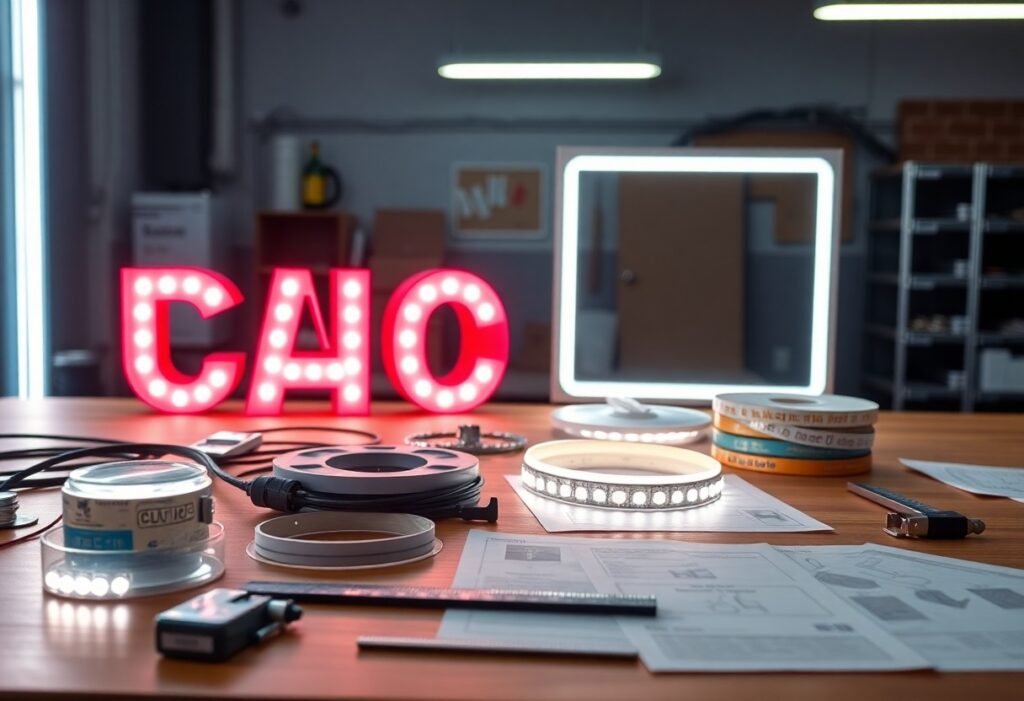
Beginners should learn illumination types (LED, neon, edge-lit), material choices, mounting and wiring basics, and how brightness, color temperature and contrast affect visibility so you can design signage that meets zoning rules and maintenance needs; prioritize energy efficiency, safety, budgeting and working with reputable fabricators to ensure your sign performs reliably and communicates your brand clearly.
Key Takeaways:
- Understand common types: LED, neon, backlit (lightbox), and channel letters-each has different brightness, lifespan, and cost profiles.
- Design for visibility: prioritize legible fonts, high-contrast colors, appropriate letter size and spacing for expected viewing distance and lighting conditions.
- Plan for electrical and safety needs: verify power supply, wiring, IP/weather ratings, and local permits or signage codes before ordering or installing.
- Consider installation and maintenance: choose durable materials, weatherproofing, accessible access for bulb/LED replacement, and a cleaning schedule to preserve performance.
- Balance upfront cost and operating efficiency: LEDs typically offer higher energy efficiency and lower long-term maintenance costs despite higher initial investment.
Types of Illuminated Signage
Different installations trade off brightness, lifespan, and upfront versus operating cost; you’ll pick based on where the sign will sit, how long you want it to run, and the visual style you want to project.
| LED Signs | Low energy, 50,000+ hrs, programmable, best for long-term ROI |
| Neon Signs | Glass tubes, warm color, higher power use, iconic retro look |
| Channel Letters | 3D faces (front/halo), aluminum builds, common for storefronts |
| Light Boxes | Backlit graphics, uniform illumination, ideal for branded art |
| Digital Displays | Full-motion content, high brightness, higher initial cost |
- Brightness: LEDs typically exceed 1,000-5,000 lumens for medium storefront signs.
- Lifespan: LEDs often outlast neon by 3-5×; plan maintenance accordingly.
- Cost: neon can be cheaper initially for small art, LEDs win on lifetime cost.
- Permits: channel letters and illuminated fascias often need electrical and planning approval.
- Installation: mounting type, wind load, and access for service change labor and permit needs.
Neon Signs
Glass neon uses gas-filled tubes to emit a vivid, continuous glow; you’ll see typical lifespans of 8-15 years with higher energy draw and specialist repair needs, yet it remains preferred for vintage bars and distinctive indoor branding where that warm hue matters.
LED Signs
Solid-state LEDs offer modular brightness, color temperature control, and up to 50,000+ hours of operation; you can program color changes, dimming, and scheduling, making LEDs cost-effective for 24/7 storefronts and large-format builds you want to run with minimal onsite maintenance.
Energy studies show LEDs can reduce consumption by up to 70-80% compared with neon; typical outdoor modules are IP65-rated, use 12-24V systems with remote transformers, and allow pixel-mapped signage for animations and dayparting-factors that boost visibility and lower operating budget.
Channel Letters
Three-dimensional letters are built from aluminum with acrylic faces and internal LEDs; you’ll choose face-lit, backlit (halo), or front-and-back options depending on depth (commonly 4-12 in.) and the illumination effect you want for roadside or mall placements.
Fabrication details matter: return depth, face thickness, and masking change light spill and uniformity, while transformer placement, conduit routing, and anchor types determine installation cost-expect $100-$400 per letter installed for typical retail sizes, varying by finish and engineering.
Light Boxes
Backlit light boxes use printed or translucent graphics over an illuminated cavity to give even, brand-true color at night; they work well for wayfinding, menu boards, and illuminated storefronts where consistent face uniformity is necessary and swapping graphics is frequent.
Construction options include edge-lit acrylic panels or full backlit LED arrays; you’ll measure uniformity in lux and aim for even diffusion with 3-6 in. shallow boxes for indoor use or deeper, weather-rated assemblies for exterior signage, and consider snap-frame faces for quick graphic changes.
This helps you match sign type to budget, brand, and location.
Important Factors to Consider
Balance brightness, lifespan and upfront cost against where the sign will sit and who will see it; you’ll weigh LEDs for low energy and channel letters for brand impact.
- Visibility: lumen output, mounting height, and contrast
- Durability: IP rating, materials, and expected service life
- Maintenance: access, replaceable modules, and spare parts
- Budget: capex vs ongoing energy and repair costs
Thou should factor warranties, typical LED life (50,000-100,000 hrs) and total cost of ownership.
Location and Visibility
Place signs to match sightlines and viewer speed: for pedestrian-facing storefronts design for legibility at 30-50 ft, while roadside signs should be readable at 100-200 ft; use the guideline of ~1 inch letter height per 30-50 ft of viewing distance, check sightlines from approach lanes, and test nighttime contrast against ambient lighting so your message reads instantly.
Regulations and Permitting
Check local zoning for maximum sign area, height limits, illumination rules and permitted hours-many municipalities require electrical and sign permits and inspections, with review times commonly 2-6 weeks and fees that vary by size and type; noncompliance can trigger fines or removal, so you must verify rules before fabrication.
Start by contacting the planning or building department for application requirements: submit scaled elevations, site plan, structural calculations and electrical diagrams, include a photometric plan if required, supply contractor licensing and insurance, and expect possible design review in historic districts-iterative reviews may require revisions to materials, brightness or mounting details.
Power Supply and Energy Efficiency
Specify efficient LED modules and quality drivers (85-95% efficiency), and design control systems like photocells, timers or dimmers to limit run hours; LEDs typically deliver up to ~70% energy savings versus older technologies, so plan dedicated circuits, surge protection and easy access to drivers to minimize downtime and operating costs.
For budgeting, use a simple energy check: a 100 W sign running 12 hours/day consumes 1.2 kWh/day (~36 kWh/month); at $0.15/kWh that’s about $5.40/month. Factor driver losses, maintenance of power supplies, and consider solar + battery only after comparing payback against grid connection and local incentives.
Tips for Effective Design
Prioritize hierarchy and viewing distance: use the 1 inch per 10 feet guideline for letter height, keep primary message to 3-5 words, and maintain contrast ratios near 4.5:1 for legibility under mixed lighting. Test materials for LED diffusion and glare, and consult the Beginner’s Guide To Backlit Signage for backlit specifics. Thou prototype at full scale and review on-site before final approval.
- Limit typefaces to 1-2; use bold sans-serifs for headlines
- Stick to a 2-3 color palette and verify Pantone/hex matches
- Mock up at actual viewing distances and test at night
Choosing Colors and Fonts
You should pick a palette with a primary and accent color, keeping contrast at least 4.5:1 for text over background; consider luminous paints or LED tunable white for visibility. For fonts, use clean sans-serifs with open counters-aim for stroke widths that hold up when reduced to small sizes, and follow the 1″ per 10 ft letter-height rule for distance legibility.
Incorporating Branding Elements
You must preserve logo proportions and color fidelity: specify Pantone or hex values, provide vector files (SVG/EPS) to fabricators, and set minimum clearspace-commonly 0.2× logo height-to avoid crowding. Keep brand icons simplified for backlit use and limit ornamentation that casts unwanted shadows.
For practical controls, define a minimum logo height (for example, 3-4 inches for interior signs and 6-8 inches for outdoor storefronts), lock logo aspect ratio, and supply a one-color negative version for illuminated mounts; those steps prevent distortion in production and ensure consistent brand recognition across materials.
Ensuring Readability
You should optimize spacing: use letter-spacing slightly increased for uppercase words, avoid long blocks of all-caps, and keep line lengths short-3-5 words per line for signs. Verify contrast under daytime sun and nighttime LED conditions, and test with common viewing angles of 15-30 degrees.
Measure readability by placing a printed mock at the intended viewing distance and confirm legibility for at least 90% of passersby; adjust kerning, stroke width, or illumination uniformity if letters blur or hotspots appear, and document final specs for repeatable fabrication.
Step-by-Step Guide to Installation
Installation Steps Overview
| Step | What you do |
|---|---|
| 1. Site survey | Measure facade, sightlines, mounting substrate and obstructions; note viewing distance to size letters (1″ per 10 ft guideline). |
| 2. Permits & approvals | Confirm zoning, electrical permit and HOA rules; typical municipal turnaround 2-6 weeks. |
| 3. Electrical planning | Calculate load, specify driver/transformer, circuit (14 AWG for ≤15A, 12 AWG for ≤20A) and breaker size; plan conduit route. |
| 4. Mounting prep | Select anchors for wall type (2-3″ stainless anchors for masonry), check wind rating and attach backing plates to studs where possible. |
| 5. Installation | Pre-fit sign, secure brackets, pull wiring through grommets, seal penetrations with silicone; use level and torque specs. |
| 6. Testing & commissioning | Verify polarity, measure lumen output and uniformity, test drivers at full load, run 24‑hour burn‑in for LEDs. |
| 7. Handover & maintenance | Provide wiring diagrams, driver specs, expected driver life (5-10 years) and a cleaning schedule. |
Planning Your Installation
You should map mounting points, power access and cable paths before ordering parts; for example, a 10 ft viewing distance requires 1″ letters, and signs over public walkways may need engineer-stamped attachments or wind‑load calculations – factor in permit lead times of 2-6 weeks and coordinate with the utility if a new service or transformer is required.
Tools and Materials Needed
You’ll want a hammer drill with 1/4″-3/8″ bits, stud finder, level, torque driver, wire strippers, multimeter, fish tape, silicone sealant, stainless anchors (2-3″), IP65 LED drivers, waterproof connectors, conduit, mounting brackets and a lift or scaffold rated for the install height.
Choose drivers with at least 20% headroom on wattage to avoid overheating and select connectors rated to IP65 or higher for exterior use; specify wire gauge by circuit load (use 14 AWG for runs under 15 A, 12 AWG for 20 A), keep spare LEDs and a replacement driver on hand, and pack a heat‑shrink kit, stainless fasteners, and a corrosion‑resistant sealant for long‑term reliability.
Safety Precautions
You must de-energize circuits and use lockout/tagout when working on live systems, wear PPE (insulated gloves, safety glasses, hard hat), secure falls with harnesses for heights over 6 ft, and never work alone when using lifts or performing high‑voltage connections.
Engage a licensed electrician for mains tie‑ins and follow local electrical code; confirm fall‑protection per OSHA for installs above 6 ft, use class‑rated insulated tools for any live troubleshooting, and keep a Class C fire extinguisher nearby when testing electrical components – perform a low‑voltage continuity check before full power application.
Pros and Cons of Illuminated Signage
Compare trade-offs to match your budget and location: illuminated signage delivers high visibility and measurable evening footfall gains, but adds energy and maintenance obligations. For example, LED channel letters often last 50,000-100,000 hours and can lift evening traffic by 20-30% for storefronts, yet you’ll need to plan for permits, dimming controls, and occasional component replacement.
| Pros | Cons |
|---|---|
| 24/7 visibility increases brand presence | Potential light pollution and neighbor complaints |
| LED efficiency: up to ~80% less energy than incandescent | Higher upfront cost vs non-illuminated signage |
| Long lifespans (LEDs: ~50k-100k hours) | Periodic maintenance and repairs (cleaning, driver replacement) |
| Flexible design: color-changing, backlit graphics | Technical skills required for neon and complex installs |
| Proven sales uplift for evening trading (retail, hospitality) | Local permits, curfews, and brightness limits may apply |
| Good ROI when targeted to high footfall locations | Vulnerability to vandalism and weather damage |
| Improved legibility at distance with proper lumen/nit spec | Risk of glare or overlighting if poorly specified |
Benefits
You gain continuous brand exposure, measurable evening traffic increases, and energy savings when you choose modern LEDs-typical lifespans of 50,000-100,000 hours cut replacement cycles. Additionally, you can use RGB LEDs for timed campaigns, dimming schedules, and targeted color schemes; a café, for example, might schedule warmer tones after 8pm to improve ambience and conversion during dinner hours.
Potential Drawbacks
You face higher initial costs and ongoing obligations: permits, utility costs, and routine servicing. Neon systems often need specialist technicians and can show reduced brightness after 15,000-30,000 hours, while LED drivers and power supplies usually require replacement every 5-10 years. Also consider neighborhood lighting rules that may force dimming or shutdowns at night.
In more detail, you should budget for regulatory and operational realities: many downtown zones enforce dimming curfews (commonly between 10-11pm) or brightness caps, so plan photo-sensors, timers, or adaptive controllers. Expect to allocate roughly 5-15% of your initial signage capex annually for maintenance, cleaning, and minor repairs, and factor permit and removal fees into lifecycle costing to avoid surprises.
Maintenance and Care
Schedule routine upkeep: clean lenses and acrylics every 3-6 months, inspect seals after storms, and plan a full service yearly for high-mounted or complex signs. You’ll extend LED life (typically ~50,000 hours) by preventing heat buildup and ingress; verify outdoor fixtures meet at least IP65, tighten mounting hardware, and budget roughly 1-3% of install cost annually for parts and labor to avoid premature failures.
Regular Inspection
Perform a quick visual check monthly for burned-out modules, loose fasteners, or water stains, then a quarterly hands-on test: measure supply voltage at the driver (12/24/24-48V DC common), confirm wiring torque, and inspect gaskets and cable glands for cracking; log findings and replace weathered silicone or foam seals to maintain intended IP rating.
Troubleshooting Common Issues
If your sign flickers, dims, or shows color shifts, first isolate power and inspect fuses and connectors for corrosion. Use a multimeter to check driver output under load (expected voltage ±5%); swap the driver with a known-good unit when uncertain, and reseal any water-entry points-most failures trace to the PSU, poor connections, or moisture.
Example: a channel-letter flicker often stems from a failing constant-voltage driver whose output falls from 24V to ~18V under load – you can confirm this by measuring at the driver and at the LED strip; if voltage drops across connectors, clean or replace them. Driver replacements typically run $50-$200, neon transformer swaps $200-$600, and resealing with marine-grade silicone or replacing IP-rated glands usually fixes moisture-related problems quickly.
Conclusion
Summing up, you should focus on selecting the right lighting type and durable materials, balancing visibility, energy efficiency and budget, and planning for safe installation, permits and ongoing maintenance; early collaboration with fabricators and electricians ensures compliance and optimal performance so your illuminated signage delivers clear branding and longevity.
FAQ
Q: What are the main types of illuminated signage a beginner should know?
A: Common types include LED channel letters, backlit/routed signs, lightboxes, neon or LED neon-effect flex, and edge-lit acrylic panels. Channel letters offer bold three-dimensional branding for storefronts. Backlit signs and lightboxes provide uniform face illumination for panels and graphics. Neon gives a classic continuous glow but is costly and fragile; LED neon flex mimics neon with lower power and greater durability. Edge-lit acrylic panels create a slim, modern look ideal for interior wayfinding or reception signs. Each type differs in visibility, cost, installation complexity, maintenance needs, and suitability for indoor vs. outdoor use.
Q: How do design choices and materials affect visibility and longevity?
A: Material selection (aluminum, acrylic, polycarbonate) impacts durability and weight. Acrylic and polycarbonate are common for faces and diffusers-acrylic gives crisp light diffusion, polycarbonate adds impact resistance. Paint, vinyl graphics, and finishes affect contrast and legibility; high contrast between text and background improves read distance. Color temperature (2700K-6500K) and LED brightness determine perceived clarity; warmer tones suit hospitality, cooler tones improve daytime contrast. Weatherproofing, UV-stable materials, and corrosion-resistant mounting hardware extend lifespan, while proper sealing prevents moisture ingress that causes LED failure and corrosion.
Q: What electrical, safety, and regulatory considerations should be addressed before installing illuminated signs?
A: Verify local permitting, zoning, and sign code restrictions (size, height, illumination hours, and allowed locations). Ensure electrical work follows local codes and is performed or inspected by a licensed electrician; this includes correct transformer sizing, circuit protection, grounding, and GFCI where required. Confirm ingress protection (IP) ratings for outdoor fixtures and choose weatherproof wiring and connectors. Plan for thermal management-LEDs need ventilation or heat sinks to avoid premature failure. Check fire-safety rules, utility easements, and, if rooftop or elevated, structural load and wind-resistance requirements.
Q: What are best practices for installation and ongoing maintenance?
A: Site survey first: measure viewing distances, sightlines, mounting substrate, and access for wiring. Use appropriate anchors and corrosion-resistant fasteners for the substrate (masonry, metal, wood). Allow access panels or removable faces for servicing LEDs, drivers, and wiring. Schedule routine inspections every 6-12 months to check seals, electrical connections, LED modules, and mounting integrity; clean diffusers with non-abrasive cleaners to maintain light output. Replace drivers before end-of-life when flicker or dimming appears, and keep spare modules and matching LEDs on hand to avoid visible color shifts during repairs.
Q: How should beginners estimate costs, energy use, and return on investment?
A: Costs include design, materials, fabrication, permits, electrical work, mounting labor, and maintenance. LED signs usually have higher upfront fabrication costs than non-illuminated signs but lower operating expenses. Calculate power consumption by summing LED wattage and driver losses, then multiply by local electricity rate to estimate operating cost. Factor in lifespan of LEDs (L70 hours) and driver replacement intervals for lifecycle cost. Evaluate ROI by estimating increased visibility, extended business hours, and potential customer traffic uplift; compare these benefits against total cost of ownership over 5-10 years to decide on investment level and features like dimming, timers, or energy-saving sensors.