
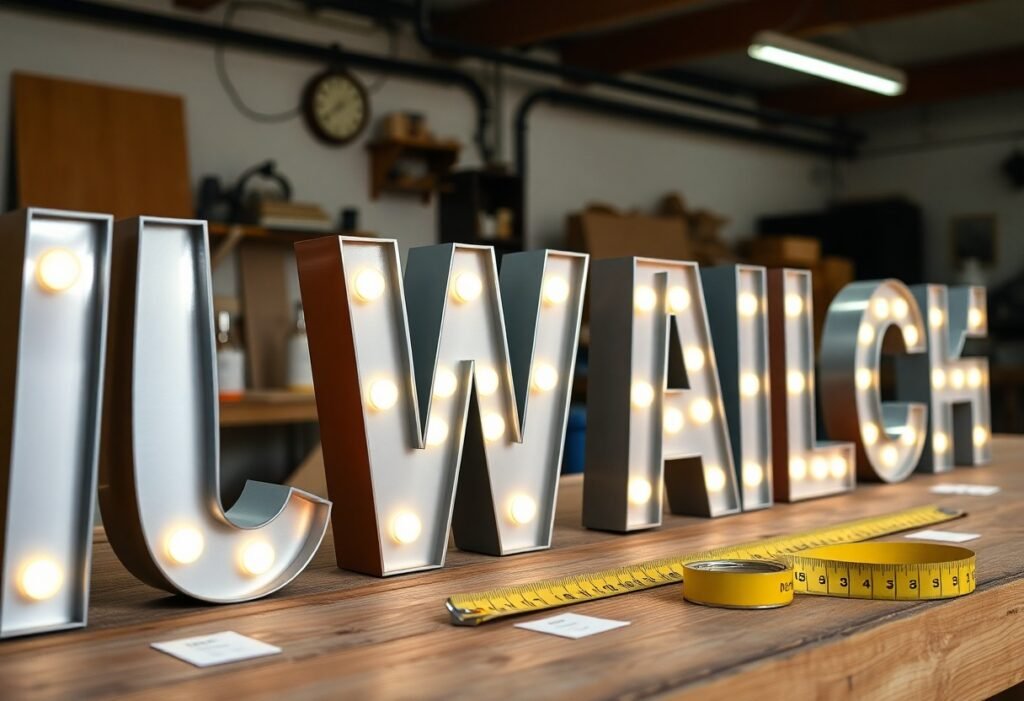
Over time you can choose from cost-effective routed foam letters, acrylic-faced aluminum returns, dimensional PVC, and halo-lit LED channel letters that balance durability and price; compare materials, fabrication methods, and lighting to match your budget and brand, seek local fabricators or standardized modular designs to lower installation and shipping costs, and evaluate warranties and energy usage for long-term savings.
Key Takeaways:
- Material options: PVC/foam board and routed acrylic are the most budget-friendly; formed aluminum with acrylic faces costs more but is durable; ACM and welded aluminum are premium choices.
- Lighting choices affect price: non-illuminated or flat-cut letters are least expensive, single-color LED face-lit or halo-lit channels are mid-range, and custom LED effects or neon-style lighting increase costs.
- Construction and mounting: raceway-mounted or stud-mounted letters reduce installation time and cost compared with individually powered, back-fed letters; reverse-halo or flush-mount styles can save on wiring and conduit work.
- Finish and customization: using stock acrylic colors, standard paint, or vinyl overlays keeps costs down; custom shapes, deep returns, and multi-color LEDs add labor and expense.
- Cost-saving strategies: limit letter depth and complexity, choose standard sizes and finishes, use efficient LED modules, and work with local fabricators to lower shipping and installation fees.
Understanding Channel Letters
When you assess options, channel letters combine visibility with modular cost choices: routed PVC or foam can run as low as $40-$80 per letter, while formed aluminum with acrylic faces typically lands between $80-$200 each. LEDs extend life to 50,000+ hours and cut energy by up to 80% versus neon. Typical storefront letter heights range 12-48 inches and depths of 3-6 inches affect mounting and wind load. You should weigh material, illumination type, and installation complexity to match your budget and expected lifespan.
| Material | PVC/foam $40-$80; Aluminum $80-$200 |
| Illumination | LED 50,000+ hrs; neon ~10,000 hrs |
| Letter height | 12-48 inches common for storefronts |
| Depth | 3-6 inches typical; deeper = higher cost |
| Installation | Permits/electrical often required; $50-$150 per letter install |
What are Channel Letters?
Channel letters are three-dimensional, custom-cut sign characters you mount to façades or raceways; you pick materials like aluminum, routed acrylic, or foam and choose internal LEDs or neon. You’ll see them on retail fronts, offices, and malls because they offer clarity at night and day, with fabrication tolerances down to ±1/16″ for sharp logos. For tight budgets, routed foam gives the letter look without formed metal costs, while acrylic faces improve color consistency and light diffusion.
Different Types of Channel Letters
Face-lit, back-lit (halo), open-face neon, side-lit acrylic, and non-illuminated formed letters each serve different visibility and budget goals: face-lit is the most common and cost-effective, halo offers upscale contrast, open-face neon gives vintage appeal but higher upkeep, and formed letters deliver premium durability. You can expect face-lit letters to range $80-$150 each for typical sizes, while halo or neon styles often add 20-50% to fabrication and install.
- Face-lit: acrylic face with internal LEDs – high visibility, lower cost.
- Halo (reverse-lit): light behind aluminum returns for a silhouette effect.
- Open-face neon: authentic neon tubes for specialty signage and period looks.
- Knowing: match type to viewing distance, brand aesthetic, and maintenance budget.
| Type | Best use & typical cost |
| Face-lit | High night visibility; ~$80-$150 per letter |
| Halo (reverse) | Premium look; add ~20-50% cost |
| Open-face neon | Retro appeal; higher energy & maintenance |
| Routed foam / non-illuminated | Cheapest visual presence; $40-$80 per letter |
When specifying types, consider mounting method (raceway vs. flush), color temperature (3,000-6,500K for LEDs), and local code limits on illuminated signs; for example, LED face-lit letters at 4,000K often balance warmth and legibility. You should also factor in maintenance intervals-LEDs typically need little attention for 5-10 years, while neon may require tube replacement every 2-5 years depending on use and environment.
- Mounting: raceway lowers install time but can add depth and visual bulk.
- Color & brightness: 300-600 cd/m² range commonly used for storefronts.
- Knowing: plan LED choices, wiring access, and serviceability to control lifetime costs.
| Consideration | Practical guideline |
| LED lifespan | 50,000+ hours; low upkeep |
| Neon lifespan | ~10,000 hours; higher maintenance |
| Permits & codes | Check local signage rules; may affect design |
| Serviceability | Raceway access eases repairs; flush mounts may cost more to service |
Factors Influencing Cost
Production cost hinges on several measurable factors: material choice (aluminum or PVC), letter size (12″-48″+), illumination type (edge-lit vs. backlit LED), and installation complexity. Typical per-letter ranges run from $30 for simple routed foam to $250+ for large illuminated aluminum; installation and permits can add $200-$1,500.
- Material: foam $20-$80; aluminum $50-$200
- Lighting: basic LED modules $15-$75 per letter
- Installation: wall-mount vs. raceway, $100-$700
Knowing these variables helps you budget accurately.
Material Choices
You’ll choose between aluminum, acrylic, PVC foam, or routed foam depending on your budget and lifespan goals. Aluminum cabinets typically cost $50-$200 per letter and last 10-20 years; acrylic faces run $15-$60 and give clean illumination; high-density foam is $20-$80 for non-illuminated, low-weight signs. You can often save by specifying aluminum backs with thinner acrylic faces to balance cost and durability.
Size Considerations
Size directly affects fabrication, LED count, and mounting: a 12″ letter might cost $30-$60 while a 48″ letter can exceed $250 because of extra framing and LEDs; anything over 6 ft often requires lift rental and engineered supports. You should factor transport and permit fees when planning larger display runs.
When you scale from 12″ to 60″, costs rarely rise linearly: structural framing, extra LED modules (typically 1 LED every 1-2 inches for even coverage), thicker returns, and additional labor can increase price by 30-200%. For example, a 24″ aluminum illuminated letter might use 40-60 LEDs and a $60 driver, while a 48″ version could need 120-160 LEDs, a $120 driver, reinforced mounts, and longer fabrication time, all pushing total project cost notably higher.
Affordable Options Available
You can choose from stock illuminated channel letters priced typically at $150-$400 per letter, while semi-custom runs fall in the $300-$700 range; full custom designs often reach $500-$900 per letter depending on size and finish. For a 12‑letter storefront expect roughly $2,000-$8,000 total, depending on LEDs and mounting. Consult this guide on Types of Channel Letter Signs for material and lighting comparisons.
Standard vs. Custom Designs
You’ll save significantly with standard templates-fabrication times often 1-2 weeks and costs can be 20-40% lower than bespoke builds. Custom designs let you match unique brand geometry and special finishes but typically add 2-6 weeks and increase labor and tooling costs. For example, switching from a stock routed face to a custom-formed letter can add $100-$400 per letter while delivering a distinct aesthetic you control.
Budget-Friendly Materials
You can trim material costs by choosing acrylic faces with aluminum returns or PVC returns for non-illuminated styles; acrylic plus standard LED modules tends to be the lowest-cost illuminated option. Common choices-acrylic, aluminum, PVC-balance appearance and price, and opting for standard color premixes rather than custom paints reduces finish costs by roughly 15-30%.
You can further reduce costs by mixing materials-use aluminum returns with standard white acrylic faces and low-profile LED strips; that combo typically lowers weight and labor. LEDs last about 50,000 hours and use up to 70% less energy than neon, cutting lifecycle costs. Also consider open-face or halo-lit styles when appropriate: they often require less material and simpler wiring, lowering both initial build and maintenance expenses.
Installation Considerations
When planning installation you must account for site survey, electrical hookup, mounting method, substrate, weatherproofing and access for lifts or scaffolding. Labor typically ranges $200-$800 per sign while licensed electricians bill $50-$100/hour; longer rooftop jobs push costs higher. You should inspect for existing conduits, roof penetrations, and run conduit paths before ordering to avoid retrofit delays and unexpected expenses.
DIY vs. Professional Installation
If you have basic wiring and metal‑work skills you can DIY small runs-typically 1-3 letters-saving 30-60% on labor but taking longer and voiding many manufacturer warranties. Professional crews handle permits, engineered attachments, lift rental ($100-$500/day) and can install a 3-5 letter channel in 2-4 hours with proper sealing and testing, reducing risk and hidden costs.
Permitting and Regulations
Your sign must comply with local zoning, setback and illumination rules; many jurisdictions cap sign area (e.g., 32-150 sq ft depending on zone) and restrict LED brightness or overnight illumination. Permit fees often run $20-$500, and electrical inspections or certification are commonly required. Apply early-codes vary widely and noncompliance can lead to removal orders and fines.
Some cities demand stamped structural drawings and contractor licensing: Los Angeles and New York commonly require engineered calculations for rooftop or heavy channel letters with review times of 4-8 weeks, while smaller towns may approve requests in days. Homeowner associations and historic districts can add design reviews or bans on illuminated signs, so factor in $200-$1,000 for variances or design fees and extra lead time.
Maintenance and Longevity
You should plan routine inspections every 6-12 months to catch water ingress, loose mounts, or fading faces; LEDs commonly last 50,000-100,000 hours, aluminum housings resist corrosion for 10-15 years, while PVC or foam letters often need resurfacing or replacement every 3-7 years depending on UV exposure and salt air. Tracking service records and using quality silicone seals will extend lifespan and avoid costly emergency repairs.
Care for Channel Letters
You can clean letters with mild detergent and a soft cloth every 3-6 months, avoiding high-pressure washes that can force water into seams; inspect wiring and drivers annually, replace failed LED modules or drivers typically after 5-7 years, and retighten mounts and fasteners during each service to prevent wind damage and maintain consistent illumination.
Long-Term Cost Efficiency
You’ll find lower upfront costs with PVC/routed acrylic (often $120-$250 per letter) but higher lifecycle costs from repainting and earlier replacement, whereas formed aluminum with LEDs ($250-$500 per letter) delivers longer service life and lower energy use-LEDs cut energy roughly 50-75% versus older neon systems, reducing operating expenses over time.
For example, a 10-letter sign using 15W LED modules running 12 hours/day consumes ~657 kWh/year (about $99 at $0.15/kWh), versus neon at ~40W consuming ~1,752 kWh/year (~$263), a savings near $164 annually; factoring in 7-10 year LED module life and 10-15 year aluminum durability, your payback on higher-quality channel letters often occurs within 3-6 years depending on local energy costs and maintenance frequency.
To wrap up
Upon reflecting, you can choose budget-friendly channel letters by opting for standard aluminum returns with acrylic faces, PVC or foam-backed letters, or open-face styles using LED modules; halo-lit or backlit effects with energy-efficient LEDs cut long-term costs. Selecting factory-standard sizes, raceway mounting, and flat finishes reduces labor and material expenses, and working with local fabricators or buying modular LED kits helps you get durable, compliant signage within your tighter budgets.
FAQ
Q: What inexpensive materials and construction methods are commonly used for affordable channel letters?
A: Budget-friendly channel letters often use aluminum returns with acrylic or polycarbonate faces, which balance durability and cost. Open-face letters (formed returns with no face) eliminate the expense of acrylic and can be front-lit with exposed LED modules behind a diffuser strip. Reverse-pan (halo) letters-where the face is painted and the back is cut for halo lighting-reduce acrylic use and fabrication time. Foam or PVC routed letters are cheaper for non-illuminated signage, and flat-cut letters mounted to a raceway or signboard minimize custom metal forming. Choosing standard gauges, stock colors, and simpler return depths also lowers fabrication costs.
Q: How do lighting choices impact price, and which affordable lighting options perform well?
A: LED lighting dominates as the most cost-effective long-term option. Low-cost options include LED modules and LED strips; modules are easy to replace and provide even illumination for front-lit letters, while strips work well for shallow-depth or edge-lit designs. SMD LEDs are energy efficient and inexpensive when bought in bulk. LED rope or LED neon alternatives give a neon look at lower cost and with simpler installation. Avoid high-voltage neon unless budget allows for specialized labor and maintenance. When specifying LEDs, request energy consumption (wattage), lumen output, and IP rating so you balance upfront price with operating cost and longevity.
Q: Can existing channel letters be retrofitted to save money versus full replacement?
A: Yes-retrofitting is a common cost-saving move. Typical retrofits replace incandescent or neon with LED modules, swap damaged acrylic faces only, repaint or re-coat returns, and service transformers and wiring. If the letter returns and structure are sound, converting to LEDs and replacing seals can extend service life at a fraction of the cost of new fabrication. For severely damaged letters, consider retrofitting only those letters and replacing others later to spread expense.
Q: What design decisions reduce cost without sacrificing visibility and brand impact?
A: Simplify profiles and limit detail: use standard fonts and avoid intricate custom shapes that require extra cutting and welding. Choose high-contrast color combinations so smaller or lower-lumen lighting still reads well. Opt for reverse-pan halo lighting for strong nighttime visibility with less material. Reduce letter depth when possible to lower metal usage and weight. Use reflective paints or matte faces strategically to improve daytime legibility. Finally, standardize sizes and repeats across a sign run to benefit from bulk fabrication pricing.
Q: Where should I shop for affordable channel letters and what questions secure the best value?
A: Compare local fabricators, regional sign shops, and reputable online kit suppliers. Ask for itemized quotes (materials, labor, installation, permits), lead times, warranty on LEDs and workmanship, power draw per letter, and serviceability (can faces or LEDs be replaced easily?). Request material specs (aluminum gauge, acrylic thickness, LED brand/IP rating) and photos of previous work. Get multiple quotes and consider a shop that offers modular or retrofit solutions if you want to phase spending. Factor installation and electrical work into the total cost when comparing bids.